

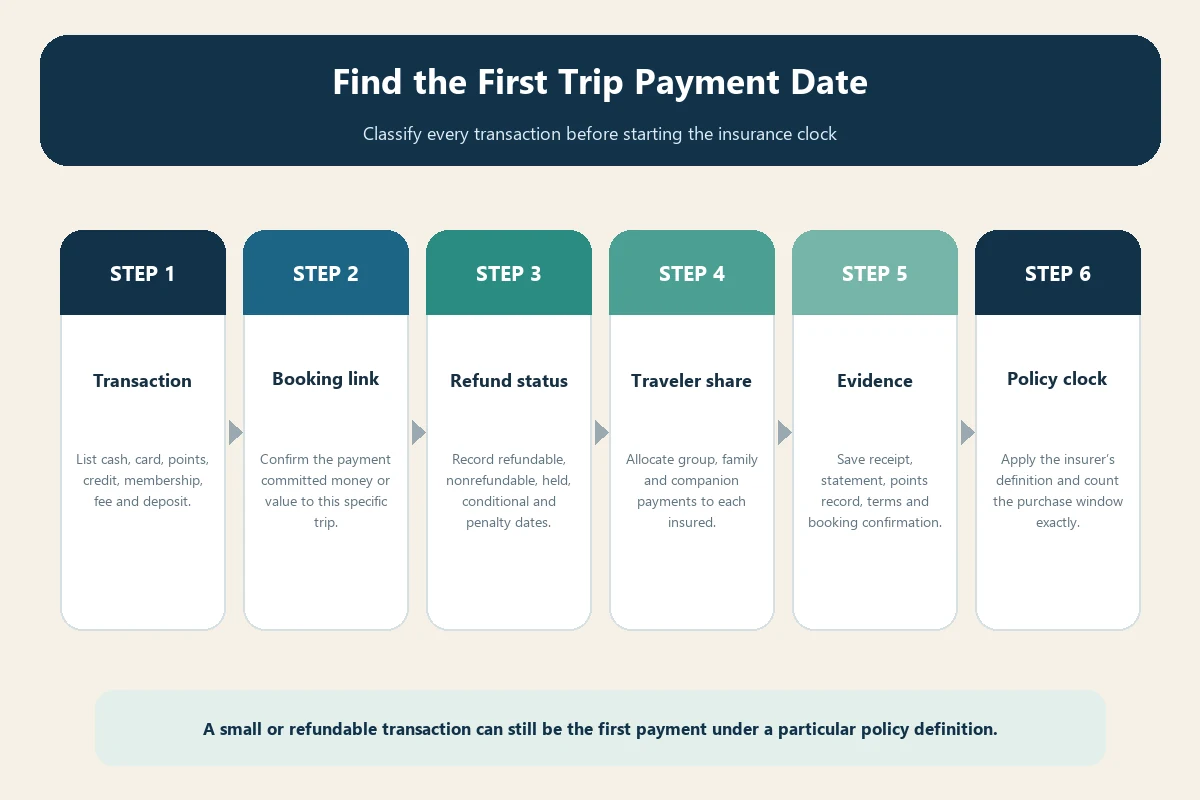
The first trip payment date is generally the earliest date money, points, credits, or another form of value is committed toward the insured trip—but the policy’s definition and administrator’s written interpretation control. It may be an airline ticket, cruise or tour deposit, hotel prepayment, award-tax charge, vacation-rental payment, or payment to a group organizer. Do not substitute final payment, booking confirmation, or insurance purchase date without verifying the contract.
This article is educational, not legal, tax, financial, or insurance advice. Definitions, purchase windows, and benefit eligibility vary by policy and state. Submit the complete transaction history to the licensed seller or administrator and keep the written answer.
Key takeaways
- The earliest trip-related transfer of value can matter even when it is refundable or small.
- Final payment and first payment are different dates.
- Points, credits, gift cards, membership fees, group payments, and deposits require written clarification.
- Time-sensitive benefits can include pre-existing-condition waivers or optional coverage, but every policy sets its own rules.
- Build a dated transaction ledger before requesting a quote.
Reviewed: August 16, 2026.
Why the date matters
Some benefits or waivers are available only when insurance is purchased within a defined period after the first trip payment or deposit. The window can vary by plan. The date may also affect whether a known event occurred before coverage or when trip cancellation begins.
A wrong date can make a quote appear eligible when the claim later is not. Treat it as a documented fact, not an estimate.
Build a transaction ledger
List every trip-related event in chronological order:
- date and time
- supplier or recipient
- traveler
- booking or reservation
- amount or points
- payment method
- refundability on that date
- whether value was charged, transferred, or only authorized
- receipt, statement, or confirmation
The first line is not automatically the answer, but it shows what must be evaluated.
Airline ticket
A ticket purchase is a common first payment even when the airfare is refundable or purchased before hotels and tours. Record the ticketing date, not only the date the reservation was created. A temporary fare hold without charge may be different.
Award tickets can involve points plus taxes and fees. Ask whether the policy treats the point redemption, cash charge, or both as the first payment and as insured trip cost.
Cruise or tour deposit
A small deposit can begin the clock long before final payment. A refundable deposit can still be a payment under some definitions. Do not wait for the cancellation penalty to begin unless the policy expressly allows that interpretation.
Keep the deposit invoice, refund schedule, final-payment deadline, and later installment records.
Hotel guarantee versus prepayment
A credit card used only to guarantee a reservation may not be charged. A hotel can also place an authorization hold, charge a deposit, collect the first night, or take full prepayment. These are distinct transactions.
Ask the hotel and insurer which event transfers value. Keep the card statement and booking terms rather than relying on the confirmation date.
Vacation rental
Rental platforms can collect a service fee, damage deposit, installment, or host payment on different dates. The earliest trip-specific charge can matter. Refundability and trip cost may change later.
Capture the original invoice and payment schedule before the platform updates the page.
Points and miles
Redeemed points have value but can be restored under different rules. Travel policies vary in how they treat point value, redeposit fees, taxes, and cash equivalents. Do not assign a retail cash price without the contract’s method.
Ask two separate questions: what date counts as the first payment, and what amount counts as insurable trip cost.
Travel credits and vouchers
A credit from a prior cancelled trip can be applied to a new itinerary. The relevant date could be the original payment, the date the credit was issued, or the date it was applied, depending on the certificate and facts.
Provide the full chain. A credit can also expire or become nonrefundable, affecting the amount at risk.
Gift cards and certificates
Buying a general gift card may not identify a trip. Applying it to a specific booking can be the relevant event. A gift purchased by someone else adds another payer and ownership question.
Ask who owns the value and whose trip cost it insures.
Membership and subscription fees
A cruise club, travel subscription, vacation club, or tour membership may be paid before a particular trip exists. A later booking fee or reservation may be the first trip-specific payment. The membership can still be nonrefundable but not part of the insured trip.
Send the membership agreement and trip booking to the insurer for classification.
Group trip organizer
A traveler may pay a church, club, school, family organizer, or travel agent before the organizer pays suppliers. The traveler’s payment date can matter even when the supplier invoice is later.
Keep the organizer receipt, roster, supplier schedule, cancellation terms, and proof of the traveler’s share. Ask whether the organizer is a travel supplier under the policy.
Someone else pays
A family member, employer, host, or rewards account can pay a traveler’s cost. The earliest payment may still belong to the trip, but the insured loss and ownership need clarification. A traveler cannot recover an expense they did not lose unless the policy treats it otherwise.
Record payer, traveler, relationship, refund recipient, and who bears the cancellation penalty.
Waitlist, reservation, or authorization hold
A supplier can create a reservation without taking payment, run a temporary card authorization, or collect a waitlist fee. Determine whether funds were transferred and whether the fee applies to the trip.
A pending authorization that disappears from the account may not be the same as a settled charge. Provide the statement to the insurer.
Travel agent planning fee
An agent can charge a consultation or planning fee before booking travel. Some fees are trip-specific and nonrefundable; others compensate advice regardless of travel. Ask whether it counts as the first trip payment and insurable cost.
Keep the service agreement and invoice.
First payment versus policy effective date
The first trip payment determines some purchase windows, while the policy effective date determines when specified coverage begins. They are not interchangeable. Emergency medical benefits may begin at departure, while cancellation can begin earlier, subject to the plan.
Read the effective-date and termination sections. Trip interruption uses a different loss timeline; our trip interruption guide separates events before and after departure.
First payment versus final payment
Final payment is the date the supplier requires the remaining balance. It can be months after the first deposit. Buying insurance at final payment may still provide valuable coverage but can miss time-sensitive benefits tied to the earlier date.
Do not use a cruise line’s final-payment deadline as the insurance window unless the certificate says so.
Pre-existing-condition waiver
A waiver can depend on purchase within the policy’s time-sensitive period, insuring the required trip cost, and medical ability to travel. A correct first-payment date is only one condition.
The pre-existing-condition questions guide explains the other gates.
Cancel For Any Reason timing
CFAR is optional coverage that commonly has early-purchase, full trip-cost, and cancellation-deadline requirements. The exact percentages and dates vary. Our CFAR guide explains the benefit without treating it as 100% cancellation insurance.
Changing the date after purchase
If new evidence shows an earlier payment, contact the insurer immediately. Do not edit a quote record silently. Ask whether the plan can correct the date, whether benefit eligibility changes, and whether cancellation during a free-look period is available.
Keep the written amendment or refund.
A five-transaction example
| Date | Transaction | Question |
|---|---|---|
| January 3 | General travel-club membership | Is it trip-specific? |
| January 12 | Tour deposit | Likely first trip commitment |
| January 20 | Award flight redeemed | How are points and taxes treated? |
| February 1 | Refundable hotel guarantee | Was value charged? |
| March 15 | Tour final payment | Not necessarily the first payment |
The administrator must classify the facts. The ledger prevents the traveler from presenting only March 15.
Questions to ask in writing
- Which transaction is the first trip payment under this certificate?
- Does a refundable deposit count?
- How are points, credits, gift cards, and vouchers treated?
- Does a group-organizer payment count before the supplier is paid?
- Is an authorization hold a payment?
- Does an agent planning fee count?
- What time-sensitive benefits depend on this date?
- What other conditions apply besides timing?
- How must later trip costs be added?
- Can the date be corrected after purchase?
Claim evidence
A claim can require the initial deposit, policy purchase, later payments, supplier penalty, and refund history. Keep original statements, not only a reconstructed spreadsheet. The travel insurance claim guide shows how to index the packet. A contradictory deposit date can delay review or support a benefit denial; the claim-denial guide explains how to respond to the stated reason with original evidence.
FAQ
Is a refundable deposit the first trip payment?
It can be. Refundability and payment timing are separate questions. Verify the policy’s definition.
Do points count?
Possibly. Ask how redemption date, redeposit fees, taxes, and cash value are treated.
Is final payment the same as first payment?
No. The first payment is normally earlier. Time-sensitive benefits may use that earlier date.
What if someone else paid the deposit?
Provide the payer, traveler, refund recipient, and loss allocation. The trip date may still begin, but insurable cost requires review.
Bottom line
The first trip payment is a transaction fact with policy consequences. Build the ledger from the earliest commitment, include noncash value and third-party payments, and obtain the insurer’s written classification. Then purchase and update coverage within the certificate’s actual rules. Save every supplier revision, receipt, and insurer response in the same dated file.
