
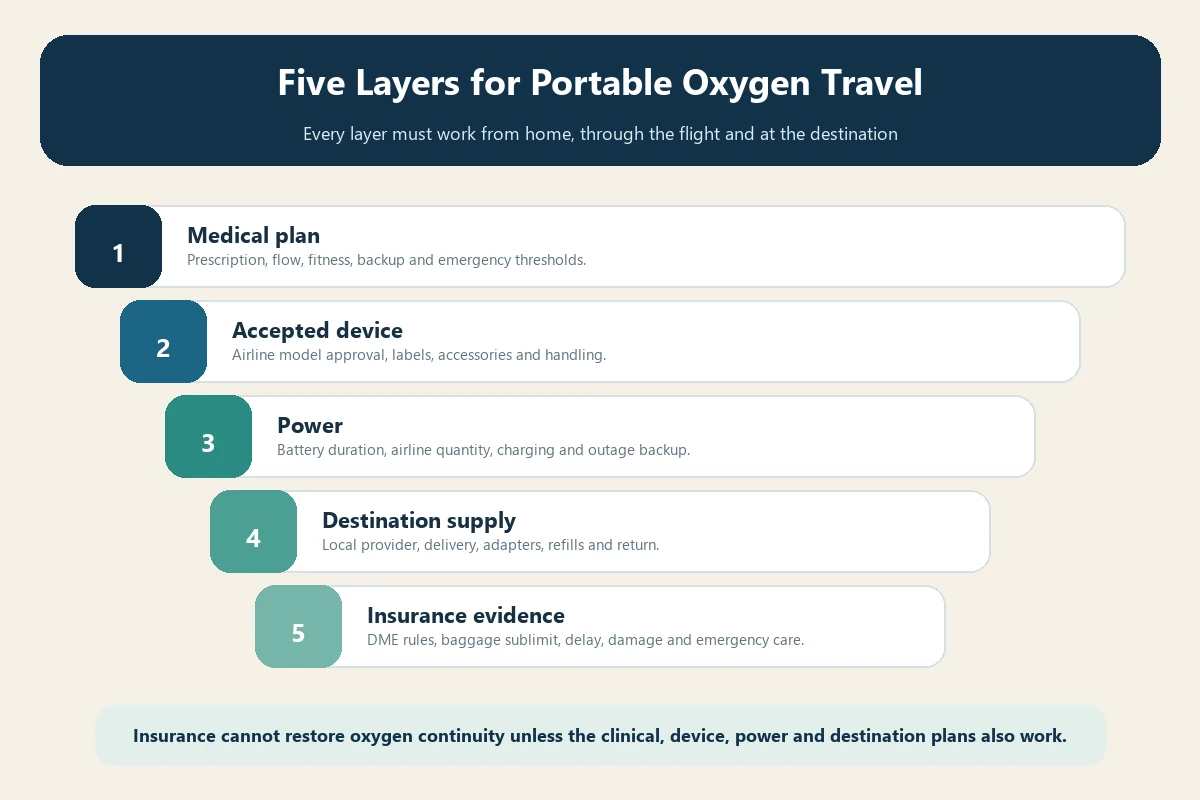
Travel insurance does not make a portable oxygen concentrator acceptable to an airline and should not be assumed to replace, repair, or supply oxygen abroad. A senior traveler needs clinical clearance, an airline-accepted device, sufficient approved batteries, destination power and supplier plans, lawful transport, and a medical contingency. Insurance is the final layer for covered medical emergencies, trip cancellation or interruption, delay, baggage, and equipment loss under the certificate.
This article is educational, not medical, aviation, legal, electrical, or insurance advice. Oxygen flow, device settings, battery calculations, and fitness to travel require the treating clinician, equipment supplier, airline, and manufacturer. Never adjust prescribed oxygen based on general travel content.
Key takeaways
- Only portable oxygen concentrators accepted under applicable airline rules may be used onboard; compressed or liquid oxygen has different restrictions.
- Airlines may require advance notice, medical documentation, device labeling, and enough batteries for the planned journey plus a specified reserve.
- Medicare oxygen equipment coverage is a domestic durable-medical-equipment benefit, not a guarantee of overseas supply or travel-device replacement.
- Travel insurance may distinguish medical equipment, baggage, delay, and emergency medical claims.
- Test the entire door-to-door itinerary, including airport time, connections, transfers, outages, and destination service.
Reviewed: August 16, 2026.
Start with the treating clinician
Cabin altitude, exertion, infection, sleep, and the underlying condition can change oxygen needs. Ask the treating clinician whether the traveler is stable for the route, what settings are prescribed at rest, during activity, and during sleep, and what symptoms require urgent care. The clinician should decide whether testing or a written order is needed.
An airline form does not replace clinical assessment, and a home setting may not be the correct in-flight setting. Carry an emergency plan that names the condition, prescription, device, medication, clinician, and destination provider.
Portable oxygen concentrator versus oxygen cylinder
A portable oxygen concentrator, or POC, draws in ambient air and concentrates oxygen using electricity. Compressed oxygen cylinders and liquid oxygen systems store oxygen differently. Airline acceptance and dangerous-goods rules vary by equipment type.
Do not arrive with a device described only as “portable oxygen.” Record the manufacturer, model, serial number, label, pulse or continuous-flow capability, battery type, charger specifications, and prescribed settings. Confirm with the operating carrier that the exact model can be used on every segment.
Airline acceptance must be confirmed flight by flight
U.S. Department of Transportation and FAA rules provide a framework for passengers using portable oxygen concentrators, but airlines can have procedures for advance notice, documentation, check-in, seating, stowage, battery protection, and device use. International and codeshare segments can involve another carrier and jurisdiction.
Contact the operating airline—not only the ticket seller. Obtain written confirmation for outbound, connection, return, and regional flights. Record whether the device may be used during taxi, takeoff, cruise, and landing and whether a physician statement or airline medical form is required.
Battery endurance is a journey calculation
Calculate power for check-in, security, boarding, taxi, flight, connection, delays, diversion, ground transfer, and arrival setup. Airlines may require a battery reserve above scheduled flight time. The exact requirement and accepted battery type must be verified with each carrier.
Use manufacturer runtime data for the prescribed setting and account for battery age, temperature, and charging limits. Protect spare battery terminals and pack them as the airline directs. Do not assume an in-seat outlet will work, be compatible, or be permitted as the only power source.
Build a segment power table
| Segment | Power source | Failure backup |
|---|---|---|
| Home to airport | Charged battery or approved vehicle supply | Spare battery and supplier contact |
| Airport and flight | Airline-accepted batteries | Required reserve and diversion plan |
| Connection | Battery plus confirmed charging location | Extra time and spare capacity |
| Ground transfer | Vehicle-compatible source if approved | Battery and alternate transport |
| Lodging | Correct voltage, plug, and stable outlet | Outage and generator plan |
A plug adapter changes shape; it does not necessarily convert voltage or frequency. Follow the device manufacturer’s electrical specifications.
Destination oxygen and supplier support
A U.S. equipment supplier may not service, ship, or replace a device abroad. Ask whether it has an international partner, what locations it can support, what prescription and deposit are required, and how after-hours failure is handled. Confirm local availability before departure rather than treating a web listing as inventory.
For a cruise, island, high-altitude location, rural area, or long ground route, identify the nearest facility capable of evaluating the underlying condition and supplying appropriate oxygen. A delivery to a port or hotel can require advance permission and timing.
What Medicare oxygen equipment coverage means
Medicare Part B can cover oxygen equipment and accessories as durable medical equipment when the beneficiary meets coverage requirements and uses a Medicare-enrolled supplier. Medicare describes a rental structure and supplier obligations under domestic DME rules.
This does not mean Medicare must buy a second travel-size concentrator, replace a unit lost on vacation, or arrange oxygen in another country. Ask the current supplier and Medicare what happens during temporary travel within the United States and what service-area limitations apply. For international travel, build a separate equipment and payment plan.
Medicare Advantage equipment rules
Medicare Advantage plans provide Medicare-covered benefits but can use networks, authorization, and preferred DME suppliers. Emergency or worldwide supplemental coverage does not automatically include routine oxygen supply, equipment rental, or repair abroad.
Read the Evidence of Coverage and ask about temporary out-of-area DME, emergency replacement, supplier network, prior authorization, and foreign reimbursement. Document the exact plan and year.
Pre-existing-condition analysis
The condition requiring oxygen is known before travel. A travel policy may exclude losses connected to a pre-existing condition unless a waiver applies. A waiver commonly has purchase timing and other eligibility conditions and applies only to otherwise covered losses.
Disclose information as the application requires. Ask how recent symptoms, hospital care, testing, oxygen initiation, flow changes, or medication changes affect eligibility. Our senior pre-existing-condition guide provides questions for the insurer.
Equipment damage, loss, and baggage coverage
A POC can be medical equipment, durable medical equipment, personal property, or baggage depending on the contract and claim. Policies may have per-item limits, depreciation, exclusions for fragile or professional equipment, unattended-property rules, and proof-of-ownership requirements.
Do not check an essential POC merely because baggage coverage exists. Keep it accessible as the airline permits. Record the serial number, photos, prescription, receipt or rental agreement, supplier contract, and replacement value. Our baggage delay and loss guide explains per-item limits and carrier reports.
Trip delay with oxygen dependency
A covered delay benefit may reimburse eligible meals, lodging, or transport after a specified trigger, but it does not guarantee oxygen delivery. The traveler needs an operational plan for battery depletion, inaccessible charging, unexpected overnight stays, and separation from checked accessories.
Contact the airline assistance desk and travel insurer, but follow the medical contingency established with the clinician. Save the delay notice, new itinerary, receipts, device logs, and any clinical record.
Trip cancellation or interruption
If the traveler becomes medically unable to travel, cancellation coverage depends on a covered reason, policy effective date, pre-existing-condition terms, and required clinician documentation. A supplier failing to provide a POC or an airline rejecting an unapproved model may not be a covered reason.
After departure, interruption coverage can address eligible unused arrangements and additional transport when a covered event occurs. It should not be assumed to pay for a medically escorted return or equipment upgrade. Read the benefit and evacuation provisions separately.
Emergency medical care and evacuation
A respiratory emergency abroad may be eligible under travel medical coverage, but routine oxygen use remains expected care. The insurer will apply emergency, pre-existing-condition, medical-necessity, and exclusion language. Contact assistance as soon as reasonably possible without delaying urgent treatment.
Evacuation may require the assistance company to determine that local care is inadequate and arrange transport to the nearest appropriate facility. Oxygen use can change aircraft, crew, battery, ground-transfer, and fit-to-fly needs. The evacuation approval guide and fit-to-fly guide explain those decisions.
Direct billing and deposits
A foreign hospital or oxygen supplier may require payment. Assistance may locate a provider without guaranteeing the charge. Ask whether the travel insurer can arrange direct settlement for a covered emergency and whether equipment replacement is reimbursed later.
Keep itemized invoices, prescriptions, proof of payment, airline reports, device diagnostics, and correspondence. The direct-billing guide shows how payment guarantees differ from referrals.
Door-to-door rehearsal
- Flight delayed six hours: recalculate batteries, charging, food, medication, and clinical thresholds.
- Connection outlet fails: identify remaining runtime and airline assistance.
- POC alarms abroad: use manufacturer and supplier troubleshooting, then the medical plan.
- Checked accessory bag is lost: locate lawful compatible supplies without changing therapy.
- Hospital recommends transfer: coordinate clinician, insurer, aircraft, oxygen, and receiving facility.
Portable oxygen document packet
- Prescription and clinician travel letter
- Airline medical form and written acceptance
- Manufacturer, model, serial number, and manual
- Battery inventory and runtime calculation
- Supplier agreement and 24-hour contact
- Destination supplier and hospital contacts
- Medicare, MA, and travel insurance documents
- Medication and allergy list
- Proof of ownership or rental and device photos
- Emergency and evacuation authorization contacts
Questions for the airline
- Is this exact POC model accepted on every operating segment?
- What notice, form, or clinician statement is required?
- How much battery capacity and reserve must be carried?
- How should spare batteries be protected and packed?
- May the device be used during every phase of flight?
- Is in-seat power available, compatible, and permitted?
- What seating or stowage rules apply?
- What changes on a codeshare or partner airline?
Questions for the insurer
- How is the oxygen-dependent condition treated under pre-existing-condition rules?
- Is the POC covered as baggage, medical equipment, or neither?
- What per-item and depreciation limits apply?
- Does delay coverage address necessary equipment expenses?
- Can an emergency replacement be directly arranged?
- What respiratory emergencies are eligible?
- Does evacuation include required oxygen and medical escort?
- Who authorizes the route and endpoint?
- What reports, receipts, medical records, and deadlines apply?
FAQ
Will travel insurance buy a portable oxygen concentrator?
Do not assume so. Equipment benefits, baggage limits, medical necessity, and exclusions vary. A planned device purchase is different from an unexpected covered loss.
Can a senior use any POC on an airplane?
No. Confirm the exact model, labeling, battery, documentation, and operating-airline procedure before every flight.
Does Medicare cover oxygen while traveling abroad?
Medicare’s domestic DME benefit does not guarantee overseas supply, service, or replacement. Verify the supplier and plan, then arrange an international backup.
Does a POC count as baggage?
Airline handling and travel insurance classification are separate. The policy may treat medical equipment differently and impose per-item limits or exclusions.
Bottom line
Portable oxygen travel succeeds when the medical prescription, exact device, airline, batteries, destination supplier, and insurance contract align. Confirm those layers before buying nonrefundable travel. Use insurance for defined covered losses, not as a substitute for oxygen continuity.
