

Medical evacuation insurance home country wording decides whether “get me home” is a covered medical transfer, a later return benefit, an upgrade, or simply a traveler preference. Many contracts first move a patient to the nearest facility able to provide adequate treatment. A separate repatriation clause may address continued treatment closer to the traveler’s residence after stabilization.
Call local emergency services and obtain appropriate care first. This guide is educational, not medical, insurance, aviation, or legal advice. Fitness to fly, receiving capacity, aircraft safety, authorization, and policy terms vary. No policy can guarantee a destination, bed, commercial-air clearance, escort, or aircraft.
Key takeaways
- Emergency evacuation and medical repatriation can be different benefits.
- “Home country,” “primary residence,” and “point of origin” are not interchangeable.
- A commercial seat, cabin upgrade, stretcher, medical escort, and air ambulance require different proof.
- Hospital-of-choice wording can still have a cost boundary.
- Receiving acceptance and written authorization should precede a non-emergency transfer.
Reviewed August 16, 2026. Definitions and benefits differ by plan and state. Copy the issued certificate’s wording for emergency medical evacuation, medical repatriation, return destination, primary residence, hospital of choice, medical escort, authorization, and maximum.
Start by asking which trip home you mean
A traveler might say “fly me home” while referring to several distinct events. The patient might need urgent movement from an island clinic to a regional hospital, a later hospital-to-hospital transfer to the United States, a commercial flight after discharge, or an ordinary replacement ticket after the medical episode ends.
The evacuation destination guide explains adequate-facility language. This guide adds the home-country and transport questions that begin after a safe treatment destination exists.
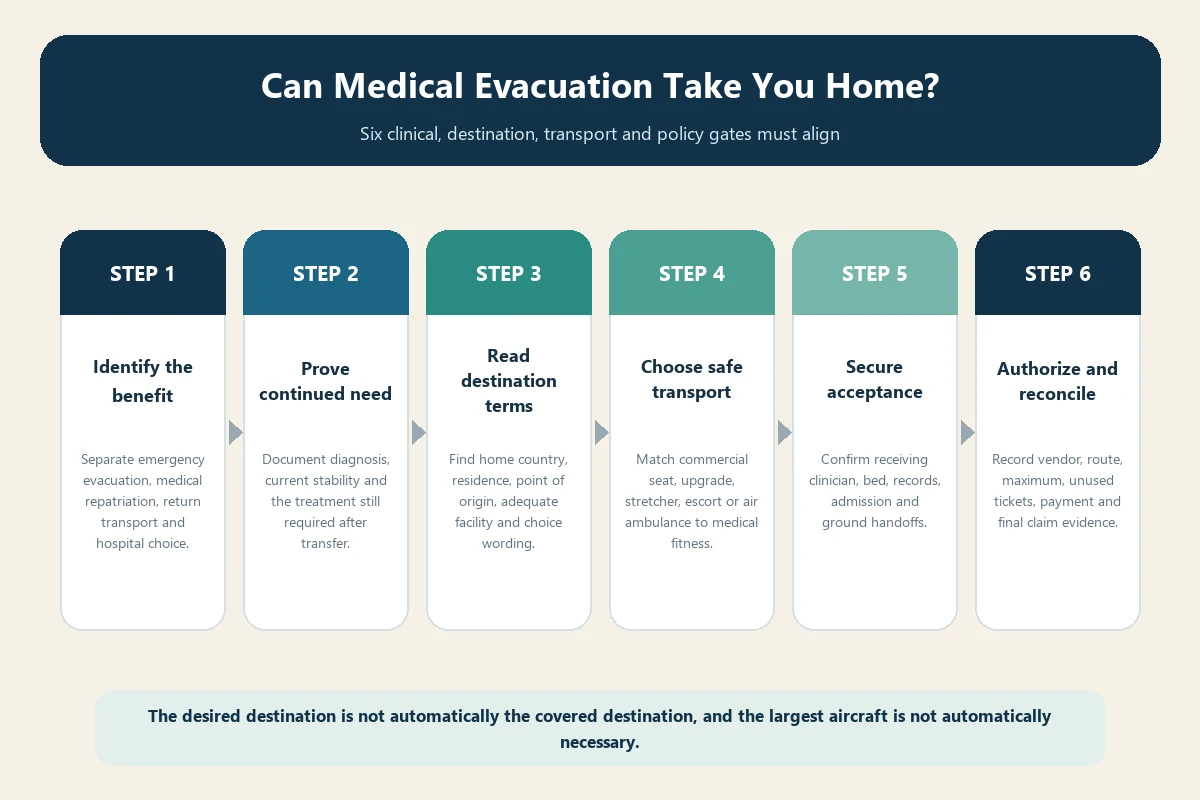
Four destination clauses that sound similar
| Clause | Typical question | Proof to collect |
|---|---|---|
| Nearest suitable facility | Where can adequate emergency treatment be provided? | Local capability and clinical need |
| Medical repatriation | May continued treatment occur near residence or origin? | Stability, ongoing need, approval |
| Hospital of choice | Can another eligible hospital be selected? | Clause, cost boundary, acceptance |
| Return transportation | How does the traveler return after an earlier evacuation? | Prior evacuation, ticket class, deadline |
Do not infer one clause from another. The international hospital-transfer workflow is useful when both the sending and receiving facilities must coordinate an active medical handoff.
Emergency evacuation usually solves the immediate care gap
The CDC Yellow Book insurance chapter describes medical evacuation insurance as emergency transport to home-country facilities or facilities equivalent to those at home. It also warns that the insurance company generally controls the evacuation decision rather than the traveler.
An Illinois-specific IMG sample contract illustrates why the actual form matters. Its emergency-evacuation section first addresses transport to the nearest suitable facility when the local physician considers the condition acute, severe, or life-threatening and adequate care is unavailable nearby. That example is not a universal trigger.
Medical repatriation can be a later, different movement
In the same sample, repatriation follows an evacuation or covered illness or injury and can return the insured toward an origin, primary residence, or qualifying continued-treatment facility. The local attending physician must approve the repatriation. Another plan may use a different sequence, destination, approver, or maximum.
Ask whether repatriation requires an inpatient status, active continued treatment, a prior covered evacuation, medical necessity, or only fitness to return. Ask whether the benefit ends at a hospital, airport, residence, or other named point.
Stable does not mean ready for an ordinary flight
Clinical stability can mean the patient no longer needs an emergency aircraft, yet cabin altitude, limited movement, infection control, oxygen, medications, recent surgery, pain, cognition, and the risk of deterioration can still affect travel. The CDC air-travel chapter explains that travelers with certain conditions may need medical clearance or supplemental planning.
The sending clinician should record the current diagnosis, treatment, vital trends, equipment, medication timing, mobility, oxygen need, infection precautions, and expected risks in transit. The carrier and transport medical director make their own operational decisions.
Use a transport-mode ladder
- Original commercial seat: suitable only when ordinary travel is clinically and operationally acceptable.
- Commercial cabin upgrade: may provide space or positioning but is not medical care.
- Commercial stretcher: requires airline acceptance, removed seats, medical planning, and ground coordination.
- Medical escort: a trained professional accompanies and treats or monitors the patient.
- Air ambulance: a dedicated aircraft and medical configuration for cases that require it.
Choose the least intensive safe mode the clinicians, carrier, and assistance team accept. The evacuation route-cost guide separates aircraft, crew, equipment, ground legs, permits, and positioning without pretending a broad estimate is a quote.
A personal companion is not a medical escort
A spouse, friend, or relative can provide history, consent support, language help, and reassurance. A medical escort is a trained professional assigned to provide clinical care during transport. Coverage for one does not establish coverage or a seat for the other.
The sample contract cited above includes written attending-physician recommendation for a medical escort and treats its transportation and accommodations within the evacuation arrangement. Read your schedule to learn whether escort cost shares the evacuation maximum or has another limit.
Hospital of choice can still have a price ceiling
A hospital-of-choice clause is not necessarily unlimited transport to any specialist. The cited sample allows an eligible U.S. city choice in defined circumstances but limits payment to the transportation cost toward the primary residence. A more distant hospital, premium route, or preference-based upgrade can leave a difference for the traveler.
Write down the permitted geography, comparison destination, maximum payable amount, responsible decision-maker, and what happens if the preferred hospital will not accept the patient.
Receiving acceptance is a release gate
A home-country facility needs a named accepting clinician, appropriate service, available bed, reviewed records, admission path, and an arrival plan. Acceptance can also depend on a financial guarantee or domestic coverage. The transfer should not launch on a hopeful referral alone.
Use the evacuation approval-chain guide to separate the sending physician, receiving physician, assistance medical team, carrier, vendor, and claim administrator.
Good local care can change the covered answer
A patient can understandably prefer familiar clinicians, language, family support, and a domestic network. Yet if the current hospital can provide appropriate definitive care, the contract may not treat a distant transfer as medically necessary. A repatriation, hospital-choice, or membership provision would need to supply a different right.
Ask the current clinician to describe the treatment still required, the facility’s capability, expected length of stay, risks of movement, and whether transfer improves care or mainly location. Keep the clinical assessment separate from family preference and from the insurer’s benefit decision.
Unused tickets and refunds change the payable amount
Some forms subtract the value of an unused return ticket or use an existing common-carrier ticket where possible. Preserve the original itinerary, ticket status, fare credit, refund response, change quote, new fare, and payment receipt. Do not cancel the original ticket before the assistance team explains how it should be handled.
Return transportation after a prior evacuation may also have a time window or original-class restriction. The Illinois sample uses such conditions, but the issued contract controls.
A membership and an insurance policy are different contracts
Google results frequently compare travel insurance with transport memberships. A membership might use eligibility, hospitalization, distance-from-home, network, stability, and transport-availability rules that differ from indemnity insurance. It may arrange a service rather than reimburse a covered loss.
Compare the governing documents, geographic scope, eligible traveler, destination promise, medical threshold, exclusions, maximum, renewal, vendor control, complaint path, and whether the product is insurance. Marketing labels are not enough.
Domestic health insurance does not answer the transport question
Medicare’s travel-outside-the-U.S. page explains that coverage abroad is generally limited to defined situations. The U.S. Department of State’s travel-insurance guidance states that the U.S. government does not pay citizens’ medical costs abroad.
Domestic coverage can still matter to receiving-hospital payment after arrival. Confirm the receiving network, admission authorization, deductible, out-of-pocket exposure, and which insurer handles each stage.
Run a six-line authorization call
- What exact benefit is being considered?
- What clinical condition and continued treatment make the movement necessary?
- Which destination does the certificate permit?
- Which mode and medical team are authorized?
- Which receiving clinician and bed accepted the patient?
- Which vendor, route, limit, payment method, and ticket credit are recorded?
The pre-authorization guide distinguishes medical recommendation, arrangement, benefit authorization, payment guarantee, and final claim review.
Compare policies with a home-country worksheet
- Definition of home country, residence, origin, and return destination
- Nearest-suitable-facility and adequate-treatment wording
- Medical-repatriation trigger and destination
- Hospital-of-choice option and cost comparison
- Commercial seat, upgrade, stretcher, escort, and air-ambulance treatment
- Receiving-facility and physician requirements
- Authorization, emergency notice, and arrangement rules
- Unused-ticket, refund, and other-insurance offsets
- Maximum, sublimit, deductible, and time window
- Companion, dependent, interruption, and follow-up benefits
The evacuation limit worksheet helps stress-test the complete route instead of choosing a maximum by slogan.
Build the claim and handoff file
- Issued policy, schedule, application, and itinerary
- Assistance case number and complete call log
- Sending records and medical-necessity statement
- Fitness-to-travel or airline medical form
- Receiving physician, bed, and admission acceptance
- Written benefit authorization and vendor assignment
- Mission, escort, aircraft, and ground-ambulance records
- Original tickets, unused credits, refunds, and replacement fares
- Itemized invoices, guarantees, currency records, and receipts
- Discharge summary and records for continuing care
The follow-up care guide explains why coverage after arrival should be checked separately from the transport benefit.
If home-country transport is declined
Ask for the decision, relied-on clause, medical reasoning, allowed alternative, covered destination, appeal or reconsideration route, and documents that could change the decision. Keep appropriate care moving while the dispute is reviewed. Do not delay necessary local treatment merely to preserve a preferred transfer.
Bottom line
Medical evacuation insurance home country coverage is not a yes-or-no phrase on a comparison page. The answer depends on the benefit stage, permitted destination, continuing medical need, fitness, transport mode, receiving acceptance, authorization, ticket offsets, and limit. Read those parts together before assuming an emergency evacuation will deliver a traveler to a chosen hospital at home.
A human medical evacuation benefit does not automatically transport or treat a pet. Use the medical evacuation insurance pets guide to separate pet return, veterinary expenses, trip-cancellation triggers, carrier rules, country documents, destination care, and crisis-departure limits.
Hospital of choice is a bounded membership service, not an unconditional request. Use the medical evacuation membership hospital-of-choice guide to audit inpatient status, distance, enrollment, stability, receiving acceptance, home-country geography, transport mode, limits, and medical-expense insurance.
Illness transport, political or security evacuation, trip interruption, and government-assisted departure use different triggers and destinations. Use the medical evacuation insurance vs political evacuation guide to audit authority, advisories, safe-location wording, access, timing, authorization, onward travel, and cost.
A natural disaster can trigger medical transport, non-medical evacuation, trip disruption, emergency lodging, or government departure under different rules. Use the medical evacuation insurance natural disaster guide to match the event, order, timing, access, authorization, endpoint, and cost to the correct path.
Fit to fly is not one signature: the treating clinician, assistance medical team, and operating airline answer different questions. Use the medical repatriation fit-to-fly guide to coordinate clinical stability, cabin risk, equipment, escorts, carrier documents, ground legs, timing, and rechecks.
