

A medical evacuation insurance family visit benefit can pay for one person to travel to a hospitalized insured, but only when the contract’s specific bedside or emergency-reunion trigger is met. It is not ordinary insurance for a trip to visit relatives. It can also be different from expenses for a companion who was already traveling with the patient.
Call local emergency services and obtain appropriate care first. This guide is educational, not medical, insurance, tax, immigration, or legal advice. Hospital status, visitor access, flights, visas, policy definitions, and payment practices vary. No insurer can guarantee a flight, hospital visit, visa, or bedside access.
Key takeaways
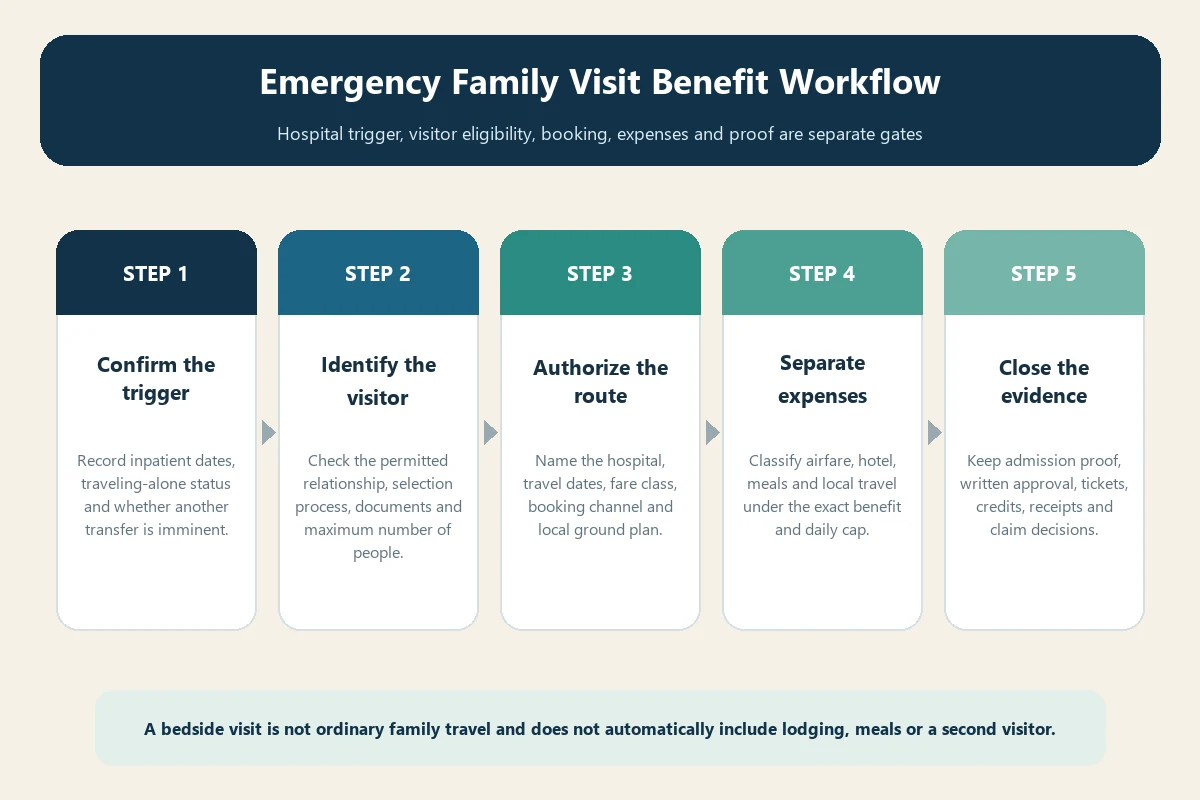
- Find the exact bedside, family-visit, or emergency-reunion clause.
- Verify the hospitalization trigger before booking airfare.
- Check whether the patient must have been traveling alone.
- Separate the visitor’s airfare from hotel, meals, and local transport.
- Record approval, fare class, booking method, credits, and receipts.
Reviewed August 16, 2026. Benefit labels, inpatient-day thresholds, relationships, fare classes, maximums, daily caps, and arrangement rules differ. The issued policy and schedule control.
First separate two search intents
Google results for this phrase mix two unrelated needs. One traveler wants medical insurance for a planned trip to see family. Another family needs to send a person to the bedside of someone hospitalized during a covered trip. This guide addresses the second event.
The travel medical benefits guide shows how to trace a listed benefit through the schedule, definition, coverage grant, conditions, and exclusions before relying on a summary page.
The benefit can use several names
Search the certificate for bedside visit, family visit, emergency reunion, emergency visit, transportation to join you, compassionate visit, and relative visit. Then search the schedule for the maximum and any daily expense row.
| Label | Possible purpose | Do not assume |
|---|---|---|
| Bedside visit transportation | Bring one person to the patient | Hotel and meals are included |
| Emergency reunion | Travel and defined stay expenses | Every relative qualifies |
| Companion daily benefit | Help a person already on the trip remain nearby | It pays inbound airfare |
| Trip interruption | Change an insured traveler’s own itinerary | It duplicates a bedside benefit |
Hospitalization is not always enough
A clause may require inpatient status for a minimum number of consecutive days. Observation, emergency-room treatment, outpatient surgery, rehabilitation, or a planned admission might not count the same way. Ask the hospital to state admission date, inpatient status, treating service, expected stay, and discharge or transfer plan.
An Illinois-specific IMG sample contract illustrates a more-than-three-consecutive-day trigger for bedside transportation. That number is an example from one form, not a universal rule.
Traveling alone can be a decisive condition
Some bedside-transport clauses activate only when the insured was traveling alone. A tour group, coworker, roommate, friend in the destination, or noninsured companion may or may not affect that definition. Copy the exact “traveling alone” and “traveling companion” wording.
If someone was already on the trip, ask whether a companion-daily, interruption, or lodging provision applies instead. Do not reshape the facts merely to reach a preferred clause.
The visitor’s relationship must fit the contract
One form might allow a person chosen by the insured. Another may require an immediate family member, relative, friend, or designated representative. A domestic partner, adult child, sibling, caregiver, legal guardian, or close friend can be treated differently.
Prepare the person’s full name, relationship, passport, contact details, departure city, availability, and any entry requirements. If the patient cannot choose, identify who has authority to communicate that choice.
One visitor means one visitor
A family may understandably want two relatives to travel. The contract might fund only one person. Additional family members should obtain their own fares, refunds, lodging, and entry documents without assuming they can be added to the insured itinerary later.
The senior traveler medical-planning guide explains why a spouse, adult child, caregiver, and tour escort can have different operational roles even when only one person receives an insurance travel benefit.
Economy airfare can be the whole transportation promise
The cited sample contract illustrates one round-trip economy ticket up to the scheduled maximum. Another plan might permit a different class, one-way travel, mileage reimbursement, or no inbound benefit. A traveler’s preferred airline, flexible fare, premium cabin, or stopover is not automatically covered.
Ask who books, which airports are permitted, whether the ticket must be round trip, which fare class is authorized, and how unused tickets or travel credits reduce payment.
Hotel, meals, and local transport need their own wording
A transportation clause may cover only airfare. A separate emergency-reunion or companion section may list lodging, meals, or local transport with daily and total limits. A general phrase such as “reasonable additional expenses” still needs a definition and receipt rules.
Record the allowed city, dates, hotel class, nightly cap, meal cap, local-transport types, taxes, currency conversion, and whether the visitor or insured must pay.
An imminent transfer can stop the inbound visit
Flying a visitor to the current hospital makes little sense if the patient will immediately be evacuated elsewhere. The IMG example conditions its bedside-visit transportation on evacuation or repatriation not being imminent.
Ask the treating clinician and assistance team whether the patient is likely to remain at the current facility, move to a regional hospital, or return toward home. Use the hospital-transfer workflow to track the receiving decision before finalizing the visitor’s destination.
Hospital access is separate from insurance payment
Payment for a ticket does not create a right to enter an intensive-care unit or stay overnight. The hospital may restrict visitor hours, number of visitors, age, infection precautions, identification, or patient consent.
Call the ward or patient liaison. Record the permitted visitor, visiting conditions, language support, accommodation options, and a plan for communicating if bedside access changes.
Coordinate privacy and consent
The patient may need to authorize the hospital, assistance company, insurer, and visitor to exchange information. If the patient lacks capacity, local law and existing healthcare authority control. Carry the appropriate emergency contact and legal documents without assuming a U.S. form has the same effect abroad.
The CDC sick-abroad chapter notes that consular staff can help locate medical services and notify family. Notification assistance is not payment for the family’s travel.
Get authorization before the ticket is issued
Ask the administrator to confirm the qualifying event, visitor, origin and destination, travel dates, fare class, booking channel, maximum, allowed stay expenses, required receipts, and whether the benefit shares a limit with evacuation or interruption.
The pre-authorization guide separates permission to arrange a service from a final claim guarantee. Save the representative, time, case number, written decision, and any condition that must be satisfied later.
Do not duplicate the companion’s claim
A family member might be insured on another policy, have airline credits, receive employer help, or claim interruption expenses. The sample contract cited above states that benefits will not duplicate other benefits under that policy.
Submit each expense once under the most accurate section. Keep insurer responses, other-policy decisions, refunds, credits, and employer payments so the final reconciliation is transparent.
Use a two-itinerary worksheet
| Patient | Visitor |
|---|---|
| Current hospital and ward | Departure city and passport |
| Admission and expected stay | Approved relationship and identity |
| Transfer or discharge plan | Authorized airport and fare class |
| Consent and communication contact | Hotel, local transport, return date |
| Case manager and physician | Booking channel and receipts |
Update both columns if the patient moves. A visitor’s ticket should not be treated as static while the clinical destination is changing.
The visitor needs an independent disruption plan
The patient can be discharged early, transferred to another city, remain hospitalized longer, or become unable to receive visitors. The inbound relative should know whether the ticket can change, who pays a longer stay, and what happens if the insured benefit ends before the visitor returns.
Check the visitor’s own health insurance, travel protection, employer leave, passport validity, visa, medication, and emergency contact. The patient’s bedside benefit does not automatically insure the visitor’s illness, baggage, delay, or cancellation.
Remote hospitals can make the visitor route indirect
The authorized airfare may end at a major airport while the hospital requires a train, ferry, domestic flight, or long ground transfer. Ask whether local transportation is included, which destination airport is approved, and whether weather or visiting hours make the planned arrival impractical.
Record each leg and keep a fallback that does not interfere with the patient’s clinical transfer. A cheaper ticket is not useful if it cannot reach the hospital safely within the covered visit window.
The family-visit evidence file
- Issued certificate, schedule, and relevant definitions
- Assistance case number and call log
- Hospital admission record and inpatient dates
- Statement that the patient was traveling alone, if required
- Visitor identity, relationship, passport, and entry documents
- Patient consent or appropriate representative authority
- Written authorization naming route, date, and fare class
- Original itinerary, fare quote, issued ticket, credits, and refunds
- Itemized hotel, meal, and local-transport receipts
- Discharge, transfer, and visitor-return records
The CDC insurance chapter notes that travel insurance can help keep relatives informed but that plans vary. The IMG plan-family page lists bedside-visit transportation as a distinct benefit while directing buyers to plan documents.
If the benefit is denied
Ask whether the issue is inpatient status, required days, traveling-alone status, visitor definition, imminent transfer, missing authorization, fare class, expense type, maximum, duplication, or documentation. Request the clause, facts relied on, appeal route, and any covered alternative.
The approval-chain guide helps direct a clinical question to the physician and a contract question to the administrator instead of treating one answer as both.
Government assistance is not a family airfare benefit
The U.S. Department of State’s insurance guidance explains that the U.S. government does not pay citizens’ medical costs abroad. Consular help may be valuable for communication or local information, but do not promise that it will fund a visitor’s flight or stay.
Bottom line
A medical evacuation insurance family visit benefit is a narrow emergency travel provision, not a general family-travel allowance. Verify the hospital trigger, traveling-alone condition, eligible visitor, permitted itinerary, fare class, separate stay expenses, imminent-transfer rule, authorization, and receipts before booking. Keep the visitor’s claim distinct from the patient’s evacuation and from an already-present companion’s interruption costs.
