
Travel insurance flash flood flight cancellation coverage depends on what the flood actually did to the booked trip. A warning can require immediate safety action without closing an airport. Water can block the only safe road to an operating flight, enter a terminal, stop ramp work, damage equipment, close a hotel, or cause an airline cancellation. Those are different facts and may engage different policy terms.
This U.S. guide shows how to connect the official hazard, airport-access conditions, facility operations, carrier decision, supplier remedies, policy language, and remaining expense. It is educational, not emergency, meteorological, aviation, engineering, legal, medical, or insurance advice.
Flash flood flight coverage at a glance
- Obey warnings and never enter floodwater to preserve a trip.
- Save the complete alert, observed flooding, location, and timeline.
- Separate a blocked journey to the airport from an airport shutdown.
- Get the airline’s final flight-specific action and reason.
- Use refunds and safe rebooking before calculating insurance loss.
- Match the facts to the issued policy, threshold, duties, and limits.
Reviewed August 17, 2026.
A Flash Flood Warning is an urgent safety message
The National Weather Service’s flood safety guidance distinguishes a Flood Watch, when flooding is possible, from a Flash Flood Warning, when dangerous flooding is imminent or occurring and people should move to higher ground. Preserve the alert type, issuing office, polygon, affected places, issue time, expiration, emergency language, and updates.
A warning is powerful evidence of the hazard at a place and time. It does not by itself prove that the airport flooded, the terminal closed, a particular road was impassable, or the booked flight was canceled. Build the next links with facility, transportation, and carrier records.
Never drive into floodwater for a flight
NWS Turn Around Don’t Drown guidance warns that a roadbed may be washed out beneath apparently shallow water and that vehicles can be swept away. Follow police, emergency-management, road-authority, and transit instructions. Missing a departure is safer than testing moving water.
Document safely: save official closure notices, geolocated alerts, transit suspensions, airline messages, and photographs taken from a lawful safe location. Do not enter a restricted area or delay evacuation to create evidence.
Build two parallel timelines
The first timeline should cover the traveler’s safe route to the airport: booked starting point, planned road or train, closure location, closure time, alternatives, journey time, and when access resumed. The second should cover the flight: check-in cutoff, scheduled departure, gate activity, delays, cancellation, reroute, and actual arrival.
This separation matters. A traveler can be unable to reach an airport while the flight operates. Conversely, roads may remain open while flooded airport infrastructure stops flights. Do not describe one as the other.
Prove airport access, not just regional rain
Preserve notices from the state department of transportation, local road agency, police, transit operator, airport, bridge or tunnel operator, and hotel shuttle. Record the exact segment, direction, start and end times, whether the closure was mandatory, and the safe alternative offered.
A map screenshot showing red traffic is weak evidence of physical inaccessibility. A closure order identifying the only practical access route is stronger. If an alternative existed, record distance, travel time, cost, flood exposure, and why it did or did not allow arrival before the cutoff.
Reasonable alternatives must remain safe
An insurer may ask whether another route, earlier departure, rail connection, taxi, or alternate airport was feasible. Answer with contemporaneous facts rather than hindsight. Record when the warning was issued, when the closure became known, road and transit advice, vehicle availability, carrier cutoff, and price.
A detour through an official warning area or across reported floodwater is not a reasonable mitigation step. Contact the airline and insurer as soon as it is safe, record the case numbers, and retain the instructions given.
Airport flooding can affect different systems
Water may affect a roadway, parking structure, people mover, security entrance, baggage area, electrical room, fuel system, ramp, taxiway, runway, drainage basin, or terminal. One affected component does not establish complete airport closure.
Save the airport’s notice describing the facility, restriction, start, inspection, reopening, and residual limits. If a formal closure occurs, apply the evidence checklist in our airport closure coverage guide. If power fails, use the separate airport power outage guide.
Record the aviation consequence precisely
Flood-related weather can lead to ramp suspension, runway inspection, ground stop, ground delay program, diversion, inbound-aircraft delay, crew displacement, or cancellation. Preserve the facility, scope, stated cause, start, extensions, cancellation of the restriction, and carrier response.
An air traffic restriction is not necessarily an airport closure. Our air traffic control delay guide explains how to document a flow-control measure without overstating it.
Get the airline’s final reason and remedy
Keep the itinerary, ticket number, flight number, scheduled times, boarding pass, app alerts, emails, texts, gate display, and call notes. Ask whether the result arose from airport flooding, thunderstorms, runway inspection, ATC restriction, inaccessible crew, inbound aircraft, or another cause.
Save every waiver, same-airline rebooking, interline option, alternate-airport proposal, voucher, meal or hotel offer, refund choice, and final ticket status. The cause and remedy can change during recovery.
Use the airline refund before insurance
The U.S. Department of Transportation’s airline refund guidance says a passenger is entitled to a refund when the airline cancels a flight and the passenger declines alternative transportation or compensation. The weather being outside the airline’s control does not erase that refund right.
A refunded ticket is not an insurance loss. If the traveler accepts safe rebooking, eligible meals, lodging, local transportation, missed connections, or unused prepaid arrangements may remain. Our trip delay reimbursement guide helps organize those expenses.
Choose the benefit that matches the outcome
Trip cancellation generally addresses an eligible pre-departure cancellation and forfeited prepaid cost. Trip delay may address reasonable additional expenses after a covered delay reaches a stated threshold. Trip interruption can address an eligible event after departure, including unused arrangements and additional transport under its wording.
A missed-connection benefit may require a specified delay cause and minimum time. Review the distinctions in our delay, interruption, and cancellation comparison and missed connection guide.
Test the exact policy trigger
Search the issued contract for weather, natural disaster, common carrier, airport closure, destination inaccessible, mandatory evacuation, uninhabitable accommodation, road closure, trip delay, cancellation, interruption, and missed connection. Then read definitions, minimum duration, purchase timing, exclusions, notice duties, per-day caps, and total limits.
Do not combine favorable fragments from different benefits. Some wording requires the common carrier itself to be delayed or canceled; a personal inability to reach an otherwise operating flight may not satisfy that trigger. Other wording may address documented road closure or destination inaccessibility. The issued policy for the purchaser’s U.S. state controls.
Known-event timing can decide the claim
Create a timestamped sequence: policy purchase, initial weather outlook, flood watch, flash flood warning, observed flooding, road closure, airport restriction, carrier decision, cancellation of prepaid bookings, and expenses. Avoid claiming that a precise universal cutoff applies; policy language and the facts determine when an event became known or foreseeable.
Buying after the flood or warning is public may not insure that existing event. The when to buy travel insurance guide explains why early purchase and dated records matter.
Hotel and destination flooding need their own proof
If the destination hotel closes or becomes uninhabitable, obtain its written notice, affected dates, refund decision, and expected reopening. A flooded neighborhood does not prove that the booked room could not be supplied. Conversely, an operating airport does not resolve an inaccessible or closed accommodation.
If authorities issue a mandatory evacuation, preserve the order, geographic boundary, effective time, covered lodging, permitted return, and supplier action. Do not substitute a voluntary precaution for an official order.
Keep a claim-ready evidence file
- Policy, declarations, proof of purchase, and full itinerary.
- Complete watch, warning, emergency, and observed-flood records.
- Road, transit, airport, and carrier notices with timestamps.
- Alternative routes and rebooking offers, responses, and case numbers.
- Supplier invoices, refund rules, cancellation statements, and recoveries.
- Itemized meal, hotel, and transport receipts with payment proof.
- A short chronology connecting each expense to the qualifying event.
Use our travel insurance claim guide to index the submission. If a supplier later refunds an item, notify the insurer; our supplier recovery guide explains why duplicate recovery is not permitted.
Calculate only the net eligible loss
Start with each prepaid forfeited cost or reasonable additional expense. Subtract airline refunds, hotel refunds, credits used, card recoveries, supplier payments, and any other reimbursement. Apply the correct benefit limit, per-day cap, deductible, and documentation rule. Do not submit the entire trip price merely because one segment was disrupted.
For example, if the airline refunds the canceled ticket and a hotel refunds the first night, those amounts leave the loss calculation. A documented replacement hotel after a qualifying delay may remain, subject to the applicable benefit and limit.
Common flash-flood claim mistakes
- Treating a watch or warning as proof the airport closed.
- Calling a blocked personal route a carrier cancellation.
- Driving into floodwater to try to mitigate the loss.
- Using regional news without matching the booked place and time.
- Discarding safe rebooking and refund offers without documentation.
- Claiming gross costs before supplier refunds and credits.
- Relying on a generic policy summary instead of the issued contract.
Frequently asked questions
Does a Flash Flood Warning automatically cover cancellation?
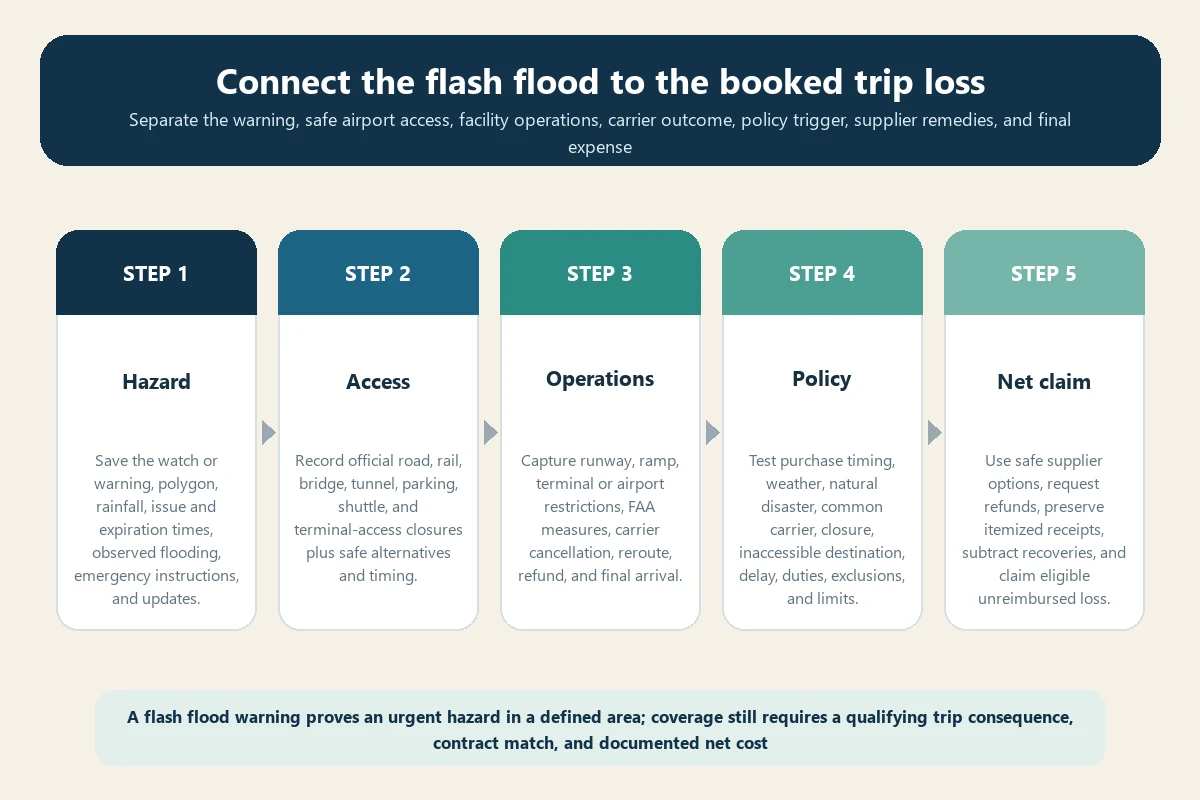
No. It establishes an urgent hazard in a defined area, but the claim still needs a qualifying trip consequence, covered policy trigger, eligible expense, and net loss.
What if floodwater blocks the road but the flight departs?
Document the official closure, safe alternatives, timeline, and airline response. A common-carrier cancellation benefit may not apply when the carrier operated; other policy wording may address road closure or inaccessibility.
What if the airport closes because of flooding?
Preserve the authoritative closure, affected operations, timing, carrier action, and reopening. Then test airport-closure, weather, natural-disaster, delay, cancellation, or interruption wording.
Should I accept airline rebooking?
Compare safe reasonable options and policy duties. Record every offer and response. If the airline cancels and you decline alternatives, request the refund to which DOT rules entitle you before calculating insurance loss.
Are extra hotel and meal costs covered?
They may be under trip-delay or interruption terms after the required trigger and time threshold, subject to reasonable-expense rules, receipts, daily caps, and total limits.
Bottom line: protect life first, then prove each link. The strongest flash-flood flight claim separates the warning, safe access, airport operation, carrier decision, policy trigger, supplier remedy, and final unreimbursed expense.
Storm surge disruption needs separate coastal-warning, evacuation, access, facility, and carrier evidence. Use this storm surge flight cancellation travel insurance guide to trace the booked-trip consequence, supplier remedies, policy trigger, and remaining net loss.
Tsunami disruption needs separate source-event, alert-level, evacuation, facility, and carrier evidence. Use this tsunami flight cancellation travel insurance guide to preserve the safety timeline, supplier remedies, policy trigger, and eligible net loss.
