

A travel insurance waiver medically able to travel condition usually asks about a specific past date: when the plan was purchased. It does not simply ask whether the traveler hopes to recover before departure. A later claim can trigger a review of what the insured and treating clinicians knew on that purchase date.
This U.S.-focused guide explains how to read and document that waiver condition without making a medical judgment. It is not medical, insurance, legal, or coverage advice. Only the insurer can decide a claim under the issued policy, and only a qualified clinician should advise whether a person can travel.
Key takeaways
- Copy the exact waiver wording and identify whose medical ability is tested.
- The relevant date may be the plan purchase date, not departure.
- A future expectation of recovery is not the same as being able to travel now.
- Contemporaneous clinical notes are stronger than a retrospective conclusion.
- Waiver eligibility and the later covered-reason test are separate decisions.
Reviewed August 16, 2026. “Medically able,” “medically fit,” and related terms vary by plan and state. The issued certificate, schedule, declarations, and endorsements control.
What the medically able to travel rule does
A pre-existing-condition exclusion waiver can remove an exclusion from specified benefits when all listed conditions are met. One condition may require an insured to be medically able to travel when the plan is purchased. The rule prevents a traveler from buying time-sensitive coverage after travel has already become medically unrealistic.
The pre-existing condition waiver guide describes the full structure. This article focuses only on medical ability, which must still be read beside purchase timing, insured trip cost, residency, and other plan conditions.
Fix the relevant date before evaluating evidence
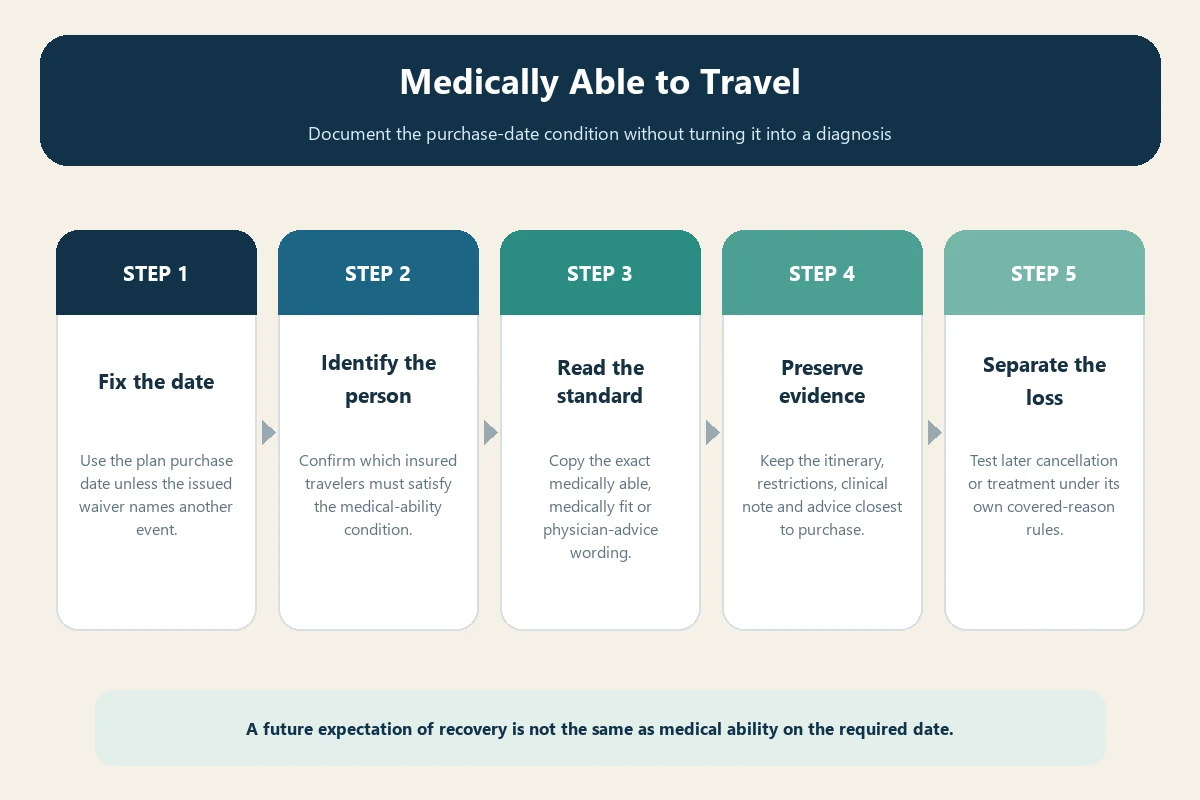
Write the plan purchase date and time at the top of the file. Do not substitute the quote date, effective date, booking date, or scheduled departure unless the contract expressly uses it. A traveler can improve or worsen between these events.
Allianz’s current existing-condition explanation says the traveler must be medically able to travel on the day the plan is purchased. It expressly distinguishes that from expecting to be able to travel later. That provider explanation is useful, but the traveler’s own form remains decisive.
Identify who must be able to travel
The condition may apply to insured travelers, not every person whose illness could cause a cancellation. A nontraveling parent, child, host, or family member might be relevant to a covered reason without needing to satisfy the traveler’s fitness condition.
Do not generalize. Follow the definitions of insured, traveling companion, family member, and person booked to travel. Allianz’s explanation, for example, says its medical-ability condition applies to people named in the plan and gives a nontraveling-parent example. Another form can word the scope differently.
“Able to travel” is not a self-certification shortcut
Feeling optimistic, walking without pain, or intending to take a gentle itinerary does not necessarily establish the contractual condition. The insurer may consider symptoms, restrictions, recent treatment, pending procedures, clinician advice, and the demands of the booked trip.
A traveler should not ask a clinician to guarantee insurance coverage. A better request is for accurate documentation of functional status, restrictions, treatment plan, and advice on the relevant date. The coverage conclusion belongs to the insurer under the contract.
The booked itinerary supplies important context
Medical ability can be difficult to evaluate without knowing the trip. A short direct flight to a city with accessible care differs from a high-altitude trek, remote cruise, or cycling tour. Save the itinerary that existed on the purchase date, including activities, flight duration, mobility demands, and distance from care.
If the itinerary later becomes more demanding, notify the insurer when required and ask whether the change affects coverage. Do not use a doctor’s note about a beach vacation as proof for an expedition added months later.
Recent surgery, hospitalization, or new restrictions need special care
A traveler recovering from surgery may expect to improve before departure while still being unable to travel when the plan is purchased. Discharge from hospital also does not automatically establish fitness. Review discharge instructions, mobility limits, follow-up appointments, medication changes, and explicit advice about flying or travel.
The after-hospital-discharge guide organizes those records. If surgery is scheduled or recovery is uncertain, the waiting-for-surgery guide explains why a future treatment plan can matter even before a claim.
Pending tests can undermine a simple yes-or-no answer
A pending test does not automatically mean the person is unable to travel. It can, however, show unresolved symptoms, a clinician’s concern, or a possible treatment change. The important facts are why the test was ordered, current restrictions, and the advice given at purchase.
Use the pending test results guide to build a dated record. Do not wait for a diagnosis and then rewrite what was known earlier; undiagnosed symptoms may still fit a policy’s pre-existing-condition definition.
Medication changes are evidence, not an automatic verdict
A new dose, new prescription, stopped drug, or adverse reaction may affect both a look-back definition and medical ability. But the meaning depends on why the change occurred and whether the condition was controlled. Preserve the prescriber’s note and pharmacy history rather than relying on a medication list alone.
The medication-change guide separates routine maintenance from a clinically meaningful adjustment. That distinction can help describe facts, but it does not decide the waiver.
Contemporaneous evidence is the strongest file
Useful records can include the visit note nearest the purchase date, discharge summary, specialist note, activity restrictions, fit-to-fly advice, physical therapy status, medication list, and the booked itinerary. Keep portal messages that show what the traveler asked and what the clinician answered.
Allianz notes that it may review medical records and speak with the physician for a related claim. A letter written after cancellation can help explain the record, but it should not contradict the notes created at the time.
A clinician note should describe facts, not policy language
Ask the clinician to document diagnosis or symptoms, stability, recent treatment, functional limits, travel restrictions, and advice given on the relevant date. Include the specific itinerary if the clinician considered it. Avoid supplying a prewritten statement that merely says “medically able to travel” without clinical context.
If no visit occurred near purchase, do not manufacture one retrospectively. Ask the insurer what evidence it accepts and whether a clinician can accurately address the date from existing records.
Medical ability and traveling against advice are different clauses
A form may require medical ability at purchase and separately exclude a trip taken against a physician’s advice. Passing the first test does not neutralize later medical advice. If a clinician advises against travel after purchase, document when and why that advice changed.
A current Travel Guard Vermont sample policy lists medical ability at purchase as a waiver condition and separately excludes a trip taken outside physician advice. This is a state-specific illustration, not a universal clause.
A later deterioration can still be unexpected
Being medically able to travel when the plan is purchased does not mean health must remain unchanged. Travel Guard’s current medical-condition page says a later change may still be covered when the waiver was qualified for and the insured was fit at purchase. It also warns that planned treatment or a worsening condition already known before purchase is not covered in its summary.
The distinction is temporal: what was true at purchase, what changed later, and what event caused the loss. Build a dated clinical timeline rather than labeling the whole condition “stable” or “unstable.”
Waiver eligibility is not the claim decision
Even if the waiver removes the pre-existing exclusion, the claim must fit an insured benefit and covered reason. Trip cancellation may require physician-certified restrictions at the time of loss. Medical expense benefits may require covered treatment during the trip. Limits and other exclusions still apply.
The claim denial guide shows how timing, exclusions, proof, and financial recovery remain separate. Never promise a payout because one waiver condition appears satisfied.
What if medical ability is genuinely uncertain?
Pause before relying on the waiver. Give the clinician the actual itinerary and ask for medical advice. Give the insurer the dates and ask what its form requires. If answers are verbal, request written confirmation or make a dated call note with representative name and reference number.
Do not conceal a restriction, move a purchase date, or pressure a clinician. If the traveler is not able to travel, the practical issue is health and trip planning first. Insurance cannot make an unsafe itinerary safe.
A five-gate documentation workflow
- Save the issued waiver wording and purchase timestamp.
- Identify every insured person subject to the condition.
- Preserve the itinerary and medical record closest to purchase.
- Record every later change in symptoms, treatment, restrictions, and advice.
- At claim time, connect the loss to a covered benefit with current physician and financial proof.
Keep sensitive records in a secure folder and share them only through the insurer’s approved channel. A medical-release authorization can allow the administrator to obtain information directly, so read its scope before signing.
Regulatory and disclosure context
The National Association of Insurance Commissioners’ travel insurance examination standards call for consumers to receive information about pre-existing exclusions, waiver circumstances, material coverage terms, and claim procedures. They do not define a nationwide medical-fitness test for every product.
That is why the correct sequence is certificate first, medical facts second, and claim conclusion last. Marketing summaries help identify questions; they do not replace the state-approved contract.
Bottom line
The travel insurance waiver medically able to travel rule is a dated eligibility condition, not a casual prediction about departure. Fix the purchase date, identify the people tested, preserve contemporaneous clinical and itinerary evidence, and track later changes. Then evaluate the actual loss under the covered-reason and documentation rules that remain.
