

Travel insurance pre existing condition claim documents must prove several different facts at once. A diagnosis alone rarely establishes waiver eligibility, a covered reason, the amount of loss, and compliance with claim procedures. The strongest file connects dates, medical records, trip payments, treatment, and refunds without forcing the examiner to reconstruct the story.
This U.S.-focused guide builds that file for trip cancellation, interruption, emergency medical expense, and evacuation claims. It is educational information, not insurance, legal, medical, or privacy advice. Follow the issued policy and the insurer’s current claim instructions.
Key takeaways
- Organize evidence into five timelines instead of one document pile.
- Prove the waiver conditions separately from the later loss.
- Keep complete clinical records, not only a short doctor’s note.
- Show original trip cost, supplier recovery, and final out-of-pocket loss.
- Use secure channels and keep an index of every submitted file.
Reviewed August 16, 2026. Required forms and records vary by claim type, insurer, plan, and state. A checklist cannot replace the claim packet issued for the traveler’s policy.
Build five timelines before collecting files
Timeline one covers health before the plan purchase. Timeline two covers waiver eligibility at purchase. Timeline three covers trip bookings and payments. Timeline four covers the illness, injury, cancellation, treatment, or evacuation. Timeline five covers refunds, credits, other insurance, and the remaining claimed amount.
Give every event an exact date and a source. The general claim documentation guide explains the broader process; this article adds the pre-existing-condition and waiver layers.
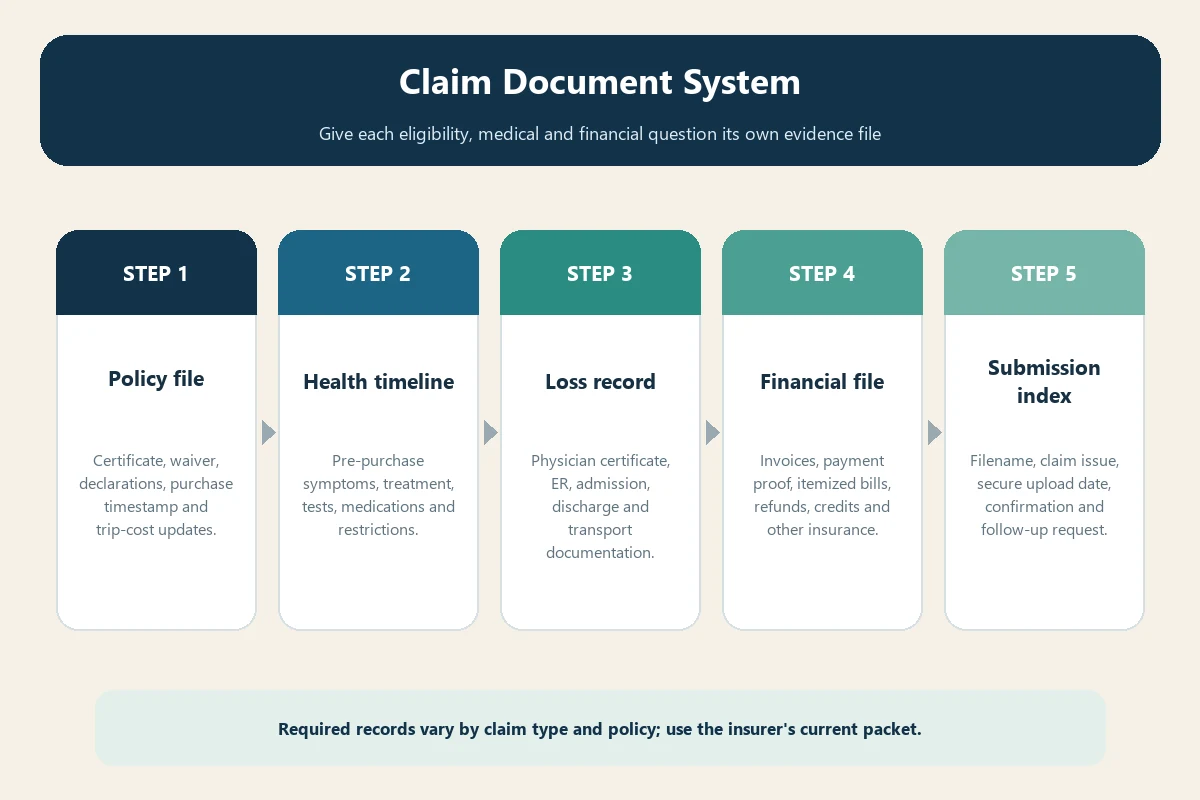
File one: the contract and waiver proof
Save the policy or certificate, schedule, declarations, state endorsements, purchase receipt, and any confirmation showing a pre-existing-condition exclusion waiver. Do not submit only a marketing page. The issued documents identify the exact waiver conditions and benefits from which the exclusion may be removed.
Add the first trip payment receipt, policy purchase timestamp, insured trip cost, and each later cost update. The waiver eligibility checklist helps map each condition to a supporting document.
File two: health before the policy purchase
Collect the records needed to apply the plan’s look-back definition. They may include office notes, specialist notes, hospital records, test orders and results, medication histories, therapy notes, symptom messages, and referrals. The relevant period is the one in the policy, not an assumed six months.
Do not remove an undiagnosed symptom because no formal diagnosis existed. The undiagnosed-condition guide explains why symptoms, examinations, recommended care, or treatment can matter under some definitions.
File three: medical ability on the purchase date
If the waiver requires an insured to be medically able to travel, preserve the clinical note closest to purchase, activity restrictions, discharge instructions, travel advice, and the itinerary considered. A later one-sentence letter may not explain what was known then.
The after-hospital-discharge guide shows how contemporaneous restrictions, follow-up care, and travel advice can document the purchase-date context. Keep that eligibility evidence apart from the certificate needed to prove inability to travel at the time of cancellation.
File four: the medical event that caused the loss
For cancellation or interruption, obtain a completed insurer medical certificate or physician statement that addresses diagnosis or symptoms, onset, treatment, restrictions, and why travel could not begin or continue. The statement should match the contemporaneous chart.
For medical expense or evacuation, keep emergency-room records, admission and discharge summaries, treating physician notes, diagnostic results, prescriptions, transport orders, and assistance-company communications. If the record is in another language, ask the insurer whether it requires a certified translation.
File five: trip cost and payment evidence
Include invoices and booking confirmations showing what was purchased, for whom, and when. Add proof of payment such as card statements, bank records, paid invoices, and points or credits. Preserve cancellation schedules and supplier terms that applied when the booking was made.
The waiver full-trip-cost guide builds the eligibility ledger. At claim time, add a second calculation showing unused prepaid cost, additional transportation, eligible medical bills, and any policy limits.
Refunds and credits belong in the claim file
Document every cash refund, reusable credit, voucher, tax refund, waived fee, chargeback, and payment from another insurer. Include a supplier’s denial or written explanation when nothing is recoverable. A claim generally concerns the net covered loss, not the original invoice in isolation.
Make a reconciliation table with original cost, amount used, refund, credit, other recovery, and claimed balance. Explain restrictions on a credit instead of omitting it.
What current insurer instructions commonly request
Travel Guard’s current required-document page lists a medical certificate and authorization for release of information for medical cancellation claims, plus trip invoices, payment proof, and evidence of refunds or credits. For emergency medical expense and evacuation, it lists treatment, emergency-room, admission and discharge records, bills, receipts, statements, and incident reports for injury claims.
A current Travel Guard Massachusetts sample policy similarly requires signed medical-release authorization, treatment records, financial documents, and event reports. These are useful examples, but only the claimant’s policy packet controls.
The medical release is not a routine checkbox
Read the authorization before signing. Confirm who may disclose information, who receives it, the purpose, the period covered, expiration, and revocation process. The patient or authorized legal representative generally must sign; the insured traveler cannot necessarily sign for a different adult family member.
Travel Guard’s current claim FAQ says medical records may be requested when physician information is incomplete and explains that its release is signed by the patient or legal guardian. Ask the insurer how to handle records for a nontraveling person whose illness caused the loss.
Prescriptions need context
A pharmacy history shows drug name, dose, prescriber, and fill date, but not always why a medication changed. Pair it with the clinical note that explains a new prescription, dose adjustment, discontinuation, or refill. Note whether the policy definition treats an unchanged medication for a controlled condition differently.
Use the medication-change guide to document the event without assuming that every refill is a change or that every change defeats coverage.
Emergency medical bills need clinical and financial detail
Ask for itemized bills, not only card receipts. The file should show patient, provider, date of service, diagnosis or reason for treatment, services, currency, amount charged, amount paid, and outstanding balance. Keep proof of currency conversion and foreign transaction fees if the policy addresses them.
If the travel plan is secondary or excess, obtain the primary insurer’s explanation of benefits or denial. Record why a domestic plan did or did not pay overseas.
Evacuation claims add authorization and transport records
Medical evacuation benefits often require coordination or approval by the assistance administrator and a determination that transport is medically necessary to an appropriate facility. Save call logs, case numbers, physician-to-assistance communications, transport orders, routing, invoices, and any refusal or alternative offered.
The medical evacuation limits guide explains why a large dollar limit alone does not establish who selects the destination or authorizes transport.
Make the clinical timeline easy to audit
Create a one-page chronology with columns for date, symptom or event, clinician, examination or treatment, medication change, restriction, and source file. Cite filenames rather than paraphrasing from memory. Mark gaps honestly.
Do not edit medical records or highlight them in a way that hides surrounding context. Submit clean copies and a separate index. If a record contains an error, ask the provider for an amendment according to its normal process.
Make the financial timeline reconcile to the cent
Number each expense and link it to an invoice, payment proof, and refund result. Use the same currency labels throughout. For foreign costs, record the transaction currency, card conversion, and the amount actually charged.
A neat total is not enough if it cannot be traced. Claims examiners should be able to move from the summary row to the underlying receipt and back without guessing.
Use a secure submission index
Name files consistently, such as 01-policy-certificate, 02-first-trip-payment, and 21-er-discharge-summary. Maintain a table with filename, date, description, person, claim issue, submission date, and portal confirmation.
Use the insurer’s secure portal when available. Avoid ordinary email for sensitive records unless the insurer specifically directs it and appropriate safeguards are in place. Keep copies of everything submitted and confirmation that it was received.
Respond to additional-document requests precisely
Match each request to a file or a short explanation of why it is unavailable. Ask what question the missing record is meant to answer. If the request is broad, ask for the date range, provider, and document type needed.
Never create a document that did not exist or coach a provider to change clinical facts. A clear gap note is safer than an inaccurate substitute.
Regulatory context supports clear claim procedures
The National Association of Insurance Commissioners’ travel insurance examination standards treat disclosure of material terms and the process for filing a claim as essential. They do not create one national evidence checklist or guarantee that a complete packet is payable.
If a claim is denied, request the decision in writing with the policy provisions and factual basis. Compare the letter with the submitted index before appealing or contacting the state insurance department.
Bottom line
Travel insurance pre existing condition claim documents work best as an indexed evidence system. Prove the contract and waiver, pre-purchase health, purchase-date eligibility, loss event, and net financial loss in separate but connected files. Accuracy, chronology, privacy, and reconciliation matter more than the size of the document pile.
A claim decision is only as strong as its policy match and evidence trail. Use how to review a medical-record authorization for a travel claim to organize the relevant records, deadlines and insurer response without submitting unrelated private information.
