

This guide covers buying travel insurance after hospital discharge when the hospitalization happened before purchase or before departure. It is not about buying insurance after a trip has already started. A recent discharge can affect pre-existing-condition definitions, waiver eligibility, cancellation risk, medical ability to travel, and the documentation needed for a later claim.
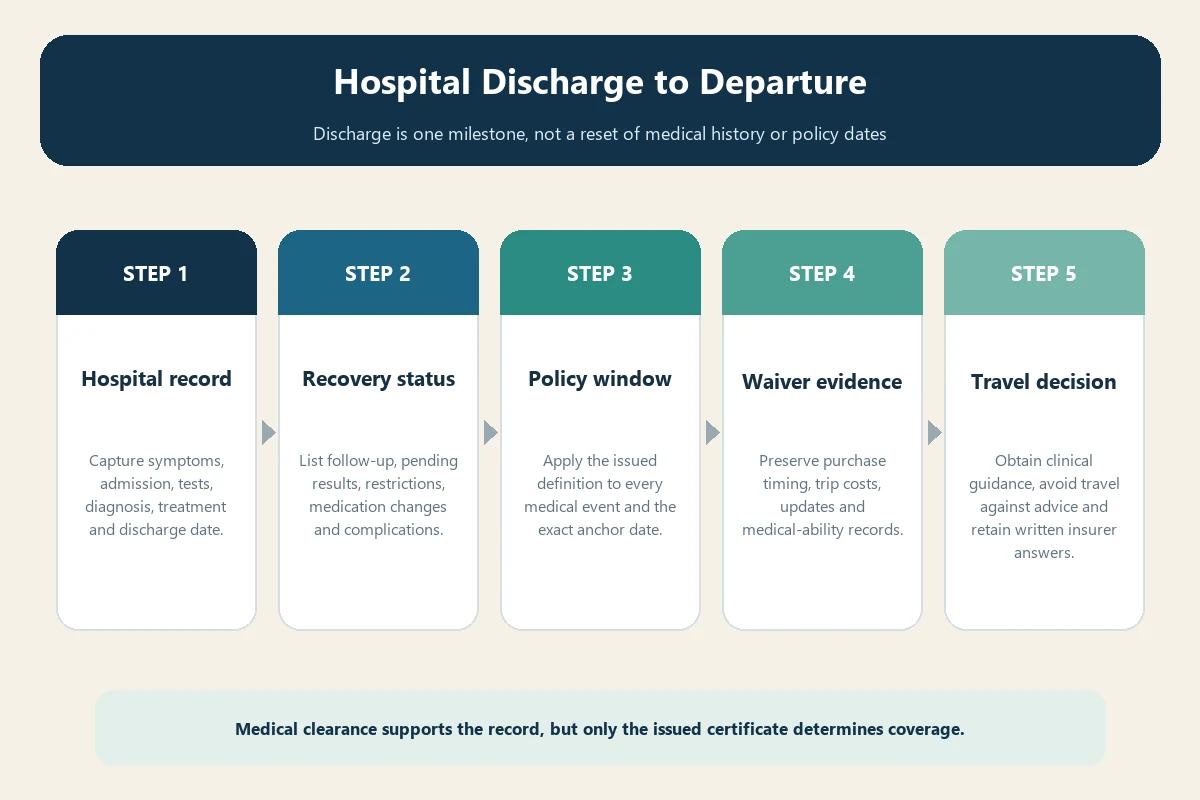
Discharge means inpatient care ended. It does not prove recovery, reset a policy look-back period, or guarantee fitness for an itinerary. Follow clinical instructions first and read the issued U.S. certificate for coverage.
Key takeaways
- Use the admission, discharge, policy purchase, and departure dates on one timeline.
- Unresolved symptoms, follow-up, tests, and medication changes can matter after discharge.
- Medical clearance and insurance eligibility are separate decisions.
- A waiver can remove one exclusion only when every stated condition is met.
- Keep the discharge summary, medication reconciliation, and physician instructions.
Reviewed August 16, 2026. Policy forms, benefits, exclusions, and state endorsements vary.
Start with the discharge-to-departure timeline
Record the first symptom or injury, emergency visit, admission, major tests, diagnosis, treatment, discharge, follow-up appointments, medication changes, policy purchase, trip payments, and departure. Add every travel restriction and the date it was changed.
This timeline prevents a common mistake: treating discharge as the only relevant medical date. A certificate may examine events during a period before purchase or coverage. Admission, symptoms, tests, treatment, and advice can remain inside that window.
Classify the post-discharge state
Recovered with no planned follow-up
Save the discharge instructions and final diagnosis. Confirm whether “follow up as needed” differs from a scheduled review. Even a completed episode must be tested against the policy’s dates and definition.
Recovering with routine follow-up
Record appointments, wound checks, rehabilitation, repeat tests, and medication plans. Expected care can be planned even when recovery is progressing well.
Symptoms or diagnosis remain unresolved
A discharge summary may list a provisional diagnosis or tests still pending. Preserve the workup and the physician’s next steps. Lack of a final label does not necessarily remove the medical facts from a policy definition.
Readmission or another procedure is possible
Document whether this is a general warning, a scheduled procedure, or a specific recommendation. Do not treat a possible return to care as impossible merely because the patient went home.
A medication changed during admission
Use the reconciliation list to identify each new, stopped, or adjusted drug. Note the reason and effective date. A medication event can be relevant independently of the discharge date.
Discharge does not reset a look-back period
A look-back definition may count backward from a policy anchor date and identify symptoms, treatment, testing, advice, or medication changes. Going home from the hospital does not erase earlier events.
Find the exact anchor and window. The pre-existing-condition look-back guide provides a step-by-step calculation. Do not substitute a general 60-day or 180-day assumption.
The worked look-back examples show how symptoms, testing, treatment, and medication changes can occupy different dates. They teach the method rather than predict a claim.
Read the definition before describing the condition
Search the certificate for “pre-existing condition,” “sickness,” “treatment,” “hospitalization,” “medical advice,” “test,” “symptoms,” and “prescribed medication.” Follow every endorsement and cross-reference.
A current Travel Guard Minnesota sample form illustrates how a U.S. certificate can use a dated definition and specific medication language. Review the sample certificate only as an example. Another form can produce a different result.
Purchase availability is not a coverage decision
A plan can be offered after discharge without covering a cancellation or medical expense related to the hospitalization. Online issuance confirms a transaction, not the outcome of every later claim.
The guide to buying with pre-existing conditions explains how to compare available plans, state forms, exclusions, and waiver deadlines.
Test medical ability to travel at purchase
Some time-sensitive waiver provisions require the traveler to be medically able to travel when coverage is purchased. Recent discharge does not automatically satisfy or defeat that requirement.
Ask the treating clinician whether the actual itinerary is appropriate. Provide flight duration, destination altitude, planned activities, access to care, and departure date. A factual clearance note can support the record, but it cannot change a policy.
Do not travel against physician advice
Some certificates exclude losses associated with travel against a physician’s advice. Others use medical ability as a waiver gate. Read the general exclusions, not only the medical section.
The standard exclusions guide shows why a favorable benefit description may still be limited by a broader clause.
Check pending tests and unresolved findings
Hospitals sometimes discharge patients before every culture, pathology report, or specialist interpretation is final. Record each outstanding item, why it was ordered, and the follow-up date.
A later result can lead to treatment or a recommendation not to travel. The analysis may consider the earlier symptoms and order, not only the day the result arrived.
Map every medication change
Compare the pre-admission medication list with the discharge reconciliation. Mark starts, stops, higher or lower doses, substitutions, and short courses. Record the clinical reason.
The chronic medication travel guide separates routine supply, new prescriptions, lost medicine, and flare-ups. Use the certificate’s own wording and never change necessary treatment for insurance purposes.
Evaluate a waiver gate by gate
A pre-existing-condition waiver can remove the specified exclusion when all conditions are met. Common requirements can include purchase within a time-sensitive period, insuring required trip costs, updating later costs, and being medically able to travel.
Complete the waiver eligibility checklist with dated evidence. A waiver does not make every follow-up visit, planned treatment, or general exclusion disappear.
Allianz’s pre-existing-condition explanation demonstrates how one insurer describes plan-specific requirements. Compare it with the certificate offered for the actual state and purchase.
Test cancellation before departure
Suppose a traveler is discharged, buys coverage, and later a clinician advises cancellation because symptoms return. A claim may require a covered sickness, physician certification, medical necessity to cancel, and satisfaction of the pre-existing-condition rules.
Now suppose the traveler simply feels unready despite no new medical advice. That fact pattern may not meet the same covered reason. Document the clinician’s finding and the date cancellation became necessary.
Separate expected recovery from a complication
Fatigue, restricted activity, and scheduled follow-up may be part of the expected recovery plan. A new infection, blood clot, or other complication may be documented as a separate development. The medical record must establish the facts.
Insurance still tests the complication against the certificate, including the underlying condition, exclusions, dates, and waiver. Do not assume the word “complication” guarantees coverage.
Evaluate emergency care during the trip
If the traveler becomes ill abroad, determine whether the event is related to the hospitalization. Then test the emergency medical benefit, deductible, limits, medical necessity, and assistance requirements.
The travel medical insurance benefits guide explains how hospital, physician, diagnostic, prescription, and evacuation charges can follow different rules.
Planned follow-up remains planned care
A wound check, physical therapy session, repeat scan, or specialist review scheduled before departure may not become an emergency merely because it occurs during travel. Ask whether the itinerary should be postponed or the care completed at home.
The continuation-of-treatment guide separates scheduled care from follow-up that becomes necessary after an eligible new event abroad.
Build the post-discharge document packet
Keep the emergency record, admission note, discharge summary, diagnoses, test reports, pending-results list, medication reconciliation, prescriptions, follow-up plan, and travel advice. Preserve the clinician’s contact details and any restrictions.
Add the trip itinerary, first payment receipt, later payments, policy confirmation, certificate, endorsements, and written insurer responses. If a claim occurs, retain itemized bills, proof of payment, physician certifications, and assistance-center records.
The travel insurance claim guide provides an evidence ledger. Never alter dates or ask a clinician to omit the hospitalization.
Ask the insurer ten clause-based questions
- Can this plan be purchased after a recent hospital discharge?
- Which date anchors its pre-existing-condition look-back period?
- Does the definition include hospitalization, symptoms, tests, advice, or medication changes?
- How are unresolved results and planned follow-up treated?
- Is a waiver available, and what deadline applies?
- How is medical ability to travel evaluated at purchase?
- Does the form exclude travel against physician advice?
- How would a documented recurrence or complication be tested?
- Would scheduled follow-up abroad be excluded as planned care?
- Which discharge and trip records would a claim require?
Provide the state, plan and form number, admission and discharge dates, current follow-up status, purchase date under consideration, departure date, and trip costs. Ask the insurer to identify the controlling clauses in writing.
Use official guidance for the baseline
The National Association of Insurance Commissioners advises consumers to compare travel insurance exclusions, limits, and covered situations. Review its current travel insurance topic before evaluating a particular form.
The CDC Yellow Book recommends confirming overseas coverage, medical assistance, exclusions, and reimbursement procedures. Its travel insurance chapter supports trip preparation but does not determine commercial coverage.
Make a recovery-aware coverage decision
Finish with four written conclusions: current medical status, certificate treatment of the hospitalization, waiver outcome, and protection for unrelated trip risks. List any unresolved results or insurer questions.
Travel insurance after discharge can still provide value, but the right plan cannot be selected from the discharge date alone. Build the full timeline, follow medical guidance, preserve time-sensitive purchase evidence, and understand which losses remain excluded before paying more nonrefundable trip costs.
Osteoporosis travel planning must separate the diagnosis, prior fractures, current mobility, recent surgery, fall prevention, and insurance. Use this senior osteoporosis travel insurance guide to test pre-existing conditions, cancellation, fracture care, interruption, and evacuation.