

Travel insurance while waiting for surgery can still be available to a U.S. traveler, but buying a plan does not mean the planned procedure or every related trip loss is covered. Surgery dates, symptoms, medical advice, recovery, initial trip payment, policy purchase, and departure must be placed on one timeline.
This guide separates purchase eligibility, pre-existing-condition treatment, trip cancellation, and emergency medical benefits. It provides no clinical safe-to-fly interval. Follow the treating team’s instructions and use the issued state-specific certificate for coverage decisions.
Key takeaways
- Being able to buy a policy is different from having the surgical condition covered.
- Planned surgery is not automatically an unexpected medical emergency.
- Physician advice and medical ability to travel can affect waiver eligibility.
- Cancellation before surgery and complications after surgery require separate tests.
- Never schedule travel or change care solely to fit an insurance rule.
Reviewed August 16, 2026. Benefits, exclusions, waiver conditions, and forms vary by state and plan.
Build the surgery-to-departure timeline first
Create one dated line with the first symptom, diagnosis, specialist referral, decision to operate, waiting-list entry, scheduled procedure, expected recovery reviews, trip deposit, policy purchase, final trip payment, and departure. Add any physician restriction or change in symptoms.
A vague statement such as “surgery is months away” hides the policy facts. The medical event might occur before purchase, between purchase and departure, or after the trip. Each sequence creates a different cancellation and medical-expense question.
Identify which surgery scenario applies
Surgery is recommended but not scheduled
The traveler may be on a waiting list or considering options. Preserve the recommendation, medical reason, expected urgency, and current restrictions. Lack of a date does not erase the recommendation.
Surgery is scheduled before departure
Record the procedure and all planned recovery checks. Ask the clinician about the itinerary’s demands. Insurance cannot substitute for a medical recovery plan.
Surgery is scheduled after return
The procedure may still reflect an existing illness or injury. Ask whether travel is medically appropriate before surgery and what symptoms require urgent care abroad.
The date could move with short notice
A cancellation list can produce an earlier procedure date. A voluntary choice to accept that date may not match a policy’s covered cancellation reason. Ask how a date change would be evaluated before relying on reimbursement.
Surgery has happened and recovery continues
This is no longer only a waiting-list question. Postoperative symptoms, follow-up, medication, and medical clearance become part of the record.
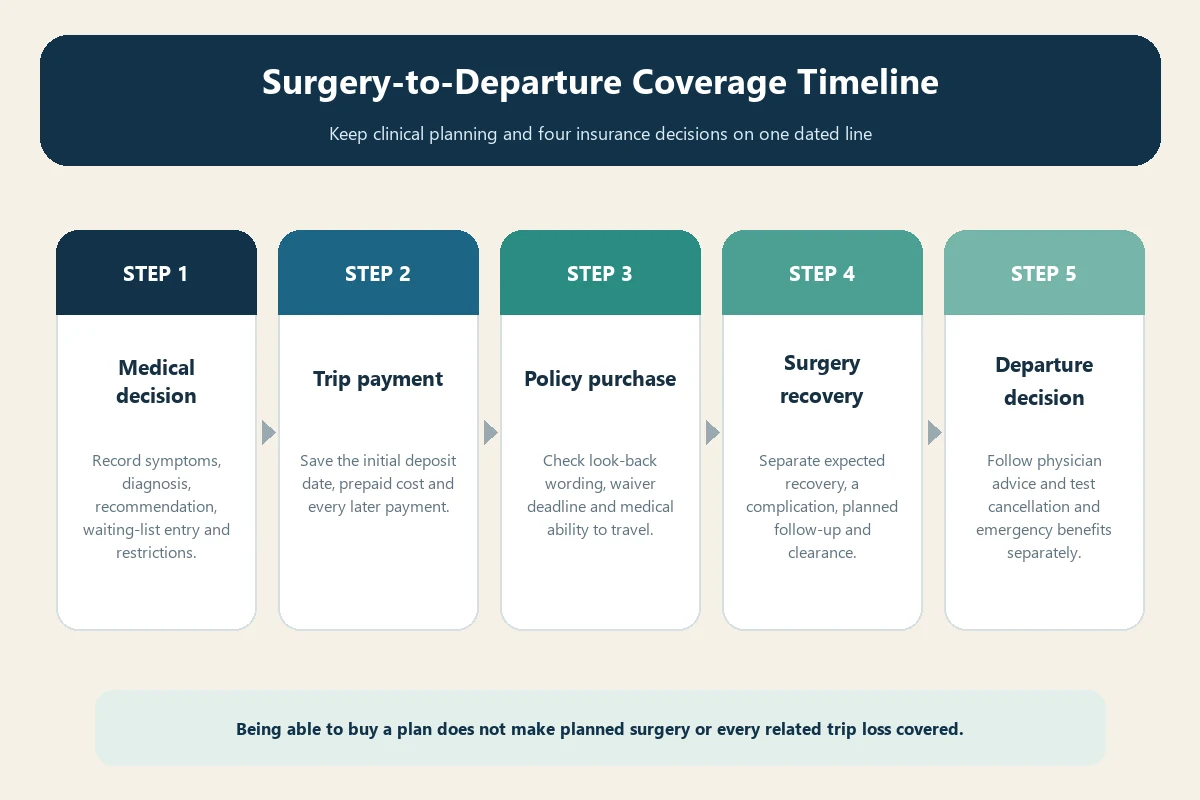
Purchase eligibility does not prove condition coverage
An online checkout may issue coverage after collecting trip details. That does not create a promise for surgery, related cancellation, or complications. The certificate may apply a pre-existing-condition exclusion, known-event language, benefit definitions, or medical-ability conditions.
The pre-existing-condition buying guide explains how to move from a quote to the actual form without treating marketing language as contract text.
Read the pre-existing-condition definition
Search for symptoms, examinations, tests, treatment, medical advice, diagnosis, hospitalization, and medication changes during the stated window. A surgery recommendation can be relevant through several of those terms.
Find the definition’s anchor date and count backward exactly. Use the look-back period guide to build the calculation. Do not assume the surgery date is the only medical date that matters.
A current Travel Guard Minnesota sample form shows how a U.S. certificate can define medical events and time-sensitive waiver conditions. Review the sample certificate as an illustration only.
Test medical ability to travel at purchase
Some waivers require the insured to be medically able to travel when the plan is purchased. Waiting for surgery does not automatically answer that test. Current symptoms, restrictions, physician advice, and the itinerary all matter.
Ask the treating clinician whether the proposed journey is medically appropriate. Request a factual note describing restrictions and review dates. Then ask the insurer how the certificate’s requirement applies. A doctor’s note is evidence, not a contract amendment.
Travel against physician advice can be excluded
Some forms exclude losses when travel occurs against a physician’s advice or when travel is undertaken to obtain treatment. Read general exclusions as well as the medical benefit. Do not treat a waiver as permission to ignore those clauses.
The travel insurance exclusions list explains how broad exclusions can reach cancellation, medical expense, evacuation, and other benefits.
Planned surgery is not emergency treatment
A procedure selected before the trip remains planned care even when it is medically important. Short-term travel medical insurance is generally structured around an unexpected eligible illness or injury during the covered trip.
The continuation-of-treatment guide separates scheduled care, ongoing treatment, recurrence, and follow-up after a new covered event.
Test cancellation before the procedure
Suppose symptoms worsen and the surgeon moves the procedure into the travel dates. A claim may require a covered sickness, physician certification, medical necessity to cancel, and compliance with the pre-existing-condition rules. A previously known recommendation can also affect foreseeability.
Now change the facts: the traveler accepts an earlier opening for convenience. That decision may not satisfy the same covered reason. Do not assume every surgery reschedule triggers trip cancellation.
Test cancellation after the procedure
Imagine surgery occurs as planned, but recovery takes longer than hoped. The relevant record may include postoperative symptoms, the surgeon’s restriction, a complication, and the original condition.
Separate expected recovery from a documented complication. Then test the covered-reason definition, the pre-existing-condition exclusion or waiver, and every exclusion. Do not predict recovery dates for insurance purposes.
A waiver removes one exclusion only
A waiver may remove the pre-existing-condition exclusion from specified benefits when every gate is met. Typical gates can include a time-sensitive purchase, required trip-cost insurance, later cost updates, and medical ability to travel.
Use the waiver eligibility checklist to document each gate. It does not automatically cover planned surgery, rehabilitation, routine follow-up, or travel against medical advice.
Allianz’s pre-existing-condition guide demonstrates why the selected plan’s time-sensitive rules matter. Requirements differ, so preserve the actual quote and form.
Protect the time-sensitive purchase window
Record the date of the first trip payment, not merely the booking confirmation. Identify whether the plan measures its deadline from initial deposit or another event. Buy only after reading the offered certificate.
If later payments increase prepaid nonrefundable cost, check whether coverage must be increased within another deadline. Save every invoice, payment record, and adjustment.
The pre-existing-condition waiver guide explains purchase timing and continuing obligations in more detail.
Evaluate emergency care during the trip
A traveler waiting for knee surgery might develop unrelated appendicitis abroad. The new illness still must fit the emergency medical benefit, medical-necessity definition, exclusions, deductible, and assistance requirements.
If the knee worsens, the relationship to the known condition becomes central. Use the travel medical benefits guide to test the benefit before applying condition-specific wording.
Do not confuse emergency stabilization with elective surgery
An acute complication abroad may require immediate evaluation or stabilization. That does not mean the policy will fund the already planned operation. The treating physician, assistance team, and policy may distinguish urgent care from care that can wait until return.
Ask whether preauthorization is required, whether the assistance center must approve transportation, and what happens when the traveler is medically able to return home.
Build a document packet before purchase
Keep the specialist note, diagnosis, test reports, surgery recommendation, waiting-list notice, scheduled date, medication list, current restrictions, and expected follow-up. Add the trip itinerary, deposit receipt, later payments, certificate, endorsements, and written insurer answers.
After surgery, retain the operative summary, discharge instructions, complication records, and updated travel advice. For any claim, keep itemized bills and proof of payment. The claim documentation guide provides a structured ledger.
Ask the insurer ten precise questions
- Can this plan be purchased while the traveler is waiting for surgery?
- Which medical facts fall within its pre-existing-condition definition?
- What date anchors the look-back period?
- Is a waiver offered, and what is the purchase deadline?
- How is medical ability to travel evaluated at purchase?
- Does accepting an earlier surgery date qualify for trip cancellation?
- How would a documented postoperative complication be tested?
- Are planned surgery and routine follow-up excluded from medical expense?
- Does travel against physician advice trigger a general exclusion?
- Which clinical and trip-payment records would a claim require?
Include the state, plan, form number, procedure status, relevant dates, trip dates, and trip costs. Ask for a clause-based written answer. A general sales statement is not enough.
Use official insurance and health guidance
The National Association of Insurance Commissioners tells consumers to compare covered events, exclusions, and limits. Its travel insurance overview provides a current regulatory baseline.
The CDC Yellow Book advises travelers to verify overseas coverage and understand medical assistance and reimbursement. Review its travel insurance chapter alongside clinical advice for the itinerary.
Make four decisions, not one
End the review with four written outcomes: whether the policy can be purchased, how the existing condition is treated, which cancellation events may qualify, and how emergency care abroad would be tested. Add unresolved questions beside each outcome.
Travel insurance may still protect meaningful risks while someone waits for surgery. The responsible approach is to preserve waiver timing, document medical facts, follow physician advice, and understand the exclusions before committing nonrefundable money.
