

Travel insurance with pending test results is not a simple yes-or-no issue for U.S. travelers. You may be able to buy a plan while a result is outstanding, yet a related condition, cancellation, or medical expense may still be excluded. Symptoms, medical advice, an ordered test, a referral, and a planned procedure can each matter before a final diagnosis exists.
This guide provides a certificate-first workflow for U.S. policies. It does not decide a claim, diagnose a condition, or replace medical advice. Answer every application question accurately and preserve the insurer’s written response.
Key takeaways
- Separate a pending test from a pending result, diagnosis, referral, or procedure.
- A diagnosis is not always required for a pre-existing-condition definition to apply.
- Purchase eligibility and coverage for the medical issue are different questions.
- Known-event and foreseeability language can affect cancellation before departure.
- Do not import UK or Canadian medical-screening rules into a U.S. certificate.
Reviewed August 16, 2026. Policy definitions, applications, exclusions, and state endorsements vary. Only the issued form controls.
Start with five different pending states
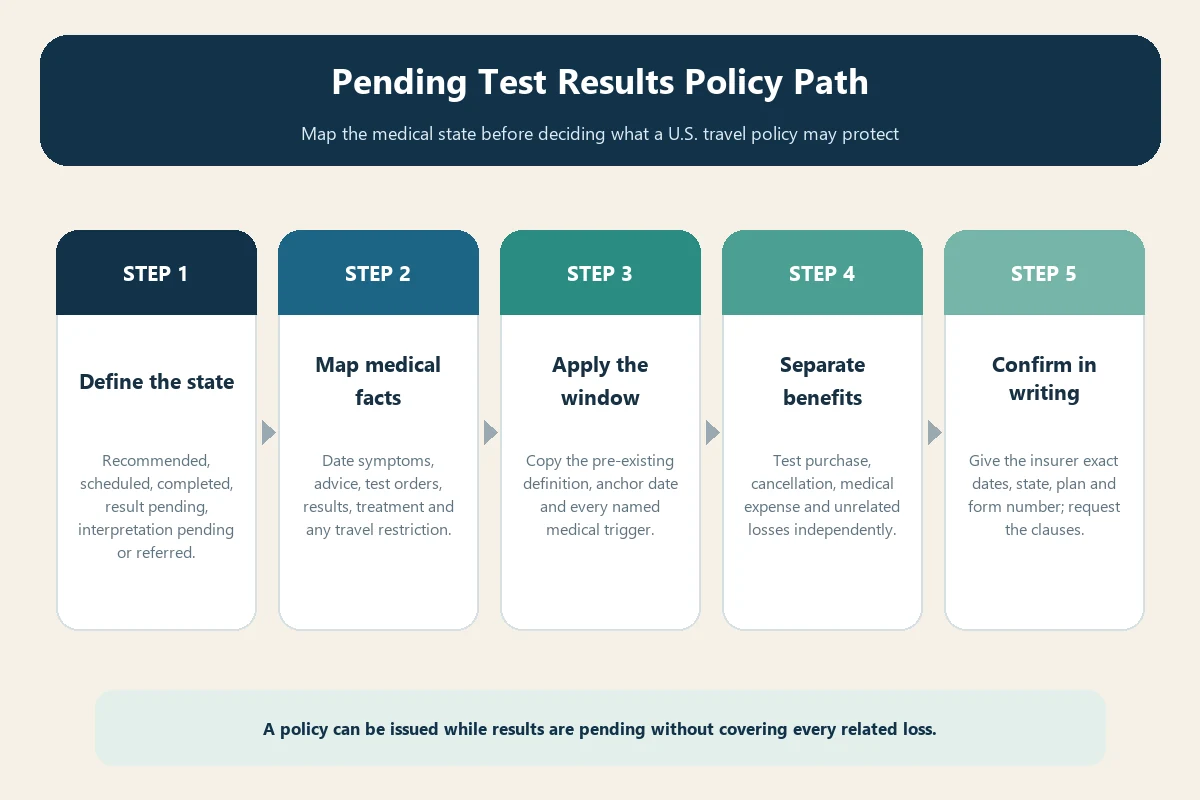
Write the situation as one or more of five states. Do not use “awaiting tests” as a catch-all phrase.
1. A test has been recommended but not scheduled
A clinician may recommend laboratory work, imaging, monitoring, or another examination. Record the date, reason, and urgency. A recommendation can matter even before an appointment exists.
2. A test is scheduled but not completed
Save the order and appointment date. Note whether the traveler has symptoms, restrictions, treatment, or a provisional diagnosis while waiting.
3. A test is complete but the result is pending
Record the specimen or imaging date and the expected review date. The medically relevant event may be the earlier symptom, consultation, or test order rather than the date the result appears in a portal.
4. A result exists but interpretation or diagnosis is pending
A numerical result without clinician interpretation may still lead to follow-up. Preserve the report and every message. Do not characterize it as normal or abnormal without medical confirmation.
5. A referral or procedure is pending
A specialist referral, biopsy, endoscopy, or surgery creates facts beyond an ordinary lab result. Capture the reason, scheduled date, and any physician advice about travel.
Do not wait for a diagnosis to build the timeline
Many travelers assume a condition cannot be pre-existing until a doctor names it. Some certificates define the term through symptoms, examinations, treatment, tests, or medical advice during a stated period. A final diagnosis may not be required.
Build a dated line for the first symptom, first contact with a clinician, test recommendation, test completion, result, follow-up recommendation, and any treatment. The look-back period guide shows how to compare those dates with an actual definition.
Find the policy’s anchor date
A look-back window must count from a defined point. The anchor can differ by form and benefit. It might be the purchase date, coverage effective date, or another date stated in the certificate.
Copy the anchor and window length exactly. Then place each medical event on the calendar. A test result received after purchase does not automatically move the earlier symptoms or test order outside the window.
Use the worked look-back examples to practice the calculation. The examples are instructional and cannot determine a real claim.
Read symptoms, tests, and advice as separate triggers
Search the definition for “symptoms,” “examination,” “test,” “treatment,” “medical advice,” “diagnosis,” and “prescribed medication.” A form may list several triggers. Do not stop after finding the word “diagnosis.”
A current Travel Guard Minnesota sample certificate illustrates how plan wording may reach treatment, testing, and medication changes during a defined period. Read the sample form only as an example. Your own state form may differ.
Purchase eligibility is not the same as medical coverage
A website may accept payment and issue a policy while medical work is pending. That transaction does not prove that cancellation related to the unresolved issue will be covered. It also does not establish eligibility for a medical claim tied to the same symptoms.
The guide to buying travel insurance with pre-existing conditions separates shopping, application accuracy, certificate review, and waiver timing.
Check application and eligibility questions literally
Some travel insurance purchases involve only trip and traveler information. Others ask health, eligibility, or medical-ability questions. Read every question and definition before answering.
Do not infer that an unasked question creates coverage. Conversely, do not volunteer an imprecise medical conclusion. If a question is unclear, provide the exact facts and request written guidance from the insurer or licensed representative.
Test cancellation as a known-event problem
Imagine a scan was ordered before purchase. The later result leads a doctor to recommend that the traveler cancel. A policy may examine whether the sickness meets a covered-reason definition, whether it was pre-existing, whether the event was foreseeable, and whether coverage began before the loss became known.
Do not assume that the result date is the only relevant date. The symptoms, consultation, test order, and medical advice can all form part of the record.
The travel insurance exclusions guide shows how known events and general exclusions can operate alongside a benefit’s covered reasons.
A waiver may help only if every gate is met
A pre-existing-condition waiver can remove the named exclusion from specified benefits. Requirements can include a time-sensitive purchase, insuring required trip costs, later cost updates, and being medically able to travel at purchase.
Pending testing can be relevant to that last condition, but the certificate decides. Use the waiver eligibility checklist and preserve the evidence for every gate.
Allianz’s pre-existing-condition explanation shows how one insurer describes time-sensitive requirements. Treat it as plan-specific guidance, not a market-wide promise.
A waiver does not turn planned care into an emergency
If a biopsy, procedure, or specialist visit is already planned, removing a pre-existing-condition exclusion does not necessarily create affirmative coverage for that care. Emergency medical benefits usually have their own definitions, exclusions, medical-necessity rules, and trip requirements.
The continuation-of-treatment guide separates ongoing planned care from an unexpected new event and its medically necessary follow-up.
Evaluate unrelated losses without promising coverage
An unresolved thyroid test and a later stolen suitcase involve different facts. The pending test may have no medical relationship to the theft, but the baggage claim must still satisfy its own benefit, exclusions, item limits, proof, and reporting deadlines.
The same logic applies to an unrelated accident abroad. Use the travel medical insurance benefits guide to test the accident. Avoid blanket statements that “everything unrelated is covered.”
U.S. readers should not import foreign screening rules
Google results for “pending test results” frequently lead to UK and Canadian pages. Those markets may use medical screening, declaration, stability, or waiting-list language that does not appear in a U.S. travel insurance form.
Do not copy a foreign answer into a U.S. purchase. Confirm the insurer, state of residence, plan, form number, edition, and endorsements. The U.S. stability-period guide explains why the same phrase can represent different contract mechanisms.
Medical clearance and coverage remain separate
A clinician should decide whether the itinerary is medically appropriate. The insurer applies the contract. A clinician’s note can document symptoms, restrictions, and fitness, but it cannot waive an exclusion by itself.
Do not travel against medical advice. Do not cancel a test, conceal symptoms, or defer necessary treatment to create a cleaner insurance timeline.
Build a pending-results evidence file
Save the appointment note, test order, scheduling record, laboratory or imaging report, portal messages, referral, medication list, and follow-up plan. Add the policy certificate, endorsements, trip invoice, initial payment proof, purchase confirmation, and written insurer answers.
If a claim occurs, preserve the medical record that connects the cancellation or overseas treatment to the diagnosis. Keep itemized bills and proof of payment. The travel insurance claim guide provides a document ledger.
Send a precise written inquiry before buying
State the facts without guessing at the diagnosis. For example: “A physician ordered an MRI on August 3 because of recurring knee pain. The scan is scheduled for August 22. No surgery is scheduled. The trip starts October 10. How do the pre-existing-condition definition, waiver requirements, trip cancellation benefit, and medical-expense benefit apply under form X in my state?”
Ask the insurer to cite the relevant clauses. Include the state of residence, purchase date under consideration, initial trip-payment date, total prepaid cost, and every traveler whose condition could trigger a benefit.
Ask these nine policy questions
- Which date anchors the pre-existing-condition look-back period?
- Does the definition include symptoms without diagnosis?
- Does it include tests ordered, recommended, completed, or awaiting results?
- How does a pending referral or procedure affect the analysis?
- Is a waiver available, and what deadline applies?
- Must the traveler be medically able to travel at purchase?
- Would a later cancellation be tested as a known or foreseeable event?
- How are unrelated medical and nonmedical losses evaluated?
- What records would be required for a claim?
Use official guidance as the baseline
The National Association of Insurance Commissioners advises consumers to understand exclusions and compare coverage before purchase. Review the NAIC travel insurance topic for the regulatory baseline.
The CDC Yellow Book recommends checking overseas health coverage, exclusions, reimbursement rules, and assistance arrangements. Its travel insurance chapter is useful for medical planning, but it does not interpret a commercial certificate.
Make a five-state decision, not a one-line assumption
Identify which medical state applies, plot every date, copy the exact definition, and test cancellation, medical expense, and waiver conditions separately. Then document the insurer’s answer before paying.
A pending result does not automatically make every plan unavailable. It also does not disappear because no diagnosis exists yet. The professional approach is to preserve the medical facts, follow care promptly, and choose coverage with a clear understanding of what remains protected and what remains excluded.
