

Travel insurance should not be assumed to pay for scheduled chemotherapy, routine oncology visits, expected side effects, or a trip undertaken against medical advice. A senior considering international travel during treatment needs explicit oncology clearance, a treatment and laboratory timeline, medication and device continuity, destination infection and care planning, and a written insurance analysis of the cancer-related pre-existing-condition terms. Cancellation, interruption, emergency medical, and evacuation benefits must be tested separately.
This article is educational, not oncology, medical, legal, financial, or insurance advice. Chemotherapy regimens, immune effects, complications, and travel fitness differ. The treating oncology team must decide whether, when, and how travel is appropriate. Do not delay, move, or alter treatment based on general travel content.
Key takeaways
- Obtain treatment-team clearance for the exact dates, destination, transport, and activities before booking.
- Scheduled chemotherapy and monitoring are planned care, not ordinary travel medical emergencies.
- Cancer, treatment, symptoms, laboratory changes, and recent hospitalization can all affect pre-existing-condition eligibility.
- A cancellation waiver does not create coverage for foreseeable treatment or an excluded event.
- Identify an oncology-capable destination hospital, payment route, and evacuation endpoint before departure.
Reviewed: August 16, 2026.
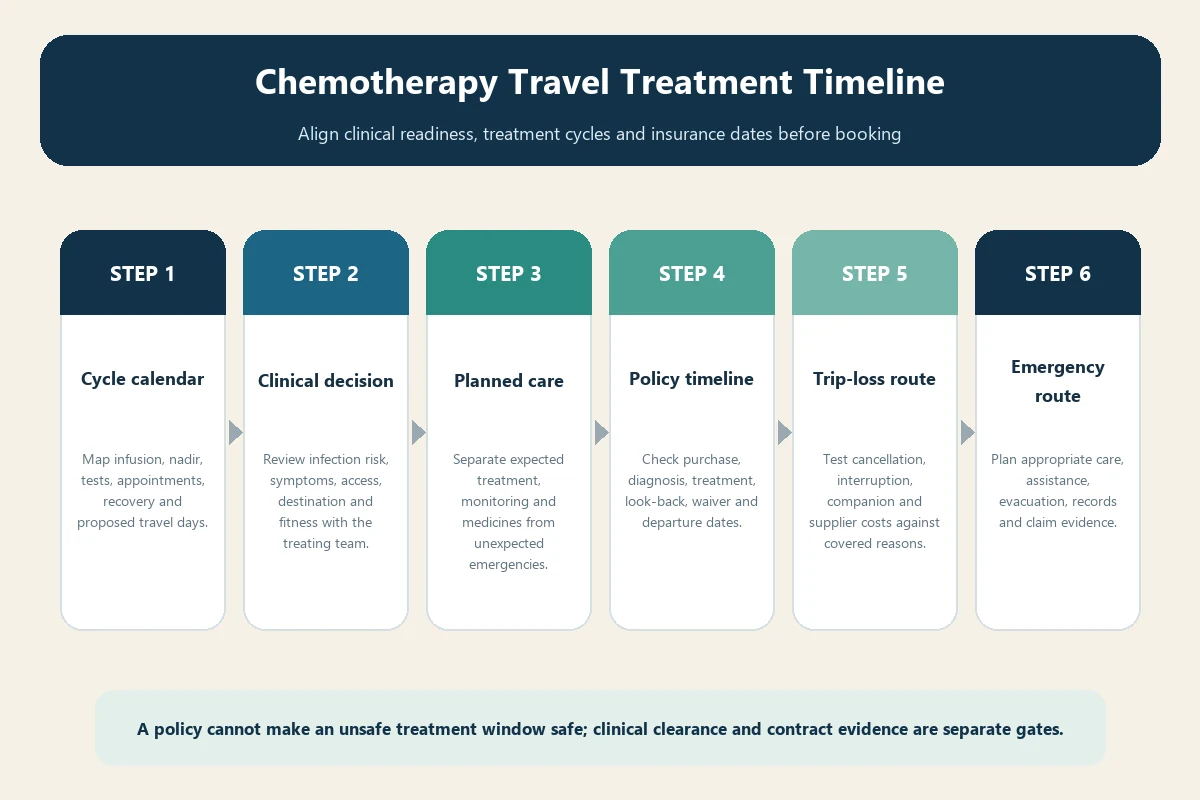
Begin with the oncology team
The oncology team should assess the regimen, treatment cycle, blood counts, organ function, side effects, infection exposure, venous access, medications, vaccine timing, mobility, fatigue, and destination care. A traveler may feel well on one day while a predictable treatment phase creates different risk later.
Ask for advice about flight duration, cruise, altitude, heat, crowds, food and water, sun, activity, time zones, and the distance from qualified care. Insurance approval does not equal clinical clearance.
Put treatment and travel on one calendar
Mark every infusion, injection, oral therapy cycle, laboratory test, imaging appointment, line care, follow-up, expected symptom window, prescription refill, and clinician availability. Add the flight, cruise, tour, hotel, cancellation deadlines, and policy purchase date.
This timeline reveals whether the trip depends on moving care, whether a policy timing rule can be met, and when a new medical development could create a cancellation question. Do not move treatment solely to protect a travel deposit.
Scheduled chemotherapy is planned care
Travel medical insurance generally focuses on unexpected illness or injury during a covered trip. Treatment known before departure—chemotherapy, monitoring, imaging, line care, or routine supportive medicine—is planned. A high emergency medical maximum should not be interpreted as payment for scheduled oncology care abroad.
If treatment must occur during travel, obtain written confirmation from the foreign oncology center, home team, payer, and pharmacy. Verify protocol, drugs, dose, timing, laboratory standards, records, payment, complications, and continuity. The complexity often makes postponing travel or changing dates safer and simpler, but the medical team decides.
Original Medicare and treatment abroad
Original Medicare generally does not cover health care outside the United States except in narrow border, Alaska-transit, residence, and cruise situations. Routine chemotherapy during an overseas trip ordinarily does not qualify. Medicare Advantage plans may offer international emergency benefits, but planned cancer treatment still needs explicit contract confirmation.
Medigap’s foreign travel emergency benefit is also not general scheduled-treatment coverage. Build a separate payment plan rather than expecting reimbursement.
Pre-existing-condition analysis
Cancer and chemotherapy are known before policy purchase. A travel policy may exclude related losses unless a waiver applies. The look-back can include diagnosis, symptoms, testing, treatment, prescriptions, dose changes, laboratory findings, and hospitalization.
Use our travel medical insurance for cancer survivors guide for the broader condition framework and the senior pre-existing-condition questions for certificate review.
What a waiver can and cannot do
A pre-existing-condition waiver can remove an exclusion for an otherwise covered loss when purchase timing and other eligibility conditions are satisfied. It does not guarantee that active treatment is covered, make an expected event unexpected, waive medical-ability requirements, or add benefits absent from the policy.
Ask the insurer to evaluate examples: a new unrelated injury, an unexpected serious treatment complication, a routine infusion, a clinician-requested cancellation after new laboratory results, and a trip booked despite existing advice not to travel.
Medical ability to travel at purchase
Some policies require the insured to be medically able to travel when coverage is bought. Only the treating clinician can assess ability, and the policy defines the insurance condition. Record the clinical status and advice on the purchase date.
A waiver bought after a new recommendation to cancel may not repair the timeline. Buy early, but only after accurate disclosure and clinical review.
Infection and immune considerations
Some cancer treatments can weaken immune defenses. CDC advises immunocompromised travelers to seek individualized pretravel consultation and consider destination disease risks, vaccines, food and water, respiratory exposure, and access to care. Live vaccines may be inappropriate for some people, but the clinician decides.
Ask the oncology and travel-medicine teams to coordinate. A destination’s entry requirement does not establish that a vaccine is medically safe, and a vaccine waiver may not eliminate infection risk.
Ports, cruises, and remote destinations
A cruise medical center or resort clinic may stabilize a problem without oncology, blood products, imaging, or intensive-care capability. Map the route to a qualified hospital and determine whether a port can disembark the traveler. Sea days and remote lodges can create long transport times.
The evacuation destination guide helps assess geography. Do not assume a ship or travel insurer will fly the traveler directly home.
Medication and supportive care
Arrange lawful supplies of oral anticancer drugs, anti-nausea medicine, pain medicine, growth factors, anticoagulants, and other prescribed treatments. Some may need refrigeration, special handling, controlled-substance documents, or a specialty pharmacy. Medicare Part D generally does not cover retail prescriptions bought outside the United States.
Use our chronic medication guide to align supply, storage, and monitoring. Never change dose or schedule for a flight without oncology guidance.
Central lines, ports, pumps, and supplies
A central venous catheter, implanted port, or infusion pump creates device and infection considerations. Carry the device card, access information, manufacturer details, and emergency instructions. Identify who can safely access or manage it at the destination.
Routine supplies may be planned expenses and not insured. A device failure can lead to separate property, medical, and trip claims. Ask the insurer how each is classified.
Emergency medical coverage
A travel medical benefit may pay eligible unexpected treatment, subject to the pre-existing-condition provision, deductible, coinsurance, limits, exclusions, and coordination. The oncologist’s view of a medical complication and the insurer’s view of coverage are different decisions.
Ask whether the policy can cover an unexpected fever, infection, dehydration, allergic reaction, blood clot, bleeding, fall, or unrelated illness. Seek urgent care under the clinical plan without waiting for claim authorization.
Direct billing and deposits
A foreign hospital may require payment before admission, testing, transfusion, or treatment. Assistance can arrange a payment guarantee for an eligible event, offer only a referral, or reimburse later. Confirm the process and carry payment access.
The direct-billing guide explains these models. Keep itemized bills, clinical records, drug administration records, laboratory results, and proof of payment.
Trip cancellation
Cancellation may apply when an unexpected covered medical change makes the traveler unable to depart. Cancer-related claims depend on the pre-existing-condition terms, purchase timing, medical-ability condition, clinician documentation, and supplier refunds.
Cover the actual nonrefundable amount. A refundable hotel or airline credit is not the same loss as a forfeited tour. Keep the first payment date and every cancellation deadline.
Treatment schedule changes and supplier cancellation
A chemotherapy appointment moving by one day is not automatically a covered reason. A clinic rescheduling, drug shortage, or inability to obtain foreign treatment may be outside the policy’s covered events. Ask before booking a trip that relies on a precise treatment gap.
Flexible fares and refundable lodging can protect the itinerary more reliably than trying to insure a known schedule dependency.
Trip interruption
Interruption benefits may cover eligible unused trip arrangements and additional transport after a covered event. A new ticket, medical escort, companion stay, and unused cruise nights can follow different limits.
Ask who must authorize the return, whether a treating clinician must certify medical necessity, and how refunds and credits are deducted.
Medical evacuation
Evacuation commonly requires that local care be inadequate and that the assistance company approve the transfer. The covered endpoint is often the nearest appropriate facility, not the traveler’s home oncology center. A receiving hospital must have capacity and accept the patient.
Use the evacuation approval guide and preserve the records in the evacuation claim checklist.
Five-scenario rehearsal
- Laboratory result changes before departure: the oncology team advises against travel.
- Infusion is rescheduled: the trip overlaps planned care.
- Unexpected fever abroad: urgent evaluation is needed.
- Flight delay separates medicine from refrigeration: the pharmacy and manufacturer must assess usability.
- Local hospital lacks oncology capability: assistance evaluates transfer to an appropriate center.
For each, identify the clinical action, policy provision, decision-maker, payment route, and evidence.
Document packet
- Diagnosis and current treatment summary
- Regimen, cycle dates, laboratory and monitoring plan
- Medication, allergy, device, and access information
- Oncology, pharmacy, and infusion-center contacts
- Clinical travel clearance and emergency thresholds
- Destination hospital and assistance contacts
- Medicare-related and travel policy documents
- Trip deposits, purchase dates, refunds, and penalties
- Secure records access and companion authorization
Questions for the insurer
- How do cancer, chemotherapy, recent laboratory results, and symptoms fit the pre-existing-condition definition?
- Is a waiver available and valid for the purchase timeline?
- What medical-ability requirement applies?
- Is scheduled treatment excluded?
- How are unexpected treatment complications handled?
- Would a clinician-directed cancellation be eligible?
- Does interruption pay for a medically necessary return?
- Can assistance guarantee hospital payment?
- What evacuation endpoint and authorization apply?
- Which records and deadlines control a claim?
FAQ
Can a senior buy travel insurance during chemotherapy?
Availability varies. The policy may exclude cancer-related losses unless a waiver applies, and active treatment or medical-ability rules can affect eligibility.
Will travel insurance pay for chemotherapy abroad?
Do not assume so. Scheduled chemotherapy is planned care, while travel medical benefits generally focus on unexpected covered events.
Does a waiver cover all cancer-related claims?
No. It removes a specified exclusion only for otherwise covered losses and does not create planned-treatment or excluded-event coverage.
Will evacuation return the traveler to the home cancer center?
Not necessarily. Many policies cover the nearest appropriate facility, subject to medical necessity and authorization.
Bottom line
Travel during chemotherapy must fit the treatment plan before it can fit an insurance contract. Align the clinical timeline, destination care, medication, immune risk, and payment plan. Then test pre-existing-condition, cancellation, interruption, emergency medical, and evacuation provisions against specific scenarios.
Sources
- CDC Yellow Book — Immunocompromised Travelers
- CDC Yellow Book — Travelers With Chronic Illnesses
- American Cancer Society — Traveling During Cancer Treatment
- Medicare — Coverage Outside the United States
- U.S. Department of State — Insurance Coverage Overseas
- U.S. Department of State — Medications and International Travel
