

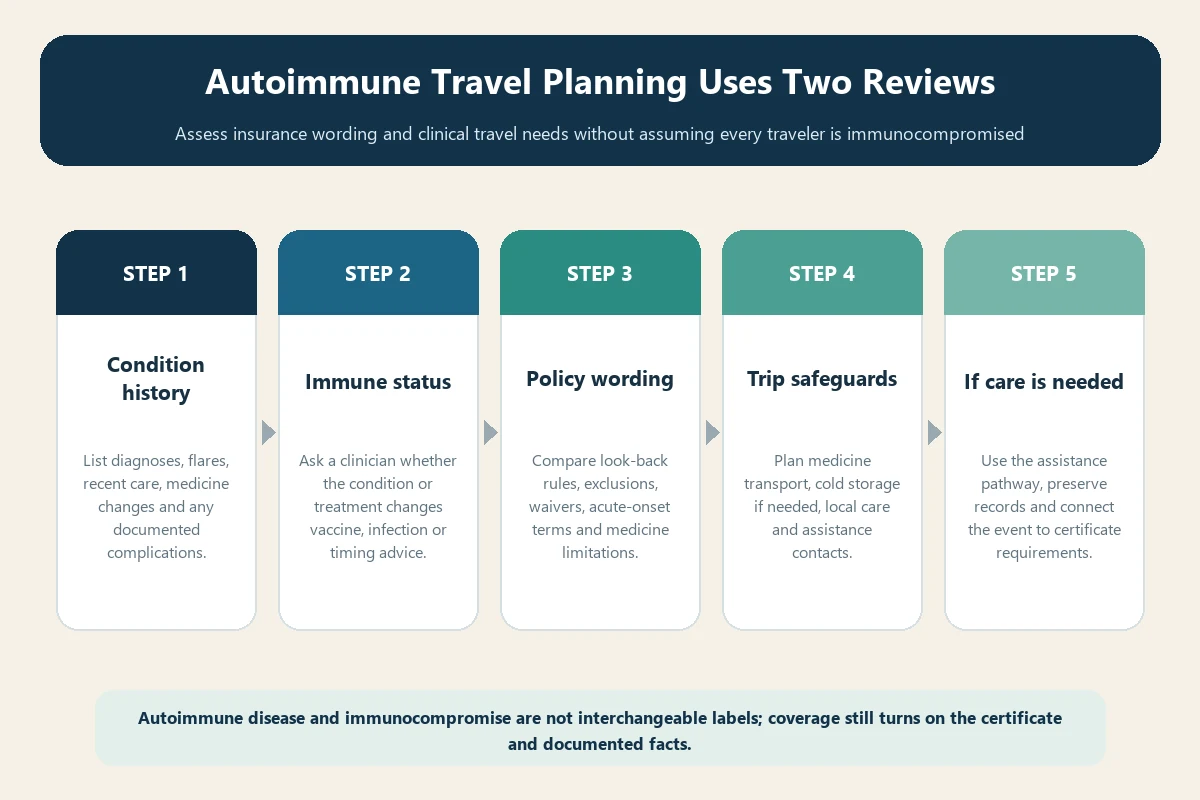
Travel medical insurance for autoimmune disease should distinguish the underlying condition, immune-modifying treatment and the event abroad. A flare, infection, routine infusion, medicine loss and unrelated injury can follow different certificate rules. The diagnosis alone does not produce one universal coverage answer.
This guide helps U.S. travelers compare policies and prepare documentation. It does not diagnose a flare, assess immune status, recommend vaccines or change medicine schedules. Coordinate those decisions with the disease specialist and a travel-medicine clinician.
Key takeaways
- Build separate timelines for disease activity, infections, tests and medication changes.
- Do not assume every autoimmune condition or treatment causes the same level of immune suppression.
- Classify routine monitoring and planned infusions separately from an unexpected flare or infection.
- Test pre-existing-condition, diagnosis, medicine, vaccine, evacuation and travel-purpose clauses.
- Carry enough lawful medicine, a clinician letter, generic names, a care plan and claim-ready records.
Reviewed August 16, 2026. Immune status and insurance terms vary; obtain individualized clinical guidance and verify the issued certificate.
Create two medical timelines
The disease timeline includes symptoms, flares, remission, specialist visits, imaging, laboratory tests and hospitalizations. The treatment timeline includes medicines started, stopped or changed; injections or infusions; steroid courses; and adverse effects.
Compare both with the pre-existing-condition look-back guide. A policy may consider treatment or recommended care even when symptoms feel stable.
Define the condition without overgeneralizing
Autoimmune diseases differ substantially in organs affected, course and treatment. A plan’s application may ask for the specific diagnosis, complications, hospitalizations or medication rather than accept “autoimmune disease” as one category.
Use the clinician’s accurate diagnosis and records. Ask the insurer how to disclose multiple related conditions or uncertain diagnoses.
Separate immune status from the diagnosis label
Some travelers are immunocompromised because of treatment or disease activity; others are not. Vaccine timing, infection prevention and destination suitability require an individualized assessment. Insurance eligibility cannot answer those clinical questions.
CDC’s guidance for travelers with weakened immune systems advises reviewing health care and evacuation coverage, carrying extra medicine and preparing for destination-specific risks.
Apply the certificate’s pre-existing-condition test
Search for symptoms, advice, diagnosis, treatment, prescription, test, chronic condition and acute onset. Build the dated facts before requesting coverage. A laboratory check or message to a specialist may matter under some definitions.
Do not decide that remission automatically means the condition is outside the look-back period. The exact wording controls.
Evaluate a waiver without assuming it fixes everything
A qualifying waiver can remove a general pre-existing-condition exclusion when purchase timing, trip-cost and medical-ability conditions are met. It may not remove separate exclusions for ongoing treatment, immune therapies, experimental care or travel for treatment.
The waiver checklist helps document eligibility. Ask which clauses remain after the waiver applies.
Classify a flare precisely
A flare can involve new or worsening symptoms, but coverage requires the certificate’s definition and accurate medical evaluation. Document onset, prior baseline, first request for help, diagnosis, treatment and response. Do not self-label an unrelated infection as a flare.
The primary care coverage guide helps classify a first evaluation abroad. Some episodes may require specialist or emergency care.
Distinguish infection from disease activity
Fever, fatigue, pain or other symptoms can have multiple causes. Only a qualified clinician can assess the episode. For insurance, keep the diagnostic reasoning, laboratory results and treatment rather than assuming the cause from symptoms.
A new infection may be evaluated differently from treatment of the known autoimmune condition, but another exclusion or the treatment history can still affect the claim.
Plan routine medicine and temperature control
Bring enough permitted medicine plus a delay buffer. Follow manufacturer and clinician storage instructions for injections or temperature-sensitive products. Plan transport, power, refrigeration and a backup if lodging equipment fails.
The chronic medication guide separates routine supply, loss, a new prescription and a flare. Insurance may not pay for medicine damaged by improper storage.
Schedule injections and infusions deliberately
A treatment planned before departure is usually not an unexpected medical event. Coordinate timing, required laboratory work and permissible delays with the specialist. Do not assume a travel policy pays for an infusion abroad.
If travel is partly for treatment, search for a travel-for-medical-care exclusion. Keep leisure and medical-tourism assumptions out of the decision.
Document steroid and medicine changes
List recent courses, dose changes, new medicines, discontinued treatments and clinician recommendations. These facts can affect fitness, immune status and the look-back definition.
The prescription medication guide helps separate an ongoing medicine from a new drug prescribed for an eligible event abroad.
Review vaccine and infection planning clinically
Some immune-modifying treatments affect which vaccines are appropriate and when. A travel-medicine clinician should review the destination, timing and medication regimen. Do not stop treatment or receive a vaccine solely to satisfy travel plans.
CDC’s current immunocompromised traveler guidance provides clinician-level considerations. Its medical recommendations are not insurance promises.
Prepare medicine and destination documents
Carry original packaging, prescriptions, generic names, dose list, allergies, diagnosis summary and necessary equipment letter. Check destination and transit-country restrictions, including limits on quantities or injectable products.
The U.S. Department of State medicine guidance recommends extra supply, original containers and a doctor letter. Foreign law can differ from U.S. rules.
Identify appropriate destination care
Research hospitals, pharmacies, infusion centers only if clinically needed, and specialists along the route. Confirm language, weekend access and remote transport. Ask the assistance center about provider referrals and direct billing.
Record which facility can perform the laboratory or imaging work likely to be needed during an emergency. A provider directory entry alone does not confirm current capability or availability.
CDC’s current chronic illness chapter recommends planning four to six weeks ahead, obtaining a clinician letter and identifying care.
Test emergency services one by one
Separate physician evaluation, laboratory work, imaging, emergency medicine, ambulance, hospital admission and specialist consultation. Apply the pre-existing-condition analysis and then each benefit, exclusion and maximum.
The travel medical benefits guide provides an event-to-service worksheet. A new infection can still involve a prescription sublimit or authorization rule.
Check follow-up and return-home treatment
Repeat laboratory work, additional medicine and specialist follow-up can depend on the original event, location and policy end date. Ask whether treatment after returning home is recognized and which payer handles it.
The follow-up care timeline keeps later services connected without assuming they remain eligible indefinitely.
Evaluate medical evacuation for the actual risk
A severe infection, organ-specific complication or other emergency may require higher-level care. Confirm whether the event survives the applicable exclusions, who authorizes transport and whether the receiving destination is the nearest adequate facility.
The medical evacuation guide explains the role of clinical necessity, stabilization and plan control.
Prepare for deposits and reimbursement
Foreign providers can require payment before treatment. Ask whether the insurer can arrange direct billing and what documentation is necessary for reimbursement. Carry an emergency payment method within the traveler’s means.
The CDC Yellow Book’s travel insurance guidance advises checking preauthorization, pre-existing-condition terms and up-front payment before departure.
Coordinate domestic coverage
Ask the domestic plan what it covers abroad and whether the travel policy is primary or secondary. An explanation of benefits or denial from the first payer may be required.
The health insurance abroad guide helps identify payer order and evacuation gaps.
Build a claim file with clinical neutrality
Keep the application, issued form, waiver evidence, disease and treatment history requested, overseas diagnosis, clinical notes, test results, itemized bills, prescriptions, receipts and authorization. Preserve the clinician’s actual reasoning.
The claim documentation guide helps track deadlines and supplemental requests. Do not edit records to make a flare appear unrelated.
Use consumer guidance to compare plans
NAIC’s current travel insurance guidance says every policy sets its own covered situations, limits and exclusions. Ask whether prior approval and pre-existing-condition exclusions apply.
A comparison result claiming “autoimmune coverage” is incomplete unless it identifies the issued form and the traveler’s facts.
Run a biologic-and-fever scenario
Imagine a traveler takes a temperature-sensitive biologic, has a routine dose planned before departure and develops fever abroad. A clinician diagnoses an infection and prescribes treatment. Test routine medicine, storage, disease history, infection, emergency visit, prescription, waiver, evacuation and follow-up separately.
The scenario reveals both the clinical uncertainty and the contract boundaries that a generic coverage question misses.
Ask these questions before buying
- How does the form define the autoimmune condition as pre-existing?
- Do laboratory monitoring, flares, steroid courses or medication changes affect the look-back test?
- Which exclusions remain after a waiver applies?
- Are planned infusions, routine injections and surveillance excluded?
- How are a flare, infection and unrelated emergency distinguished?
- Are temperature-sensitive medicine loss and device costs covered anywhere?
- Can a severe related event qualify for evacuation?
- Which history, authorization and claim records are required?
Make the final autoimmune coverage decision
Choose only after the disease history, treatment timeline and realistic event pass the exact pre-existing-condition, waiver, service, medicine, evacuation and evidence clauses. Obtain written answers tied to the form.
Complete preparation also needs specialist guidance, destination risk review, lawful medicine supply, storage backups, reachable care and payment capacity. The policy is most useful when those operational gaps are already addressed.