

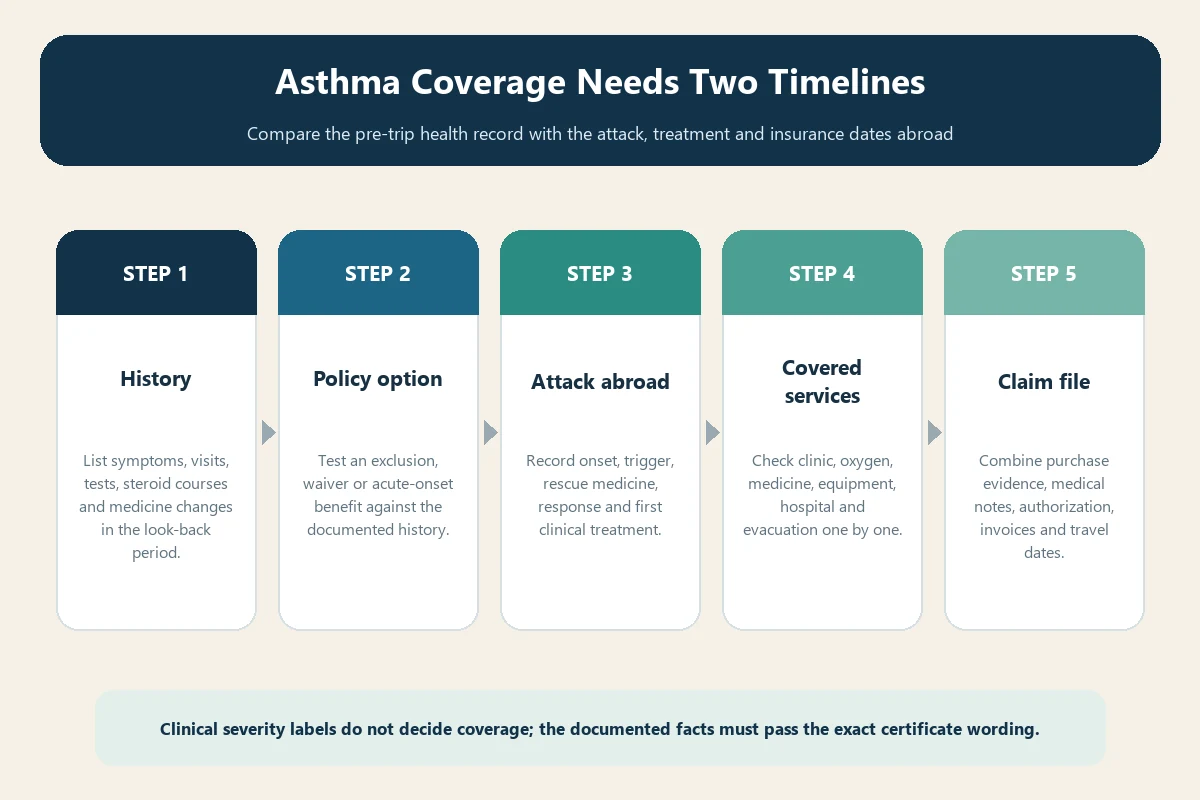
Travel medical insurance for asthma is decided by the issued certificate, the traveler’s pre-trip history and the event abroad. Asthma can be treated as a pre-existing condition, yet an eligible plan or waiver may cover some acute episodes. A mild label does not guarantee payment, and a severe label does not answer every policy question.
This guide is for U.S. travelers comparing coverage and preparing records. It does not replace an asthma action plan or advice from a clinician. Seek local emergency help for severe breathing difficulty, blue or gray lips, confusion, inability to speak normally, or symptoms that do not respond as the traveler’s clinician directed.
Key takeaways
- Build a dated history of symptoms, visits, tests and medication changes for the certificate’s look-back period.
- Test an attack as an event, then test each service: clinic, emergency department, medicine, hospitalization and evacuation.
- A pre-existing-condition waiver must satisfy every eligibility condition and may not override unrelated exclusions.
- Carry permitted controller and rescue medicine, original packaging, generic names, prescriptions and a clinician letter.
- Document the unexpected episode and medical necessity accurately; a trigger alone does not prove coverage.
Reviewed August 16, 2026. Insurance wording and health conditions change; verify the certificate and discuss fitness to travel with the treating professional.
Begin with two timelines
The medical timeline includes diagnosis, symptoms, urgent care, routine visits, pulmonary tests, steroid courses, hospitalizations and medicine changes. The insurance timeline includes quote date, initial trip payment, policy purchase, coverage start, departure, attack, first treatment and claim deadline.
Put them side by side. The pre-existing-condition look-back guide explains how a certificate can evaluate treatment, advice or symptoms within a stated window.
Do not use “mild” as an insurance conclusion
Clinical severity and contract eligibility are related but not identical. A traveler with infrequent symptoms may have received a recent prescription change. Another with persistent asthma may have had no change during the look-back period. The certificate definition, not a casual severity label, determines the contractual test.
Ask the clinician for accurate records, not a statement designed to fit coverage. Ask the insurer how its form treats the documented facts.
Search the full certificate for asthma-related terms
Search for pre-existing condition, chronic illness, respiratory, breathing, acute onset, medically necessary, emergency, prescription, nebulizer, durable medical equipment, oxygen, evacuation and return-home treatment. Review the schedule, definitions, covered expenses, exclusions and riders.
The travel medical benefits guide helps connect those sections. A broad emergency-medical heading can still be narrowed by a pre-existing-condition exclusion.
Define the attack as a specific event
Record when symptoms began, the suspected trigger, rescue medicine used, response, first call for help and first clinical treatment. Then list services separately. A physician visit, chest imaging, oxygen, nebulized treatment, prescription, ambulance and hospital admission can each face different limits.
A trigger such as smoke, infection, cold air or exertion does not by itself decide coverage. The plan will apply its sickness, pre-existing-condition, medical-necessity and exclusion terms to the whole episode.
Test the pre-existing-condition definition
Asthma diagnosed before purchase can fall within a pre-existing-condition clause, but the exact test varies. Some definitions look for care, advice, symptoms or treatment during a look-back period. Some include conditions a prudent person would have investigated.
Gather pharmacy and portal records because a refill, message or recommended test may matter. Do not omit inconvenient dates from an insurer question.
Evaluate a waiver line by line
A pre-existing-condition waiver may be valuable when the traveler meets purchase timing, trip-cost and fitness conditions. Confirm whether asthma-related emergency medical expenses are included after the exclusion is waived and whether medicine supply, routine care or travel against medical advice remain excluded.
The waiver eligibility checklist provides a dated evidence file. Save the issued form and the proof of when the first trip payment and policy purchase occurred.
Ask about acute-onset benefits carefully
Some travel medical plans offer a limited acute-onset benefit rather than a full waiver. The definition may require a sudden and unexpected recurrence, immediate care and a specific age or maximum limit. A stable-sounding condition does not automatically meet that definition.
Ask for the exact acute-onset clause and every linked exclusion. Compare physician care, ambulance, hospitalization and evacuation limits separately.
Build a medication-change record
List controller, rescue and other relevant medicines with generic names, doses and start dates. Record any recent increase, decrease, new inhaler, steroid course or stopped drug. Those changes can matter to medical readiness and the look-back test.
The prescription medication guide separates routine supply from a new drug prescribed for an eligible event abroad. Bring enough permitted medicine rather than expecting the policy to fund ordinary refills.
Prepare medicine and devices lawfully
Carry inhalers in original labeled packaging when permitted, copies of prescriptions and a clinician letter listing the condition and generic names. Check airline rules for nebulizers, batteries and liquids. Confirm destination and transit-country restrictions.
The U.S. Department of State medicine guidance recommends extra medicine for delays and checking each country’s restrictions. U.S. legality does not guarantee admission through foreign customs.
Use an asthma action plan for operations, not coverage
Ask the treating professional for an action plan that explains routine control, worsening symptoms and emergency steps. Share it with a travel companion when appropriate. Include clinician and emergency contacts, allergies and a current medication list.
The action plan guides care. It does not promise reimbursement. Keep the certificate and assistance-center instructions with it so the traveler can handle both needs under pressure.
Assess destination and itinerary triggers
Review air quality, smoke, dust, pollen, altitude, cold, heat, humidity, exertion and access to care. Build rest and medication access into the itinerary. A remote activity can turn an otherwise manageable episode into a transport problem.
The Asthma and Allergy Foundation of America’s traveling with asthma guidance recommends checking insurance, packing medicine and planning for triggers. Use destination-specific official air-quality and health sources near departure.
Confirm outpatient emergency and hospital coverage
Ask whether urgent care, physician evaluation, diagnostic testing, emergency medicine and hospital admission are eligible after the pre-existing-condition test. Check provider definitions, network rules, deductible, coinsurance and overall maximum.
The primary care coverage guide helps classify a lower-acuity visit. If symptoms become severe, seek appropriate emergency care rather than choosing a setting solely for insurance reasons.
Check equipment and oxygen terms
Nebulizer treatment at a facility, a purchased device, rented equipment and oxygen can fall under different clauses. Search for durable medical equipment, supplies and physician prescription requirements. Check whether ordinary equipment the traveler already owns is excluded from replacement.
Obtain an itemized invoice that separates professional services, medicines, device rental and supplies. A bundled receipt makes limits harder to apply.
Plan for evacuation from a remote destination
Medical evacuation generally requires insurer coordination and clinical necessity. Confirm whether a pre-existing respiratory episode can qualify, who selects the receiving facility and whether the benefit covers only the nearest adequate hospital or later transport home.
The medical evacuation limits guide shows why access rules matter alongside the maximum. Carry the assistance number offline where service may be unreliable.
Understand up-front payment
A clinic or hospital may demand a deposit or full payment. Ask whether the assistance center can arrange a guarantee of payment and what happens if direct billing fails. Keep a usable emergency payment method within the traveler’s means.
The CDC Yellow Book’s travel insurance guidance warns that travelers can be required to pay abroad and seek reimbursement. It also advises asking about authorization and pre-existing-condition coverage.
Document the episode without overstating the trigger
Ask the treating clinician for onset, symptoms, objective findings, diagnosis, treatment, response and follow-up instructions. Record suspected environmental exposure only as the clinician documents it. Insurance eligibility should not be inferred from a traveler’s guess.
Keep the original record, a translation if requested, itemized bills, pharmacy receipts and payment proof. Provide the overseas summary to the U.S. clinician after return.
Connect repeat care to the first attack
A second visit, steroid prescription or respiratory check can depend on the original episode and policy time window. Ask whether continuing treatment abroad or after return home is eligible, and whether it shares the same maximum.
The follow-up care guide provides a location-and-date timeline. Keep one incident identifier across all later submissions.
Prepare a claim package
Include the pre-trip policy evidence requested by the insurer, overseas clinical notes, itemized invoices, receipts, prescriptions, authorization references and proof of travel dates. If a waiver applies, attach purchase-timing and trip-cost evidence.
The claim documentation guide helps organize requests and deadlines. Answer medical-history questions accurately and let the insurer request records through proper channels.
Coordinate with existing health insurance
Ask the U.S. health plan what emergency care it covers abroad and whether it is primary. A travel policy may be secondary and require the domestic plan’s explanation of benefits. Neither assumption should wait until after a claim.
The health insurance abroad guide supplies a payer comparison. Include the cost of evacuation, which many domestic plans do not cover.
Use official chronic-illness guidance
CDC’s travel guidance for chronic illness includes asthma among conditions that need advance preparation. It advises confirming overseas insurance, carrying condition and medication information, and taking enough medicine plus extra for delays.
These health preparations reduce operational risk. They remain separate from the certificate’s reimbursement rules.
Run a realistic smoke-exposure scenario
Imagine a traveler with no recent urgent care but a controller dose change six weeks before purchase. Wildfire smoke at the destination leads to an emergency visit, nebulized treatment, a new prescription and one follow-up. Test the dose change under the look-back rule, any waiver, the acute event, each service, air-quality disruption, return date and claim proof.
The scenario exposes more than the question, “Is asthma covered?” It shows exactly which fact could change the outcome and which cost needs a backup plan.
Ask these questions before buying
- How does the certificate define a pre-existing condition for asthma?
- Do symptoms, refills, tests or medication changes count during the look-back period?
- Is a waiver or acute-onset benefit available, and what are its conditions?
- Are physician care, emergency medicine, oxygen, equipment and hospitalization eligible?
- Does respiratory evacuation have a separate rule or maximum?
- Which services require authorization or prompt notice?
- Can follow-up continue after return home?
- What medical-history and claim documents are required?
Make the final asthma coverage decision
Choose a plan only after a realistic attack scenario passes the definition, pre-existing-condition rule, waiver or acute-onset clause, service list, exclusions, authorization requirements and limits. Ask for written answers tied to the exact form.
The right preparation also includes medical clearance, enough lawful medicine, an action plan, trigger awareness, emergency contacts and a claim-ready record system. Insurance is one layer of that plan, not a substitute for it.
COPD travel planning must align respiratory stability, inhalers, oxygen, altitude, infection risk, destination care, and insurance. Use this senior COPD travel insurance guide to test pre-existing conditions, delays, cancellation, emergencies, ambulance, and evacuation.
