
Travel insurance for seniors planning COPD international travel must be reviewed against disease severity, recent exacerbations, hospitalization, infection, medication or oxygen changes, and the pre-existing-condition definition. Obtain clinical clearance for the flight, altitude, climate, cruise, and activity; protect inhaler and oxygen continuity; and identify destination respiratory care before comparing cancellation, emergency medical, interruption, and evacuation benefits.
This article is educational, not pulmonary, medical, oxygen, aviation, legal, or insurance advice. COPD severity and travel fitness vary. The pulmonology team, oxygen supplier, airline, manufacturer, and insurer must guide the exact plan. Never change inhalers, oxygen flow, or treatment based on general travel content.
Key takeaways
- Recent flare-ups, hospital care, steroid or antibiotic use, and oxygen changes can affect insurance eligibility.
- Cabin altitude and destination elevation require individual clinical assessment.
- Airline approval, device acceptance, and battery endurance are separate from insurance coverage.
- Routine inhalers and oxygen are expected care; an unexpected exacerbation is a different claim.
- Medical evacuation depends on local care, medical necessity, authorization, and the covered endpoint.
Reviewed: August 16, 2026.
Start with current respiratory stability
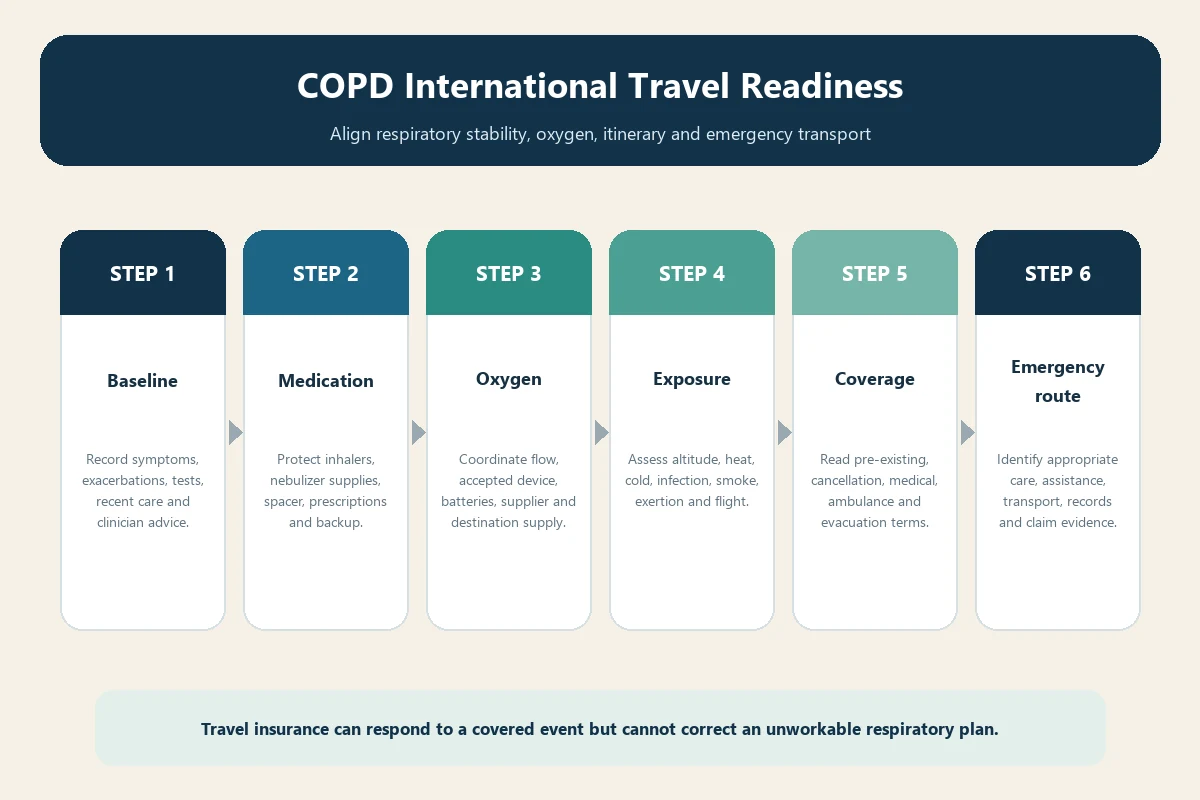
Ask the pulmonology team to review symptoms, baseline oxygen level, exercise tolerance, recent exacerbations, infection, emergency visits, hospitalization, steroid or antibiotic use, pulmonary rehabilitation, and comorbid heart disease. The clinician decides whether testing or supplemental oxygen is needed for the route.
A quiet week at home does not prove that a long airport walk, cabin altitude, heat, cold, humidity, or high-elevation destination is safe.
Build the COPD timeline
Record diagnoses, last exacerbation, hospital or urgent care, testing, medication start or change, oxygen prescription, flow change, rehabilitation, and clinician clearance. Add the trip’s initial payment, policy purchase, departure, and cancellation deadlines.
This timeline supports accurate application answers and pre-existing-condition analysis. A flare after policy purchase can be different from symptoms already present when the trip was insured.
Pre-existing-condition rules
COPD and its treatment are known before purchase. A policy can exclude connected losses unless a waiver applies. The look-back can include symptoms, testing, treatment, prescription changes, oxygen changes, and hospitalization.
A waiver removes an exclusion only for otherwise covered losses and can require timely purchase and medical ability to travel. Use the senior pre-existing-condition questions.
Cabin altitude and flight assessment
Commercial aircraft cabins are pressurized but not to sea-level conditions. The effect on an individual with COPD depends on respiratory status and other illness. The clinician should decide whether preflight testing, in-flight oxygen, or a different itinerary is needed.
Airline acceptance does not establish medical sufficiency. Conversely, a clinician’s prescription does not guarantee the airline accepts the device or arrangement.
Destination altitude, heat, cold, and pollution
High elevation, extreme temperature, smoke, dust, or air pollution can worsen symptoms for some travelers. Review the destination season, wildfire or pollution patterns, heating or air conditioning, and emergency access with the clinical team.
A destination advisory is not a personalized forecast. Build flexibility to reduce exposure or change activities.
Inhaler and medication continuity
Carry an adequate lawful supply of controller and rescue medicine, spacers, nebulizer supplies if prescribed, and a written action plan. Keep original labels, generic names, storage requirements, and prescriber contacts. The clinician should decide time-zone timing and response to worsening symptoms.
Medicare Part D generally does not cover prescriptions bought outside the United States. Use the chronic medication travel guide to plan refills and storage.
Nebulizers and power
A nebulizer may depend on voltage, plug, battery, compressor, medication, tubing, and cleaning. Confirm the exact device’s electrical specifications and airline rules. A plug adapter does not convert voltage.
Ask the supplier whether a travel unit, battery, or destination replacement is supported. Routine device use and supplies may not be travel-insurance benefits.
Portable oxygen
A traveler using oxygen needs an airline-accepted portable oxygen concentrator when applicable, enough approved batteries for the full journey and required reserve, and a destination supply and outage plan. Compressed or liquid oxygen follows different carrier restrictions.
Medicare’s domestic oxygen equipment benefit does not guarantee foreign supply or a second travel unit. Confirm the current supplier, Medicare Advantage network, airline, and destination vendor.
Accessibility and airport distance
Long terminals, standing, security, and tight connections can increase exertion. Request wheelchair or cart assistance even if the traveler normally walks independently. Verify connection support and ground transport.
The mobility-aid insurance guide helps document equipment. Assistance reduces exertion but is not medical monitoring.
Infection planning
Respiratory infections can trigger COPD exacerbations. Ask the clinician and travel-medicine provider about vaccines, masks, crowds, hand hygiene, destination disease, and what symptoms require testing or treatment. Vaccine timing and eligibility are individual.
Keep the action plan and identify qualified care. Do not self-start a prescription unless the clinician has given explicit instructions.
Original Medicare abroad
Original Medicare generally does not cover health care outside the United States except in narrow foreign hospital and cruise situations. A COPD flare during ordinary overseas travel usually requires another payer.
Medicare Advantage or eligible Medigap coverage may add limited foreign emergency benefits. Verify ambulance, emergency department, admission, oxygen, post-stabilization, and evacuation separately.
Travel medical coverage
An emergency medical benefit may cover eligible evaluation and treatment for an unexpected COPD exacerbation, subject to the pre-existing-condition clause, deductible, coinsurance, maximum, exclusions, and coordination. Routine inhalers, oxygen rental, or a planned clinic visit are different.
Ask how ambulance, nebulizer treatment, oxygen, imaging, admission, physician care, medicines, and follow-up are classified. Our travel medical insurance for asthma guide provides another airway-focused policy comparison without treating the conditions as identical.
Direct billing and appropriate facilities
A destination clinic may treat a mild problem but lack respiratory or intensive-care capability. Identify hospitals with oxygen, imaging, respiratory therapy, and critical care. Assistance may arrange a payment guarantee for an eligible event or only make a referral.
The direct-billing guide explains payment models. Keep respiratory records, itemized bills, proof of payment, imaging, medications, and discharge instructions.
Trip cancellation
Cancellation may apply when a covered change makes the traveler medically unable to depart. A flare, infection, hospitalization, oxygen change, or medication change can be evaluated under pre-existing-condition, waiver, and medical-ability rules.
Keep the clinical record, initial trip payment, policy purchase date, supplier refunds, and nonrefundable amount. A clinician’s advice is important but does not override an exclusion.
Trip delay
A delay can exhaust oxygen batteries, separate the traveler from inhalers, or create an inaccessible overnight stay. Delay coverage may reimburse eligible expenses after a trigger, but the respiratory continuity plan must work immediately.
Carry medicines and required batteries, save carrier notices and receipts, and contact the airline and assistance service.
Trip interruption
Interruption can address eligible unused arrangements and additional transport after a covered event. A medical return may require oxygen, wheelchair support, fit-to-fly clearance, an escort, or a different cabin class. These costs can fall under different benefits.
Medical evacuation
Evacuation may be authorized when local care is inadequate. The endpoint is often the nearest appropriate facility, not home. Oxygen, ventilation, medical crew, aircraft, ground ambulance, and receiving-facility acceptance affect the route.
Use the evacuation approval guide and fit-to-fly guide.
Five-scenario rehearsal
- Airport walk causes symptoms: follow the action plan and request assistance.
- Flight delayed: recalculate oxygen batteries and medication access.
- Destination air quality worsens: modify activity or location under clinical guidance.
- Unexpected exacerbation: seek qualified care and contact assistance.
- Local hospital lacks capability: coordinate authorized transfer to an appropriate center.
Document packet
- COPD diagnosis and baseline summary
- Recent exacerbation, hospital, and treatment timeline
- Inhaler, medicine, allergy, and action plan
- Oxygen prescription, device, battery, and supplier records
- Pulmonology and pharmacy contacts
- Airline approval and accessibility confirmations
- Destination hospitals and oxygen supplier contacts
- Travel policy and Medicare-related documents
- Trip deposits, refunds, and claim evidence
Separate three COPD-related loss types
Expected care: ordinary inhalers, prescribed oxygen, routine monitoring, and planned appointments belong in the trip budget and continuity plan. Unexpected medical loss: an eligible acute exacerbation, infection, injury, ambulance, or admission is evaluated under the emergency medical benefit and pre-existing-condition rules. Travel loss: a cancelled departure, unused arrangements, extra hotel, or changed flight is evaluated under cancellation, delay, or interruption provisions.
The same respiratory episode can generate all three records, but payment is not automatic. Ask the clinician to document the medical event and inability to travel, ask suppliers for refunds, and keep the carrier’s change evidence. Submit each expense under the provision that matches it rather than combining oxygen, hospital, and trip costs into one unsupported total. This separation also helps identify a gap before purchase: a policy can provide emergency medical coverage while offering little for a companion, equipment failure, or a medically supported return.
Questions for the insurer
- How do COPD, recent symptoms, treatment, and oxygen fit the pre-existing-condition definition?
- Is a waiver available and valid?
- What medical-ability condition applies?
- Would an exacerbation be eligible?
- Are routine oxygen and inhalers excluded?
- Can assistance guarantee payment?
- What delay benefit can respond to oxygen-related expenses?
- What cancellation and interruption documentation is required?
- What evacuation endpoint and authorization apply?
- Which records and deadlines control the claim?
FAQ
Can a senior with COPD buy travel insurance?
Often, yes, but availability and coverage depend on severity, recent care, oxygen, age, destination, and policy terms.
Must COPD be disclosed?
Answer the application’s health questions accurately, including symptoms, medicine, oxygen, testing, and hospitalization when asked.
Does insurance pay for routine oxygen abroad?
Do not assume so. Routine oxygen is expected care, while travel medical benefits generally focus on unexpected covered emergencies.
Will evacuation fly the traveler home?
Not necessarily. Many policies cover the nearest appropriate facility and require medical necessity and authorization.
Bottom line
Travel insurance for COPD works only after the respiratory plan is ready. Confirm clinical stability, altitude, inhalers, oxygen, power, accessibility, and destination care. Then test pre-existing-condition, delay, cancellation, emergency, interruption, and evacuation provisions against specific scenarios.
Sources
- COPD Foundation — Traveling With COPD
- American Lung Association — Traveling With COPD
- CDC Yellow Book — Travelers With Chronic Illnesses
- Medicare — Oxygen Equipment and Accessories
- U.S. Department of Transportation — Passengers With Disabilities
- U.S. Department of State — Insurance Coverage Overseas