

Travel insurance for Poland from USA trips should be compared against advance medical payment, long-distance rail contracts, rural access and winter-road conditions. A Warsaw–Kraków trip on one ticket differs from a chain of regional trains, a mountain rental car and separately booked lodging. Build the policy around the route.
Key takeaways
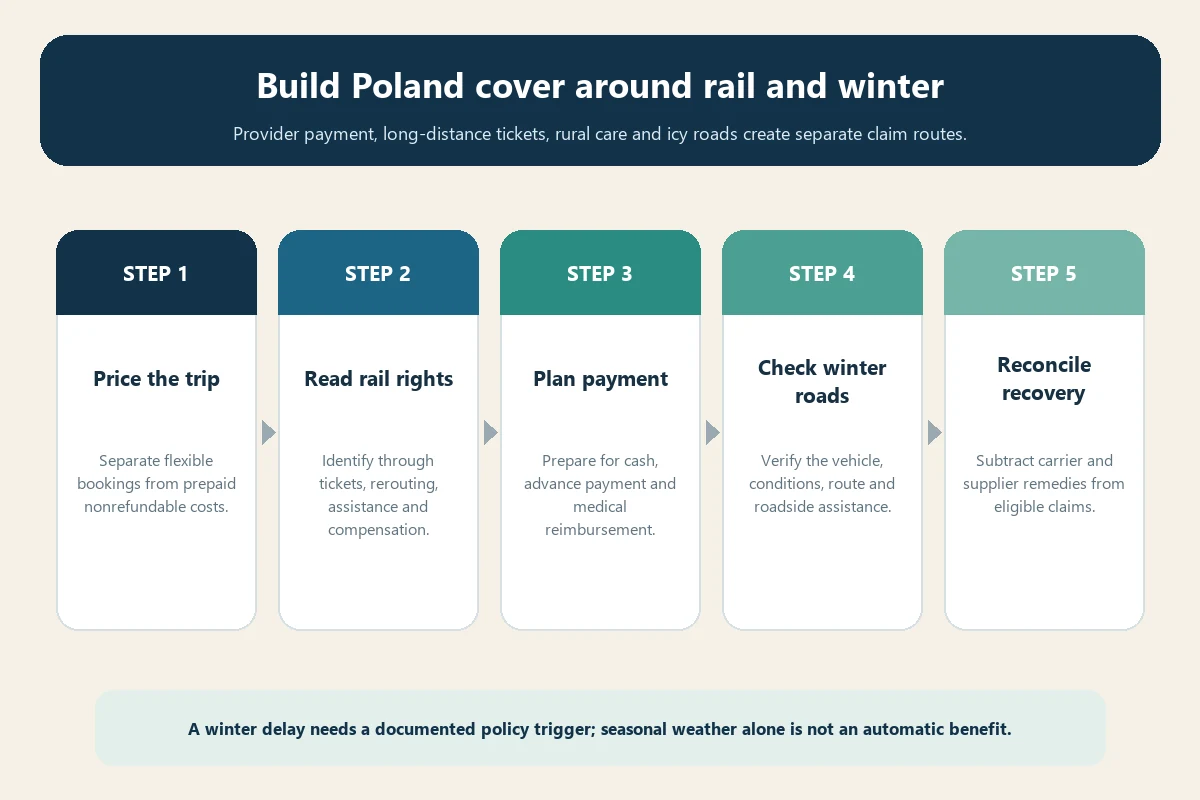
- Prepare for providers to request cash, advance payment or insurance proof before treatment.
- Keep each rail ticket and identify whether connections form one contract or separate journeys.
- Use railway rerouting, assistance and compensation before claiming eligible residual costs.
- Check live winter-road conditions and the actual rental vehicle before leaving the depot.
- Increase medical-transport scrutiny for small-town, rural or mountain stays.
Planning information reviewed August 16, 2026. Entry procedures, rail rules, road conditions, provider practices and policy terms can change. Confirm current facts for the trip.
Build a Poland route and cost ledger
List the U.S. flights, arrival airport, every train, hotel, rental car, tour and return connection. Add the seller and operator for each. Record cancellation terms and the amount that would remain after a refund or credit.
Next, mark high-consequence joins. Examples include a separate train to an international flight, a last evening service to a rural hotel or a rental return before a reserved train. The policy must address the cause and the resulting eligible loss; a complicated itinerary alone is not insured.
If Poland is part of a route through Germany, Czechia, Slovakia or Lithuania, use the multi-country Europe insurance guide to check every territory and travel date.
Entry status does not describe the benefits
Many U.S. citizens visit Poland for short tourism under current Schengen arrangements without applying for a traditional visa. Other passports, purposes or long stays can require formal documentation. Verify the traveler’s complete circumstances.
An insurance certificate used for an entry process does not show rail missed-connection rules, rental-car exclusions or every medical condition. The full contract controls. The Schengen insurance requirements guide separates compliance evidence from usable protection.
Plan for advance medical payment
The U.S. Department of State’s official Poland travel information says doctors and hospitals often expect cash before treatment. It notes that private hospitals usually require advance payment or proof of adequate insurance, and patients bear transfer costs.
Ask the existing U.S. health plan whether care in Poland is covered, which network rules apply and what must be filed first. Ask the travel insurer whether its medical benefit is primary or secondary and whether assistance can arrange a provider or guarantee payment.
Carry more than one practical payment method. Obtain the diagnosis, clinician report, itemized invoice, prescription and proof of payment. The primary medical coverage guide explains reimbursement order and coordination.
Rural stays change the medical-transport test
The State Department says emergency services may be lacking in small towns and rural areas. Poland uses 112 for emergencies and ambulance service is widely available, but a local response is not the same as an insurer-authorized hospital transfer or evacuation.
Read who determines medical necessity, which facility is considered suitable and when advance approval applies. Ask whether ground ambulance, transfer between hospitals, air ambulance and repatriation share a limit. Check whether non-medical search and rescue is excluded.
The evacuation and repatriation guide provides questions for each transport stage.
Classify every rail connection
Write whether each journey is domestic or international, reserved or flexible, and sold as one continuous contract or separate tickets. Save the conditions that applied at purchase. A booking folder containing several PDFs does not prove the carriers accepted responsibility for the whole chain.
For a self-transfer, calculate platform changes, station transfers and the next available service. Leave a defensible buffer. Missed-connection insurance can require a listed common-carrier cause, a minimum connection and a specified delay.
The Europe train travel insurance guide provides a ticket-structure worksheet.
Use Polish rail passenger remedies first
Poland’s Railway Passenger Rights Ombudsman publishes official passenger-rights information. It explains rights to information, assistance and compensation under current EU rail rules. Its compensation page describes options when a delay exceeds 60 minutes, subject to the applicable journey.
Ask the operator for the official cause, expected arrival and rerouting offered. Obtain delay confirmation when available. Before buying an expensive replacement, document whether the carrier had an opportunity to help and whether self-rerouting was allowed.
The EU’s official rail passenger-rights overview explains reimbursement, rerouting, assistance and exceptions across member states. A carrier remedy reduces the net loss submitted to insurance.
Put rail disruption on the correct timeline
| Fact pattern | First contract to check | Possible policy benefit |
|---|---|---|
| Train canceled before boarding | Rail refund or rerouting | Delay expenses left unrecovered |
| Through connection missed | Continuous-ticket protection | Eligible residual lodging or meals |
| Separate flight missed | Airline fare conditions | Missed connection only if wording fits |
| Illness ends trip early | Provider and assistance | Interruption and authorized return |
| Weather changes plans voluntarily | Flexible booking terms | No automatic insurance trigger |
Do not submit the same rail fare after accepting a full refund. Keep the refund decision, travel credit terms and proof of any cost that remained.
Check winter conditions before driving
Poland’s General Directorate for National Roads and Motorways publishes official winter travel preparation. Its guidance recommends checking current road information, preparing tires, brakes, wipers, battery and winter washer fluid, and recognizing that cleared roads can remain wet or icy.
At rental pickup, photograph the vehicle, tires, glass and existing damage. Confirm roadside assistance, towing, replacement-vehicle rules and permission for every country. Ask about chains where relevant and avoid assuming a rental category guarantees particular equipment.
Winter preparation reduces risk but does not create a covered reason. The Europe road-trip insurance guide separates rental damage, liability, breakdown and traveler injury.
Keep four road protections separate
A collision waiver may cover damage to the rented vehicle but exclude tires, glass, undercarriage or misuse. Third-party liability responds to harm caused to others. Roadside assistance can cover mechanical failure but not necessarily driver error. Travel medical insurance addresses the injured traveler under its own exclusions.
Credit-card rental protection can require payment with the eligible card, rejection of a waiver and compliance with country or vehicle restrictions. Request the current benefit guide, not a marketing statement.
Winter activities require exact names
List downhill skiing, cross-country skiing, snowboarding, skating, sledding, hiking and any guided mountain activity. Check whether the policy requires a sports rider and whether marked pistes, guides, helmets, racing or off-piste travel are conditions.
Medical treatment, slope rescue, equipment loss and liability can be separate. The winter-sports exclusions guide shows how to audit the exact activity.
Weather delay must meet a policy trigger
Snow, ice and low temperatures are foreseeable parts of a Polish winter. Insurance usually requires an official closure, common-carrier disruption, documented accident or other defined event. A personal decision not to drive may be handled differently.
Save current road advisories, carrier notices, scheduled and actual times and all receipts. A general weather screenshot without the route or timestamp may not prove the cause of loss. Contact assistance before costly alternatives when safe and practical.
Buying after a named storm or disruption becomes known may trigger a foreseeable-event exclusion. Purchase timing matters.
Compare Poland plans with a route worksheet
- all dates, transit countries, rural stays and separately ticketed joins;
- medical maximum, deductible, provider payment and benefit order;
- ambulance, hospital transfer, evacuation and repatriation;
- rail through-ticket protection, delay rights and rerouting;
- missed-connection causes, thresholds and onward transport;
- rental damage, liability, roadside service and winter equipment;
- winter activity, rescue and equipment exclusions;
- claim notice, records, deadlines and appeal process.
Read the complete contract issued for the purchaser’s U.S. state. Check territorial and advisory clauses using the Europe country-exclusions guide.
Document a Poland claim in real time
For medical care, collect the clinical record and proof of payment. For rail disruption, keep the ticket, official cause, delay confirmation, alternatives and refund outcome. For a road incident, preserve photos, police or rental reports, towing records and the final damage statement.
Open an assistance case and record the instructions. Disclose carrier compensation, supplier refunds and card benefits. Claim only eligible unrecovered costs. The claim-filing guide provides a chronological evidence structure.
Frequently asked questions
Is travel insurance required for every U.S. tourist in Poland?
No single private-policy rule applies identically to every short U.S. tourist. Passport, visa status, purpose and duration determine formal requirements. Verify current official entry guidance.
Will a Polish hospital accept a U.S. insurance card?
Do not assume it will. Providers can request cash, advance payment or proof of adequate insurance. Ask assistance about guarantees and preserve full reimbursement records.
Does rail compensation prevent an insurance claim?
Not necessarily, but duplicate recovery is not allowed. Apply the carrier remedy first and claim only eligible net loss that remains.
Are winter tires covered by travel insurance?
Vehicle equipment is primarily a rental and road-safety issue. Insurance can exclude damage linked to prohibited use or inadequate equipment. Verify the actual car.
Will a voluntary stop because of snow be covered?
Not automatically. The contract needs a qualifying trigger and eligible expense. Official closure or carrier cancellation can be treated differently from personal preference.
This article is educational and is not legal, medical or insurance advice. Official authorities, providers, carriers and the issued policy control.
