
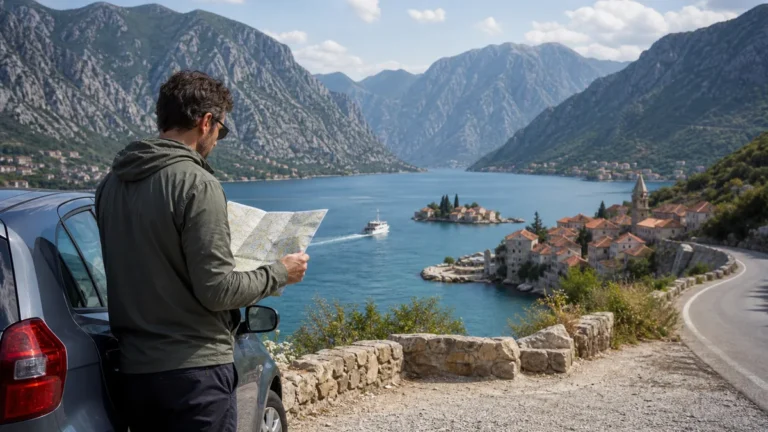
Travel insurance for Montenegro from USA trips should follow the route from the Bay of Kotor to the mountains and across every Balkan border. A public ferry, private boat tour, Durmitor hike and rental drive through a canyon can involve different contracts, providers and rescue decisions. The useful policy is the one that answers those distinctions in writing.
Key takeaways
- Prepare for cash medical payment and limited rural health capacity.
- Separate boat-operator responsibility from travel delay and medical coverage.
- Name hiking, rafting, climbing, diving and other adventure services exactly.
- Verify summer congestion, winter mountain roads and rental-car borders.
- Keep operator permits, official notices, reports, bills and refund records.
Planning information reviewed August 16, 2026. Entry rules, marine services, mountain conditions, medical practices, roads and insurance contracts change. Verify current official sources for the exact season and route.
Split the trip into bay, mountain and border legs
List the arrival airport, coastal lodging, Bay of Kotor boat, car rental, canyon route, northern mountain stay and return connection. Add Croatia, Bosnia and Herzegovina, Albania or Serbia when applicable. Record whether each booking is refundable and the date its penalty begins.
Montenegro’s government currently lists the United States among countries whose citizens may enter for up to 90 days with a valid travel document without a visa. Review the official Montenegro visa page again for the passport and travel date. Visa-free entry does not make the country part of Schengen or prove insurance coverage.
For a multi-border itinerary, apply the multi-country Europe insurance guide to every night, crossing and transit airport.
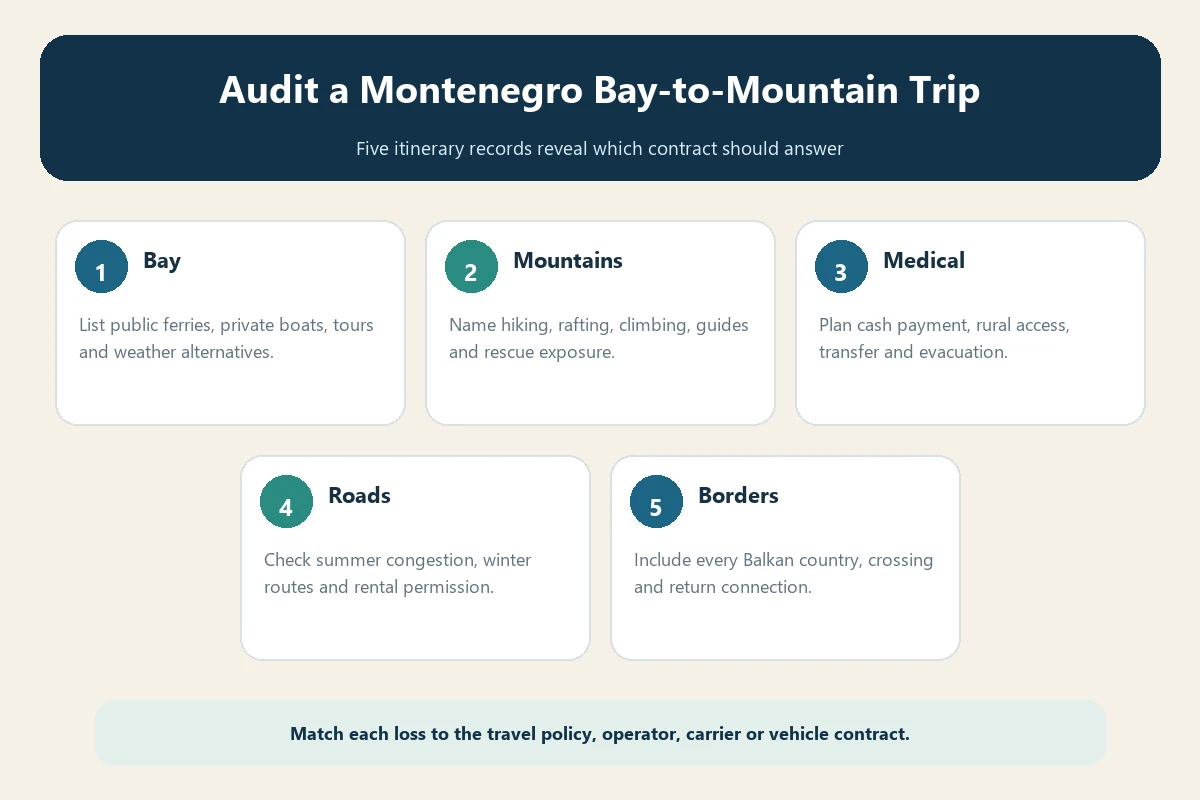
Plan for medical payment before the bay tour
The U.S. Department of State’s official Montenegro country information says adequate care is available in Podgorica and other cities but rural care may fall below U.S. standards. It notes that hospitals and private clinics may require cash and that few accept credit cards.
Ask the insurer which facilities its assistance team can contact, whether direct billing is realistic and how reimbursement works. Carry reasonable payment capacity and request an itemized bill, diagnosis, treatment notes and proof of payment before leaving a facility.
The primary medical coverage guide explains why first-payer wording does not guarantee that a Montenegrin provider accepts the policy at the desk.
Design the transfer chain for rural areas
The State Department describes ambulance availability as limited and says emergency services generally respond only in the most severe cases; otherwise, travelers may need to arrange transport to a hospital or clinic. It strongly recommends medical-evacuation coverage.
Ask what happens if the nearest facility cannot provide the required specialty. Identify who authorizes ground transfer, who selects the receiving hospital, when movement outside Montenegro becomes medical evacuation and how repatriation to the United States is decided.
Dial 112 for emergency coordination. Local ambulance is 124. Montenegro’s government describes 112 as a 24-hour service that coordinates emergency medical, fire-rescue, police and specialist response in its official emergency-number overview. Follow current instructions and protect life first.
The evacuation and repatriation guide separates these transport decisions and their documentation.
Classify the Bay of Kotor vessel
A public car ferry, scheduled passenger vessel, private speedboat, sailing charter and guided excursion are not automatically treated alike. Identify the operator, vessel type, ticket terms, passenger status and whether the traveler will operate anything.
Ask whether the policy’s common-carrier definition includes the service. Find the weather-delay threshold, missed-connection clause and exclusion for private or noncommercial vessels. If the operator cancels, obtain the written cause, alternative and refund statement.
The Europe ferry insurance guide provides a document checklist for ports, public ferries and private excursions.
Check operator credentials and user insurance
Montenegro regulates certain tourism activities. The government’s official tourism license and permit page says rafting providers must submit evidence that includes a qualified boat or raft leader, navigation and safety documents, third-party liability insurance and insurance for service users.
That operator insurance does not automatically replace the traveler’s medical, cancellation or evacuation plan. Ask what the operator policy covers, who is insured, what deductible applies and which insurer responds first. Keep the permit details, booking description, waiver and incident report.
Name every mountain and water activity
| Activity | Policy question | Evidence |
|---|---|---|
| Marked-trail hiking | What altitude, route and seasonal limits apply? | Trail, forecast and closure check |
| Rafting | Are river grade, operator and guide conditions satisfied? | Permit, booking and safety briefing |
| Climbing or canyoning | Is technical equipment or rope use excluded? | Route, grade and guide credentials |
| Recreational diving | What depth, certification and equipment limits apply? | Certification, log and operator report |
| Private boat operation | Is operating a vessel excluded from the travel policy? | Charter contract and required license |
Search and rescue may have a separate sublimit even when the activity is covered. Use the adventure-activity exclusion guide to demand exact-name answers.
Audit canyon and mountain roads
The State Department says rural roads do not meet U.S. standards and coastal roads become congested in summer. It specifically warns about the twisting Morača Canyon route, rockslides, snow and winter hazards in northern Montenegro.
Confirm the rental company’s permitted countries and roads, driver documents, winter equipment, roadside territory, towing and replacement-car procedure. Photograph the vehicle and supplied equipment at pickup. Travel insurance does not replace motor liability, collision coverage or the rental agreement.
The Europe road-trip guide separates medical, vehicle, roadside and trip-interruption expenses.
Protect connections from summer congestion
Do not schedule a tight flight after a peak-season drive around the bay. Note the last practical ferry or road alternative and build a buffer around border crossings. A predictable traffic jam is not automatically a covered delay.
Find the minimum delay, named causes, daily amount and reasonable-alternative requirement. If a carrier or operator refunds the ticket, calculate only the eligible remainder. The delay, interruption and cancellation guide helps assign each expense correctly.
Map rental-car borders in writing
Get written cross-border permission before leaving Montenegro. Verify locally valid liability documents, roadside assistance, prohibited regions and the vehicle return requirement for Croatia, Bosnia and Herzegovina, Serbia, Kosovo or Albania as applicable.
Do not infer that a “Europe” policy includes every Balkan territory or that a car document expands travel coverage. Use the country-exclusions guide for the travel policy and the rental agreement for the vehicle.
Compare with a bay-to-mountain scenario
Give every insurer one complete test: U.S. flights, Kotor lodging, a passenger boat excursion, rental travel through Morača Canyon, a Durmitor hike and a border crossing into Croatia. Add a weather cancellation and a rural medical transfer.
- Are every country, border, bay service and date covered?
- Can the assistance team arrange provider payment?
- Who authorizes rural transfer, evacuation and repatriation?
- Does the vessel qualify as a common carrier?
- Are the exact mountain and water activities covered?
- Which rental, towing and vehicle losses are excluded?
- What evidence and notice deadline apply?
Require policy page references. A representative’s broad assurance cannot resolve an exclusion or operator condition that appears in the issued contract.
Keep a cross-contract incident file
Store the travel policy, assistance number, rental contract, motor insurance, vessel booking, activity documents and route offline. During an event, record coordinates, official warnings, operator instructions, assistance calls and provider decisions.
Collect the medical diagnosis, itemized bill, payment proof, police or rescue report, carrier notice, refund statement and replacement booking. The claim filing guide turns the records into a single chronology while keeping expenses assigned to the correct contract.
Build seasonal decision points
Montenegro’s practical risks change with the calendar. In summer, congestion around the bay, limited parking and busy border crossings can threaten a tight connection. In winter, snow, ice and rockfall can change the northern road plan. Shoulder seasons may bring reduced boat schedules or tours that operate only with enough passengers. Put a decision time beside each exposed leg: the hour to abandon a coastal circuit, take the tunnel or road alternative, or replace a mountain night.
Ask suppliers what happens when they cancel for weather, low participation or an unavailable vessel. Record whether they refund, reschedule or issue credit, because insurance normally evaluates the remaining loss after supplier remedies. For a boat or rafting trip, keep the final operating notice and the name of the contracting company. For a rental drive, preserve the official road warning, the rental company’s instruction and the safe alternative chosen.
Recheck the itinerary at booking, before cancellation penalties begin and 48 hours before each exposed segment. If a forecast or warning exists before a new purchase, ask how the policy defines a foreseeable event. Do not rely on a screenshot without its date and issuing authority.
A seasonal decision plan protects more than a claim. It reduces rushed driving, makes supplier choices comparable and shows exactly why a traveler changed course. Insurance can then be evaluated against a documented event rather than an improvised itinerary with no clear trigger.
Bottom line
The strongest Montenegro plan connects bay travel, mountain activity, rural medical access, canyon roads and borders. Test the real operators and locations, not just the country name. When each loss has a contract, authorization path and evidence requirement, the itinerary becomes far more claim-ready.
