
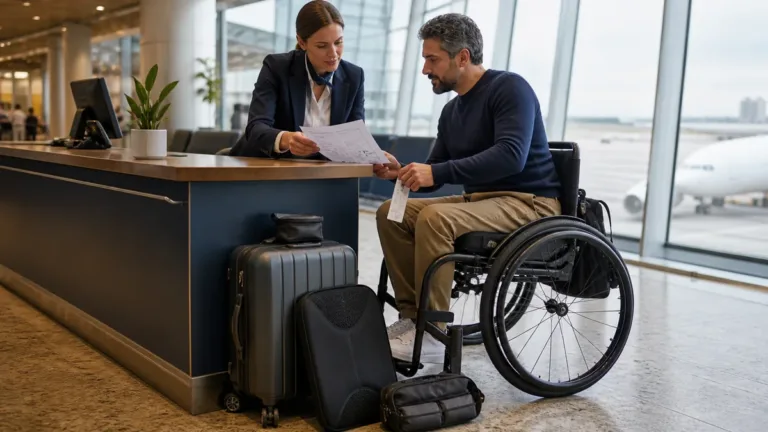
Travel medical insurance for mobility aids is not one automatic wheelchair benefit. A damaged power chair can involve airline liability, a baggage or equipment limit, temporary rental, repair costs and medical treatment caused by loss of mobility. Each path uses different definitions, limits and evidence.
This guide helps U.S. travelers compare certificates and organize a claim. It does not determine whether a device is safe to fly, prescribe mobility equipment or replace an individualized accessibility plan.
Key takeaways
- Separate airline responsibility, property coverage and medical coverage before comparing limits.
- Document the device, accessories, batteries, serial number, condition and original price before departure.
- Confirm repair, replacement and temporary-rental language instead of assuming a baggage benefit covers all three.
- Plan gate handling, battery instructions, local service and accessible transport with the airline and destination providers.
- Preserve reports, photographs, receipts, estimates and medical records for every possible payer.
Reviewed August 16, 2026. Airline rules and policy wording vary by itinerary, jurisdiction and certificate; verify current requirements before travel.
Start with five possible payment paths
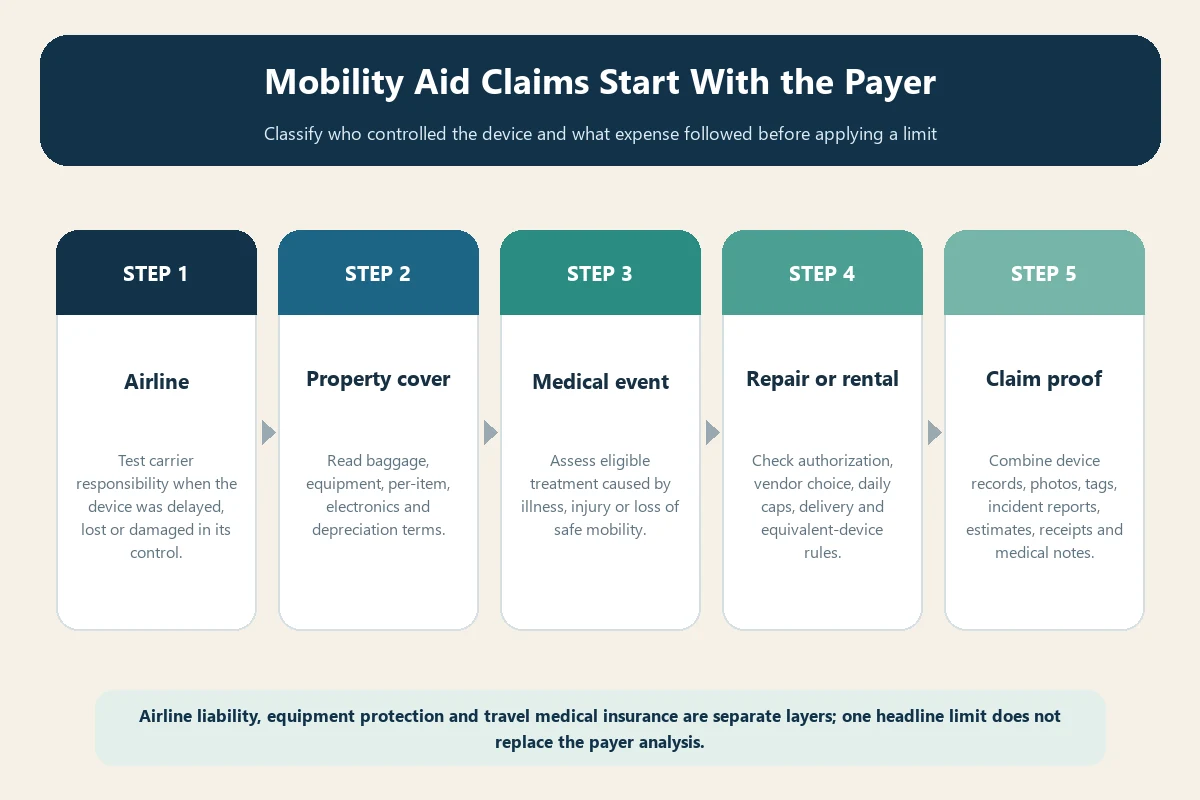
First classify the expense. Airline liability can address damage or delay while the carrier controls the device. A baggage or personal-property benefit may address a covered loss. A dedicated mobility-equipment benefit may add repair or rental. A medical benefit may address an eligible illness or injury. Separate equipment insurance or a homeowner policy may also apply.
Do not submit the same expense as though every path pays independently. Ask each payer about coordination, required first claims and proof of other reimbursement.
Travel medical coverage is not equipment insurance
Travel medical benefits generally focus on eligible treatment for an unexpected illness or injury. The chair, scooter, walker or other device is property, even when it is medically essential. Loss of the device can create a medical need without converting its full replacement cost into a medical expense.
Use the travel medical insurance benefits guide to map clinical services. Then find the separate baggage, assistive-device or equipment section for the property itself.
Create a device profile before requesting quotes
Record the make, model, serial number, dimensions, weight, original purchase price, current replacement estimate and customization. List every detachable controller, cushion, charger, battery, joystick, headrest and support. Photograph the assembled device and each accessory.
For a power device, identify battery chemistry and removal instructions. Keep the manufacturer manual or a concise handling sheet without exposing unnecessary health information.
Read the definition of an assistive device
A policy might use “baggage,” “personal effects,” “medical equipment,” “mobility aid” or “assistive device.” These terms can produce different item limits and exclusions. Confirm whether a customized wheelchair, rented scooter, walking frame or removable electronic controller fits the definition.
Search the full certificate for wheelchair, scooter, medical equipment, assistive device, prosthetic, baggage, valuable, electronic, fragile, wear and tear, mechanical breakdown and unattended property.
Check airline rights before relying on insurance
The U.S. Department of Transportation’s Airline Passengers with Disabilities Bill of Rights says assistive devices may be carried free of charge consistent with safety rules and do not count against the normal carry-on limit. It also explains priority stowage and carrier responsibility for lost or damaged devices.
The applicable Air Carrier Access Act protections cover flights of U.S. airlines and flights to or from the United States by foreign airlines. Other routes can follow different national rules.
Domestic and international airline liability can differ
DOT’s current assistive-device damage guidance distinguishes domestic and international flights. Domestic liability can reach the original purchase price when the airline is responsible, while an international treaty may impose a lower limit.
That difference makes itinerary analysis essential. Ask the airline which liability regime applies to each segment and how it handles a through-checked device across partner carriers.
Do not treat airline liability as guaranteed payment
Report damage or delay immediately and request a written incident report. Carrier responsibility still depends on facts such as when the damage occurred and whether it was pre-existing. Photograph the device before surrender and after return.
If the airport response is unresolved, request the airline’s Complaint Resolution Official. Keep names, times, baggage tags and every written communication.
Test baggage coverage at the item level
Read the overall baggage maximum, per-item maximum and special sublimit. A high total limit can still leave an expensive mobility device underinsured. Determine whether the benefit pays replacement cost, actual cash value or repair up to the lesser amount.
The travel medical sublimits guide shows why the smallest applicable cap controls. Also test exclusions for fragile equipment, electronics, mechanical breakdown and ordinary wear.
Separate loss, damage, breakdown and delay
These are different events. Theft may require a police report. Accidental damage may require evidence of a covered cause. Mechanical or electrical breakdown can be excluded. Delay can pay only necessary interim expenses after a stated waiting period.
The baggage delay and lost luggage guide helps distinguish temporary purchases from a final loss settlement.
Confirm repair and temporary-rental benefits separately
A certificate that mentions replacement may say nothing about urgent repair. A rental benefit can have a daily cap, total cap, waiting period or prior-approval rule. Ask whether accessible delivery, setup and collection charges are included.
Confirm whether the insurer chooses the vendor and whether an equivalent customized device is available. A generic chair that does not meet documented needs may not be a practical substitute, but the policy’s definition still controls reimbursement.
Plan for batteries and chargers
Battery rules come from aviation safety requirements as well as airline procedures. Give the airline the correct battery type and device dimensions before travel. Protect terminals and pack detachable components as instructed.
The State Department’s accessibility guidance recommends checking rules for equipment and batteries, destination voltage, outlet type and electrical reliability. Insurance does not make an unsafe battery configuration acceptable for transport.
Use gate-check documentation as evidence
Ask to retain the device to the aircraft door when the itinerary permits. Obtain the gate-check receipt and attach handling instructions. Remove loose accessories and carry critical controllers or cushions in the cabin when allowed and safe.
Confirm where the device will be returned during connections and on arrival. A delay at an intermediate airport can require a different response from final loss.
Map repair and rental options at the destination
Identify providers that service the exact brand or device type. Record opening hours, emergency contact details, accessible transport and expected deposits. Do not assume parts, tires, tubes, chargers or customized seating are locally available.
The State Department advises researching wheelchair and medical-equipment providers and repair services before departure. Keep a realistic backup plan for weekends and remote locations.
Separate a medical consequence from the equipment claim
If device failure contributes to a fall, pressure injury or other medical problem, seek appropriate care. The medical claim requires clinical records showing what happened, diagnosis and treatment. The equipment claim requires proof of loss, ownership and value.
Do not assume the medical event is covered merely because the device is medically necessary. Apply pre-existing-condition, accident, medical-necessity and exclusion language to the treatment independently.
Check pre-existing-condition language
The need for a mobility aid can relate to a documented condition, but property damage is not automatically treatment of that condition. Conversely, later medical care may be connected to it. Build a clear timeline rather than relying on a label.
The pre-existing-condition look-back guide helps test symptoms, advice, treatment and medicine changes against the certificate.
Review accessible local transport and evacuation
A broken device can make ordinary ground transportation unusable. Check whether an equipment-rental benefit covers delivery and whether a travel-delay or interruption benefit recognizes accessible transport costs. These expenses are not automatically medical evacuation.
The medical evacuation guide explains the separate requirements for clinical necessity, plan authorization and an appropriate receiving facility.
Compare deductibles and payer order
A property benefit and medical benefit can use different deductibles. Airline reimbursement, other insurance or a manufacturer remedy may be applied before the travel insurer pays. Ask for the coordination rule in writing.
Use the travel medical deductible guide to identify whether the amount applies per person, policy, trip, incident or certificate period.
Build a claim file for each expense
Keep the policy, declarations, proof of purchase, device profile, pre-trip photographs, baggage tags, gate-check receipt, incident report, repair estimate, rental invoice, police report when applicable and carrier decision. For medical care, add clinical notes and itemized bills.
The travel insurance claim documentation guide provides a record checklist. Never alter an estimate or combine unrelated expenses under one receipt.
Use a scenario matrix before buying
| Scenario | First path to test | Key evidence |
|---|---|---|
| Airline damages a power chair | Airline assistive-device claim | Condition photos, tag, report, estimate |
| Chair is stolen from lodging | Property or baggage benefit | Police report, ownership, valuation |
| Controller fails without an accident | Warranty or breakdown cover | Technician diagnosis and terms |
| Temporary chair is needed | Rental or interim-expense benefit | Delay or damage report and invoice |
| Traveler is injured after device failure | Medical benefit plus equipment path | Clinical record and device evidence |
Questions to ask before purchase
- Is my exact device an assistive device, baggage item or excluded medical equipment?
- What are the per-item, baggage and dedicated equipment limits?
- Are accidental damage, theft, delay, repair and temporary rental each covered?
- Does the plan pay replacement cost or depreciated value?
- Which airline or other-insurance decision is required first?
- Does rental include accessible delivery and setup?
- What notice, authorization and documentation deadlines apply?
Bottom line
Travel medical insurance for mobility aids works only when the traveler separates property, airline and clinical events. Compare the issued certificate against the actual device, itinerary and likely expenses, then prepare evidence for every payer before departure.
A useful plan is not the one with the largest headline number. It is the one whose definitions, item limits, repair path, rental terms, medical benefits and assistance process match the traveler’s documented needs.
A wheelchair or scooter loss can involve airline liability, travel-policy sublimits, equipment insurance and an urgent temporary rental. Use the senior mobility-equipment travel insurance recovery stack to document the device, protect the handoff, restore function and prove the remaining claim.
Portable oxygen travel requires five aligned layers: clinical clearance, accepted equipment, power, destination supply, and insurance. Use this senior portable oxygen travel insurance guide to verify airline rules, Medicare DME limits, delay, damage, and medical emergencies.
A CPAP trip plan must protect therapy, power, accessories, and the device before insurance can protect a covered loss. Use this senior CPAP travel insurance guide to verify Medicare DME rules, airline handling, batteries, water, delay, damage, and replacement.
Ostomy supplies are expected care, while an unexpected complication, baggage loss, and trip interruption follow different insurance rules. Use this senior ostomy travel insurance guide to plan supplies, screening, delays, Medicare coverage, emergencies, and claims.
Parkinson’s travel planning must align medication timing, mobility, communication, rest, assistance, and insurance. Use this senior Parkinson’s travel insurance guide to test pre-existing-condition rules, delay, cancellation, emergencies, companion needs, and evacuation.
Osteoporosis travel planning must separate the diagnosis, prior fractures, current mobility, recent surgery, fall prevention, and insurance. Use this senior osteoporosis travel insurance guide to test pre-existing conditions, cancellation, fracture care, interruption, and evacuation.
Accessible travel requires usable documents, navigation support, assistive tools, and a disruption plan before insurance can reimburse a covered loss. Use this blind and low-vision senior travel insurance guide to verify assistance, equipment, companions, medical care, and claims.
