
A senior with osteoporosis can often obtain travel insurance, but the insurer may evaluate the diagnosis, prior fragility fractures, recent pain or falls, surgery, rehabilitation, medication changes, and mobility under the pre-existing-condition rules. Clinical clearance and a fall-aware itinerary come first. Then compare emergency medical, cancellation, interruption, equipment, and evacuation benefits for both a new fracture and unrelated events.
This article is educational, not orthopedic, bone-health, rehabilitation, legal, aviation, or insurance advice. Fracture risk, activity, lifting, medication, mobility, and travel fitness require the treating clinician and therapist. New pain after a fall or injury requires appropriate medical evaluation.
Key takeaways
- Document fracture, fall, surgery, pain, rehabilitation, and medication timelines before comparing policies.
- Osteoporosis can be a pre-existing condition even when it causes no current symptoms.
- A recent fracture or operation creates separate airline, mobility, and medical-ability questions.
- Accessible transport and lodging reduce risk but are not guaranteed by travel insurance.
- Evacuation after a fracture may reach the nearest appropriate hospital, not the home orthopedic team.
Reviewed: August 16, 2026.
Begin with fracture and fall history
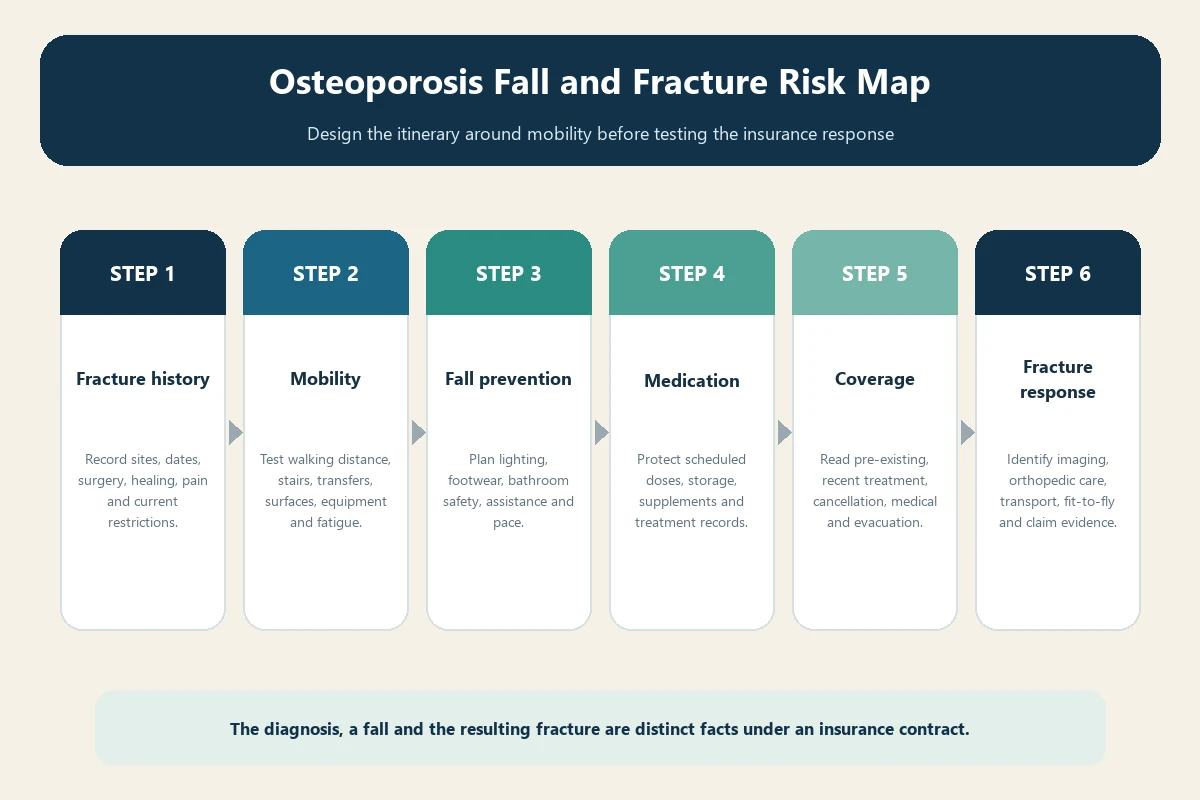
Record the osteoporosis or osteopenia diagnosis, bone density and treatment history, prior fractures, falls, pain, surgery, rehabilitation, mobility aid, and medication changes. Note whether any imaging, procedure, injection, or specialist review is pending.
An insurer may ask about the underlying condition, recent symptoms, treatment, or hospitalization. Answer the actual questions rather than assuming an old diagnosis is irrelevant.
Clinical clearance for the trip
Ask the clinician and rehabilitation team whether the traveler is ready for the flight, transfers, stairs, luggage, walking surface, cruise tender, high altitude, heat, and activities. Review balance, vision, footwear, strength, pain, and fatigue.
The clinician should decide lifting, exercise, fall precautions, and medication. Insurance cannot make a high-risk itinerary medically suitable.
Pre-existing-condition analysis
Osteoporosis, prior fractures, and related treatment are known before purchase. The policy’s look-back can include pain, falls, imaging, therapy, prescriptions, injections, procedures, and surgery. A later fracture after a minor fall can be reviewed as connected to the condition.
A waiver can remove the exclusion for an otherwise covered loss when purchase timing and other conditions are met. Use the senior pre-existing-condition questions.
Recent fracture or surgery
A healing fracture, cast, brace, weight-bearing restriction, wound, or recent operation can change mobility and flight fitness. The surgeon should decide whether travel is appropriate and what documentation or assistance is required.
Some airlines can require medical clearance or special arrangements. A policy may also require medical ability to travel at purchase. Our travel insurance after hospital discharge guide helps map the transition.
Pending surgery or treatment
If a procedure is recommended but not yet scheduled, or the traveler is waiting for results, the trip can depend on an unresolved medical timeline. The policy may exclude foreseeable care or claims connected to the pending condition.
The waiting-for-surgery insurance guide provides questions for cancellation, medical ability, and treatment timing.
Design a fall-aware itinerary
Review stairs, uneven streets, bathrooms, lighting, ice, wet decks, luggage, crowds, transfers, and the pace of tours. Favor direct routes, daylight arrivals, manageable bags, rest, accessible rooms, and reliable ground transport.
A destination can be medically reasonable with a modified itinerary and unsuitable with a rushed one. Keep flexible days and avoid activities the clinician restricts.
Airport, rail, and cruise assistance
Request wheelchair, cart, early boarding, connection escort, or accessible transfer as needed. Verify the meeting point and service on each operating carrier. Assistance can reduce walking and lifting but usually does not provide personal care.
For canes, walkers, wheelchairs, or braces, the mobility-aid insurance guide explains documentation and baggage limits.
Accessible lodging
Ask about step-free entry, elevator reliability, room distance, grab bars, shower or tub, slip-resistant surfaces, bed height, nighttime lighting, and emergency exits. Request photos or measurements. “Accessible” can describe different features in different countries.
Record the confirmation and identify a backup. Travel insurance may not cover a room that fails to match a preference unless a covered event applies.
Medication continuity
Bone-health medicines can have different dosing schedules, storage, administration, and monitoring. Arrange the trip around the prescribed plan and ask the clinician whether any dose or appointment can safely move. Carry other medicines in original labels.
Medicare Part D generally does not cover retail prescriptions bought outside the United States. Plan routine treatment before departure rather than expecting a foreign travel medical claim.
Falls and emergency medical coverage
A new fall with suspected fracture may be eligible under emergency medical coverage, subject to the pre-existing-condition clause, deductible, coinsurance, maximum, exclusions, and coordination. The insurer can review whether osteoporosis or recent symptoms connect to the event.
Seek qualified care based on the clinician’s emergency guidance. Keep the incident report, witness details, ambulance record, imaging, clinical notes, itemized bills, and proof of payment.
Destination orthopedic capability
A small clinic can assess pain but may lack imaging, orthopedic surgery, anesthesia, rehabilitation, or safe discharge equipment. Identify hospitals with appropriate capabilities and the route from lodging or excursions.
Ask the assistance company how it verifies facilities and whether it can guarantee payment. The direct-billing guide explains referral and payment differences.
Original Medicare abroad
Original Medicare generally does not cover health care outside the United States except for narrow foreign hospital and cruise situations. A fracture during an ordinary international trip usually needs another payer.
Medicare Advantage or eligible Medigap coverage may add limited foreign emergency benefits. Verify ambulance, imaging, hospital, surgery, rehabilitation, equipment, and evacuation separately.
Durable medical equipment after a fracture
Crutches, walker, wheelchair, brace, or other equipment can be prescribed after an injury. A travel medical policy may treat the item as medical expense, rental, property, or an excluded supply. Ask what maximum and authorization apply.
A foreign hospital’s discharge does not guarantee that the lodging or airline can accommodate the equipment. Coordinate transport, room, and return travel before discharge.
Trip cancellation
Cancellation may apply when a covered medical change makes the traveler unable to depart. A new fracture, fall, surgery recommendation, pain, or mobility loss is evaluated under the pre-existing-condition, waiver, purchase timeline, and medical-ability rules.
Keep the clinician’s record, initial trip payment, policy purchase date, supplier refunds, and nonrefundable balance.
Supplier accessibility failure
An elevator outage, unsuitable room, or inaccessible tour can make the trip difficult but may not be a covered cancellation reason. Verify access before booking and use refundable options when a particular feature is essential.
Travel insurance reimburses defined events; it is not an accessibility warranty.
Trip interruption
Interruption can address eligible unused arrangements and additional transport after a covered fracture. New flights, an extended hotel, companion stay, and unused tour may follow different limits. Ask who must arrange the return and deduct supplier refunds.
Fit to fly after a fracture
A traveler may need clinician and airline clearance, assistance, seating, cast review, pain control, mobility equipment, or an escort. Only the treating team and airline decide the conditions. Do not book a self-arranged return solely because the insurer has not yet answered.
The fit-to-fly guide explains the documentation.
Medical evacuation
Evacuation may be authorized when local care is inadequate. The endpoint is often the nearest appropriate orthopedic facility, not home. Ground ambulance, air ambulance, pain control, immobilization, receiving-facility acceptance, and weather affect the route.
Use the evacuation approval guide to identify decision authority.
Five-scenario rehearsal
- Fall before departure: seek care and document whether cancellation is medically necessary.
- Walker damaged: obtain a carrier report and clinically appropriate temporary device.
- Fall on an excursion: use local emergency care and preserve operator evidence.
- Fracture requires surgery: coordinate hospital payment and policy authorization.
- Traveler is stable but cannot use the booked seat: obtain fit-to-fly and airline guidance.
Document packet
- Diagnosis, fracture, fall, and treatment timeline
- Recent imaging, surgery, and rehabilitation summary
- Medicine, allergy, and mobility plan
- Clinician, therapist, and pharmacy contacts
- Mobility aid, brace, or implant information
- Accessible transport and lodging confirmations
- Destination hospitals and assistance contacts
- Travel policy and Medicare-related documents
- Trip payments, refunds, and claim evidence
Use a fracture coverage ledger
Separate the event into medical treatment, equipment, trip cost, and return travel. The hospital, imaging, surgery, medicine, and physician belong to the medical claim. A walker, brace, or wheelchair may fall under medical expense or equipment language. Unused hotels and tours belong to interruption. A new seat, escort, ground ambulance, or air transfer may depend on interruption, evacuation, or repatriation terms.
Ask the insurer which provision owns every expense before arranging a non-emergency return. Keep refunds and credits visible so the claim reflects the actual loss. This ledger prevents a covered fracture from being mistaken for automatic payment of every consequence.
Questions for the insurer
- How do osteoporosis, prior fractures, pain, falls, and recent care fit the pre-existing-condition definition?
- Is a waiver available and valid?
- What medical-ability requirement applies?
- Would a new fracture be eligible?
- Are routine treatment and equipment excluded?
- Can assistance guarantee payment?
- What cancellation and interruption documentation is required?
- Does the policy cover a companion or upgraded return seating?
- What evacuation endpoint and authorization apply?
- Which records and deadlines control the claim?
FAQ
Can a senior with osteoporosis buy travel insurance?
Often, yes, but coverage depends on fracture history, recent care, mobility, age, destination, and policy terms.
Must osteoporosis be disclosed?
Answer the application’s health questions accurately, including diagnosis, fractures, pain, treatment, or surgery when asked.
Will a fracture abroad be covered?
It may be if the event is otherwise eligible and the pre-existing-condition exclusion does not apply or is validly waived.
Will evacuation bring the traveler home?
Not necessarily. Many benefits cover the nearest appropriate facility and require medical necessity and authorization.
Bottom line
Travel insurance for osteoporosis begins with fracture-aware trip design. Confirm clinical readiness, mobility, accessible transport and lodging, medication, and destination care. Then test pre-existing-condition, cancellation, emergency, equipment, interruption, fit-to-fly, and evacuation provisions.
Sources
- Bone Health & Osteoporosis Foundation — Traveling With Osteoporosis
- CDC Yellow Book — Travelers With Chronic Illnesses
- U.S. Department of Transportation — Passengers With Disabilities
- Medicare — Durable Medical Equipment Coverage
- U.S. Department of State — Travelers With Disabilities
- U.S. Department of State — Insurance Coverage Overseas
