

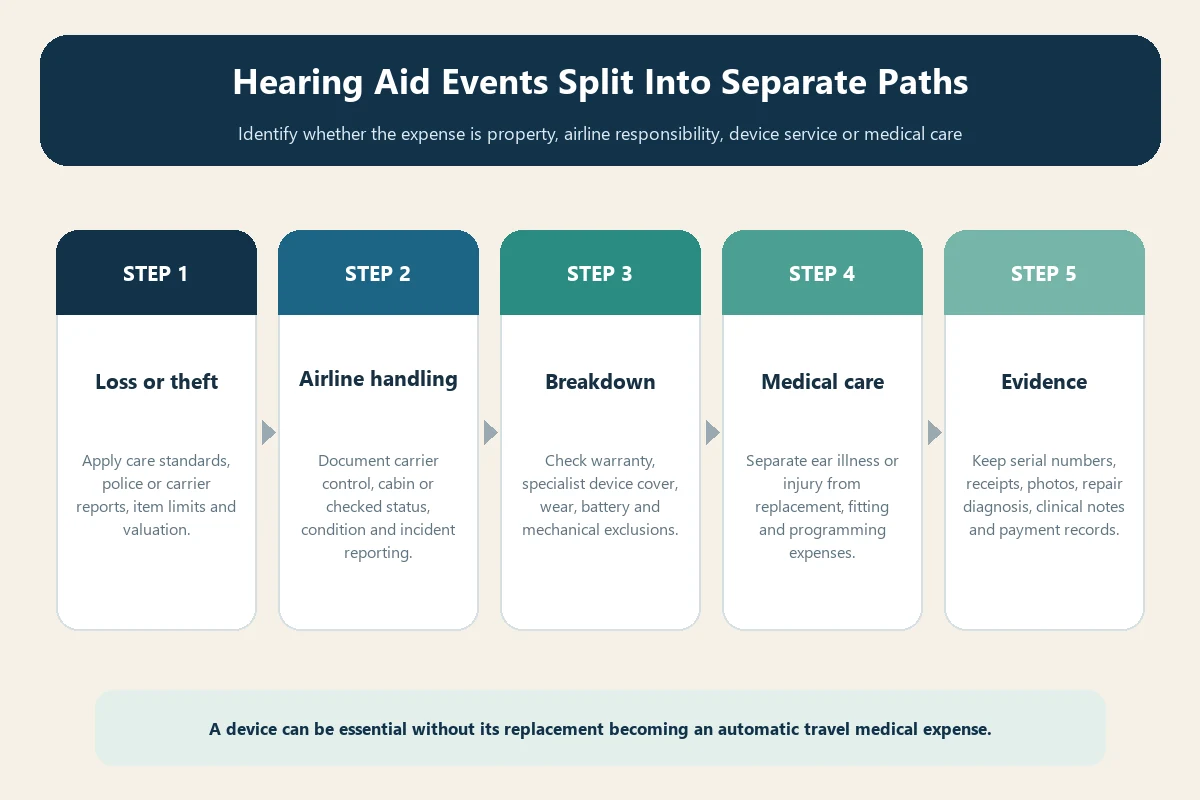
Travel medical insurance for hearing aids must separate the device from the healthcare around it. A lost hearing aid is usually a property event, a painful ear infection is a medical event, and airline mishandling can create a carrier claim. A manufacturer warranty or specialist device policy may be more relevant than the travel medical section.
This guide helps U.S. travelers compare certificates and prepare records. It does not diagnose hearing loss, adjust a device or recommend changing clinical care.
Key takeaways
- Classify loss, theft, accidental damage, breakdown and medical treatment as different events.
- Read the per-item and electronics limits, not only the total baggage maximum.
- Check manufacturer, homeowner, device and airline remedies before assuming the travel insurer pays first.
- Carry device details, spare batteries or charging equipment and a communication backup.
- Keep property evidence and medical records in separate claim files.
Reviewed August 16, 2026. Benefits, airline rules and device requirements vary; the issued certificate and current transport rules control.
Why the exact keyword is easy to misread
Ordinary U.S. health insurance may offer a hearing-aid benefit, but that is not the same as short-term travel medical insurance. A travel plan can cover eligible emergency care abroad while excluding the device itself, or it can include a limited baggage benefit that applies only after other rules are met.
Start with the event and expense. Do not ask only, “Are hearing aids covered?” Ask who owns the device, what happened, where it happened and which section could pay.
Create four coverage files
Keep one file for travel medical benefits, one for travel baggage or personal property, one for manufacturer warranty or dedicated device insurance, and one for airline rights. Add declarations and claim instructions to each.
The travel medical benefits guide helps identify eligible clinical services. It should not be used as proof that a device-replacement expense is medical.
Inventory the device and accessories
Record the manufacturer, model, serial number, purchase date, receipt and current replacement estimate. Photograph the right and left device, charging case, charger, earmolds, remote microphone and other accessories. Note any customization.
Keep records securely rather than displaying serial numbers publicly. If the device is loaned or leased, obtain the owner’s loss and claim requirements.
Read per-item and electronics sublimits
A plan can advertise a meaningful total baggage maximum while limiting one electronic item to a much smaller amount. Determine whether two hearing aids are one set, two items or one scheduled device under the certificate.
The insurance sublimits guide shows how an item cap, category cap and total maximum interact. Ask whether chargers and accessories share the same limit.
Separate loss, theft, damage and breakdown
Loss can require proof that the traveler took reasonable care. Theft can require a prompt police or carrier report. Accidental damage needs a documented incident. Mechanical failure, battery depletion and ordinary wear can fall under exclusions rather than an accidental-damage benefit.
Do not describe a device as stolen without evidence. A precise timeline improves both insurer and airline review.
Check replacement cost versus actual cash value
Replacement cost seeks a comparable new item, while actual cash value can apply depreciation. Some certificates pay the lesser of repair, replacement or the applicable sublimit. A high retail quote does not override that formula.
Ask whether a foreign-purchased replacement is eligible and whether taxes, fitting or programming fees are part of the same cap.
Review manufacturer and device protection first
A manufacturer loss-and-damage program, extended warranty or specialist hearing-aid policy may address events the travel plan excludes. Confirm geographic scope, deductible, number of replacements and whether temporary loaners are available abroad.
Keep written decisions. The travel insurer may ask for proof of other insurance or reimbursement before settling the remaining eligible amount.
Understand airline assistive-device rights
The U.S. Department of Transportation’s Airline Passengers with Disabilities Bill of Rights says assistive devices may be carried in the cabin free of charge consistent with safety rules and do not count against the normal carry-on limit.
Passengers who identify as needing hearing assistance must also receive prompt access to the same trip information as other passengers. Request communication accommodations; do not assume staff can infer them.
Carry hearing aids rather than checking them
Keep hearing devices, chargers and essential accessories in personal possession when transport rules allow. Checked-baggage delay can leave a traveler without communication access even if a later claim is paid.
The baggage delay guide explains waiting periods and necessary interim purchases. A benefit can reimburse expenses without solving immediate accessibility.
Plan batteries and charging
The State Department’s accessibility guidance recommends extra hearing-aid batteries and a portable external charger for communication equipment. Check airline battery rules and protect spare cells from short circuit.
Confirm destination voltage, plug type and whether the charger accepts it. Carry a power bank only in the location and configuration permitted by the airline.
Prepare a communication backup
Save airline alerts and enable visual or vibration notifications. Carry written accommodation requests, essential addresses and emergency contacts. Consider a pre-arranged relay service or captioning option that works in the destination.
The State Department notes that deaf and hard-of-hearing travelers may need to notify a Video Relay Service provider before going overseas. Service availability is not an insurance benefit.
Distinguish ear care from device replacement
An ear infection, sudden symptom or injury can require clinical evaluation. That medical visit is assessed under illness, injury, pre-existing-condition, medical-necessity and provider rules. Replacing a lost device is assessed under property terms.
The primary care coverage guide helps classify an initial evaluation abroad. Do not self-diagnose or insert an old diagnosis into a new medical record.
Check pre-existing-condition wording for treatment
Existing hearing loss does not automatically exclude an unrelated illness. However, care related to a known ear condition, recent symptoms or planned follow-up can be tested against a look-back definition.
Build dated facts with the pre-existing-condition look-back guide. Device ownership alone is not the same as recent medical treatment.
Plan replacement and programming abroad
A local clinic may not stock the exact device, earmold or software. Determine whether a temporary device can be safely fitted, whether remote programming is available and which records the provider needs. Only a qualified professional should advise on clinical suitability.
Ask the insurer whether fitting, audiology services and programming are considered part of a property replacement, a medical expense or excluded routine care. Get the response in writing.
Treat cochlear implant processors separately
An external processor, cable, coil or battery can have different value and warranty terms from a hearing aid. An implanted component raises separate medical issues. Do not assume one definition covers both.
Carry the manufacturer identification and relevant clinical contact details. If symptoms or implant concerns arise, seek appropriate medical guidance rather than relying solely on a property claim.
Use the assistance line for provider logistics
The assistance center may identify local clinicians or advise on claim steps, but a referral is not a coverage guarantee. Ask whether preauthorization is required and whether direct billing is available.
The assistance line versus claims guide separates operational help from the later benefit decision.
Expect payment and reimbursement questions
Foreign providers and hearing clinics can require payment at the visit. CDC’s travel insurance guidance advises checking covered services, preauthorization, provider access and reimbursement before departure.
The direct billing guide explains why an insurer’s provider referral does not necessarily mean cashless treatment.
Build separate property and medical claim files
For property, keep ownership proof, serial number, photographs, police or carrier report, warranty decision, repair diagnosis, replacement quote and receipts. For medical care, keep the clinical note, diagnosis, itemized bill, prescription and proof of payment.
Use the claim documentation checklist for deadlines and evidence. Do not combine a replacement quote and medical bill into one unexplained total.
Compare five common scenarios
| Event | Likely first path | Critical question |
|---|---|---|
| Hearing aid lost at a hotel | Property or device policy | What item limit and care standard apply? |
| Device damaged by airline handling | Airline assistive-device process | Was it in the carrier’s control? |
| Battery dies | Traveler supply plan | Is depletion excluded rather than insured? |
| Sudden ear infection | Travel medical benefit | Does the event meet illness and exclusion terms? |
| Replacement needs programming | Property plus professional service review | Which payer treats the fitting expense? |
Questions to ask before purchase
- Are hearing aids covered baggage, electronics, medical equipment or excluded property?
- What are the per-item, pair and accessory sublimits?
- Are loss, theft, accidental damage and breakdown treated differently?
- Is payment based on replacement cost, repair cost or depreciated value?
- Must I claim from the airline, manufacturer or device insurer first?
- Are fitting and programming expenses included?
- What reports and notice deadlines apply?
Bottom line
Travel medical insurance for hearing aids is useful only after the traveler separates the device from the medical care surrounding it. Compare the property limit, airline rights, warranty, clinical benefits and assistance process as distinct layers.
The strongest preparation combines adequate documentation, batteries and charging, a communication backup, provider research and realistic claim expectations. The issued certificate—not the product-page headline—decides the insured result.
Accessible travel requires usable documents, navigation support, assistive tools, and a disruption plan before insurance can reimburse a covered loss. Use this blind and low-vision senior travel insurance guide to verify assistance, equipment, companions, medical care, and claims.
