

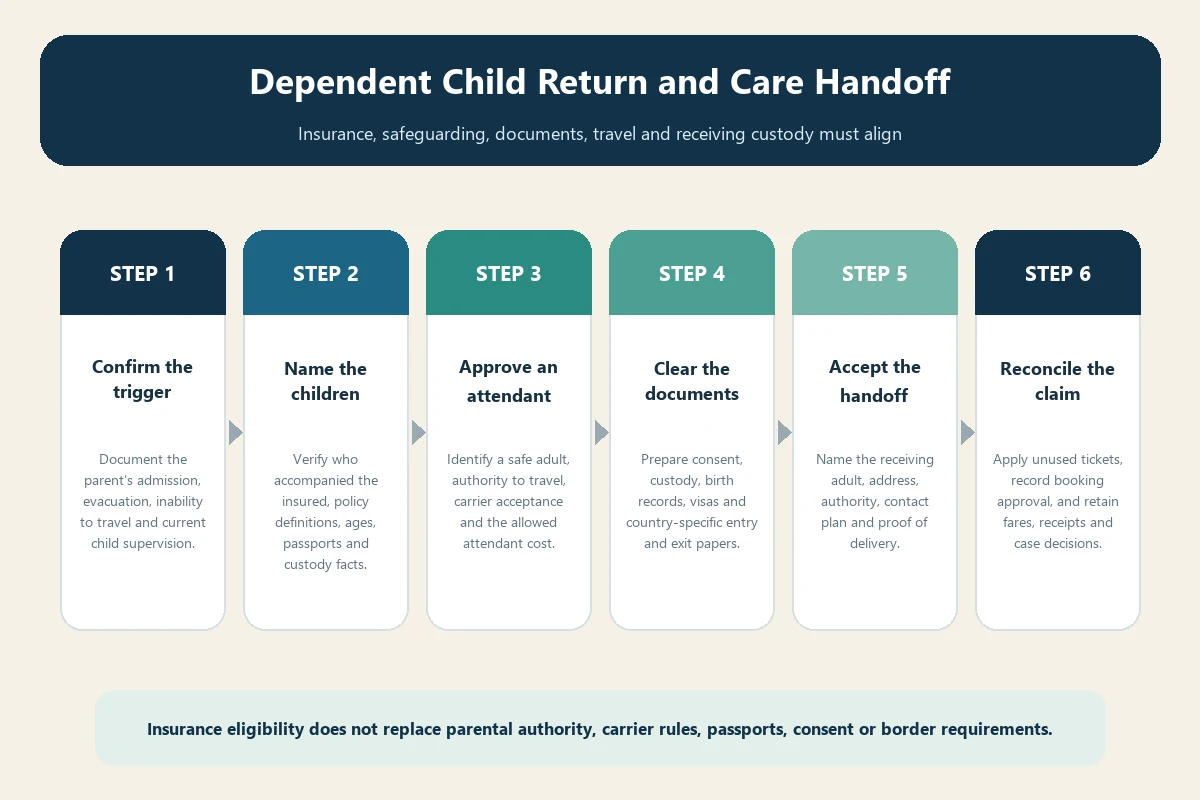
Medical evacuation insurance dependent children benefits can help return accompanying children when a parent dies, is hospitalized, is evacuated, or becomes unable to travel. The insurance clause is only one part of the solution. A safe return also needs supervision, an approved attendant, custody and consent documents, carrier acceptance, border clearance, and a named adult at the destination.
Call local emergency services and protect the child first. This guide is educational, not medical, insurance, safeguarding, immigration, or legal advice. Policies, custody orders, consent rules, passports, airlines, and country requirements vary. Contact appropriate authorities and qualified counsel when authority or safety is disputed.
Key takeaways
- Look for “transportation of children” or “return of minor children.”
- Document why the children are left without their responsible adult.
- Choose the attendant and receiving custodian before buying tickets.
- Insurance approval does not replace consent, custody, passport, or border rules.
- Preserve unused-ticket credits and a complete custody handoff record.
Reviewed August 16, 2026. Child, dependent, unattended, accompanying, attendant, primary residence, and family member are contract definitions. Read the issued schedule, coverage section, conditions, exclusions, and assistance instructions.
Separate three decisions immediately
- Care: Who is supervising each child safely right now?
- Authority: Who may consent to medical care and international travel?
- Coverage: Which transport and attendant expenses may the policy pay?
Do not let an unresolved reimbursement question leave a child without appropriate care. The evacuation approval-chain guide helps assign medical, transport, assistance, and claim decisions to the right people.
The benefit may not use the word dependent
Search for transportation of children or child, return of minor children, return of dependents, unattended children, escort or attendant, emergency reunion, and trip interruption. Then read the definitions of child, dependent, family member, insured, and traveling companion.
The travel medical benefits guide explains why a schedule label without the complete coverage grant is not enough.
A covered trigger can have several parts
A clause may respond to the insured parent’s death, minimum hospital stay, emergency medical evacuation, covered illness or injury, or inability to travel. It can require that the children were accompanying the insured and are left unattended.
An Illinois-specific IMG sample contract illustrates a trigger involving death, more than three consecutive hospital days, or inability to travel after an evacuation or covered illness or injury. Another form may use different facts, days, and definitions.
“Unattended” is a factual and contractual question
A second parent, grandparent, adult sibling, group leader, nanny, tour representative, or friend may already be present. Their presence does not automatically make them legally authorized, available, safe, or an eligible caregiver under the policy.
Record each adult’s identity, relationship, current location, consent authority, travel documents, health, willingness, and ability to complete the itinerary. Ask the administrator which facts satisfy the certificate’s unattended-child trigger.
Confirm which children qualify
A policy may cover insured children, dependent children, minor persons under the insured’s care, or children accompanying the insured. Age limits, student status, residence, financial dependency, and listing on the application can matter.
| Question | Evidence |
|---|---|
| Was the child on the covered trip? | Application, itinerary, ticket |
| Does the child fit the definition? | Policy, age, relationship, residence |
| Who had care responsibility? | Consent, custody, group records |
| Why is that adult unavailable? | Hospital, evacuation, or death record |
| Who will receive the child? | Identity, authority, address, acceptance |
The return destination must be named
The sample contract cited above refers to a child’s primary residence or the insured’s U.S. residence. Another policy may name the trip origin, return destination, home country, or an adult relative. The nearest family member is not automatically the covered destination.
Use the evacuation destination guide to build the same discipline for dependent return: copy the permitted endpoint before arranging the route.
An attendant needs both approval and authority
A young child, a child with medical or disability needs, or a carrier itinerary can require an accompanying adult. The policy may pay an attendant, but the assistance company should identify or approve that person and the allowed cost.
Separately confirm that the adult may travel with the child, make required decisions, cross every border, handle medication, manage connections, and complete the custody handoff. Insurance authorization alone grants none of those powers.
Consent and custody rules can stop the route
The U.S. Department of State’s Travel with Minors guidance says destination rules vary. Some countries require a signed, notarized permission letter when a child travels alone or with someone who is not a parent or legal guardian. Proof of legal relationship or sole custody may also be needed.
Check every departure, transit, and arrival jurisdiction. If parents disagree, a custody order restricts travel, or abduction is a concern, stop informal arrangements and obtain appropriate official and legal help.
Passports and visas belong to the child
U.S. Customs and Border Protection guidance notes that children need their own passport, visa, or other entry documents required for the destination, and that some countries require parental-consent letters.
Record passport validity, visas, residence permits, dual nationality, exit permits, transit rules, and the child’s legal name on every ticket. A medical emergency can accelerate coordination but does not erase border law.
Prepare a child travel authority packet
- Child’s passport, visa, residence document, and itinerary
- Birth certificate or evidence of legal relationship
- Custody order or proof of sole authority, when applicable
- Notarized travel consent tailored to the route
- Parent and receiving-custodian identity and contacts
- Attendant identity, relationship, and authorization
- Medical consent, allergies, medications, and clinician contacts
- Policy, assistance case number, and written travel approval
- Emergency, embassy, airline, and border contacts
The CDC child-travel chapter recommends that children carry identifying information and contact numbers and notes that a parent traveling alone with children should carry relevant custody or permission papers.
Carrier rules are another gate
The airline or other carrier can impose age, routing, connection, handoff, documentation, language, medical, and unaccompanied-minor rules. An insurer’s approved attendant does not automatically satisfy the carrier.
Ask whether the child and attendant must travel on the same booking, whether connections are allowed, who may check in the child, who must be present at departure and arrival, and what identification the receiving adult must show.
Medical needs travel with the child
Prepare medication in labeled containers, dosing times across time zones, allergies, action plans, mobility needs, devices, food requirements, and emergency contacts. Confirm who may administer medicine and seek treatment during transit.
If the child is also injured or ill, this is no longer merely a dependent-return itinerary. Appropriate clinicians must assess the child, and a separate medical transport or escort authorization may be required.
The parent’s route and the child’s route can diverge
A parent may move to a regional or home-country hospital while the child returns directly to a relative. The routes can use different countries, dates, carriers, and expense sections. One should not be delayed solely to keep the itineraries visually similar.
The international hospital-transfer guide tracks the patient’s clinical route. Build a separate safeguarding timeline for each child.
Unused tickets can reduce the payable fare
The IMG sample illustrates one-way transport in the original class, less an applied credit from an unused return ticket, and can include an attendant. Other plans may handle class, credits, refunds, and attendant costs differently.
Preserve the original booking, unused segments, airline credit, refund request, reissue quote, new ticket, service fees, and payment receipt. Ask before canceling or reusing any segment.
Get a written child-return authorization
The decision should name every child, triggering event, attendant, origin, destination, receiving adult, carrier or booking method, fare class, unused-ticket treatment, maximum, approved fees, and required documents.
Use the pre-authorization guide to keep assistance coordination, benefit approval, payment, and final claim review distinct.
Design the physical handoff
- Name the adult caring for the child at the current location.
- Confirm the attendant’s arrival and identity before care transfers.
- Inventory documents, medication, devices, baggage, and money.
- Set check-in points at departure, transit, arrival, and delay.
- Require the receiving adult to confirm identity and acceptance.
- Record the completed handoff and any missing property or medication.
The cruise ship evacuation guide shows why port, hospital, and onward routes can separate a family quickly; the same handoff discipline applies on land.
Siblings may need different arrangements
Children of different ages can have different passports, other parents, custody orders, medical needs, schools, carriers, and receiving adults. A teenager may be accepted on a route that a younger child cannot take. One child may be a policy-defined dependent while another is a minor under the insured’s care.
Build a separate checklist and authorization line for every child. Keep siblings together when that is safe and lawful, but do not assume one approval, consent letter, ticket, or receiving arrangement automatically covers the group.
The claim evidence file
- Issued policy, schedule, definitions, and assistance instructions
- Parent’s hospital, evacuation, or death documentation
- Proof the children accompanied the insured
- Evidence of current care and why it cannot continue
- Child, attendant, and receiving-adult identity records
- Consent, custody, passport, visa, and border documents
- Carrier acceptance and complete itinerary
- Written insurer authorization and case log
- Original tickets, credits, new fares, and itemized receipts
- Signed or otherwise documented final care handoff
The CDC insurance chapter advises travelers to verify coverage before departure and carry policy information. For families, the emergency file should be accessible to another trusted adult.
If dependent return is declined
Ask whether the dispute concerns the child definition, covered trip, unattended status, qualifying event, hospital days, destination, attendant, arrangement rule, fare class, unused-ticket credit, maximum, or missing proof. Request the clause and appeal path in writing.
Continue safe care planning while payment is reviewed. Contact the appropriate consular, child-protection, law-enforcement, legal, or judicial authority if safety or travel authority cannot be established.
Bottom line
Medical evacuation insurance dependent children coverage is a transport benefit inside a larger safeguarding operation. Confirm the policy trigger and eligible children, but also build lawful authority, an approved attendant, valid documents, carrier and border clearance, a named receiving custodian, a recorded handoff, and a complete fare file. Coverage never substitutes for the child’s safety or the adult’s legal authority to move them.
Claims involving several people or long-lived records need clear ownership and authority. Use the authority and documentation needed for a child’s travel claim to assign each role, expense, document and decision without duplication.
