
Travel insurance can cover defined medical and trip losses for a senior with dementia, but it does not provide supervision, decision-making authority, wandering prevention, or routine personal care. The treating team and family should assess whether the exact trip is appropriate, name a capable caregiver, document consent and communication authority, simplify the itinerary, protect medication, and identify destination care before comparing pre-existing-condition, cancellation, interruption, emergency medical, and evacuation benefits.
This article is educational, not medical, legal, guardianship, aviation, or insurance advice. Dementia type, stage, function, behavior, capacity, and travel tolerance differ. Consult the treating clinician and qualified legal counsel about fitness, consent, decision-making, and documents. Seek urgent care for sudden confusion or new neurologic symptoms.
Key takeaways
- Travel insurance reimburses covered losses; it does not supply a caregiver or make an unsuitable itinerary safe.
- Dementia, recent symptoms, hospitalization, medication changes, and behavioral changes can affect pre-existing-condition eligibility.
- Consent, privacy, payment, and medical communication authority should be resolved before departure.
- The caregiver needs a written plan for separation, wandering, agitation, illness, hospitalization, and return travel.
- Companion expenses and hospital-of-choice transport require explicit policy language.
Reviewed: August 16, 2026.
Begin with whether the trip serves the traveler
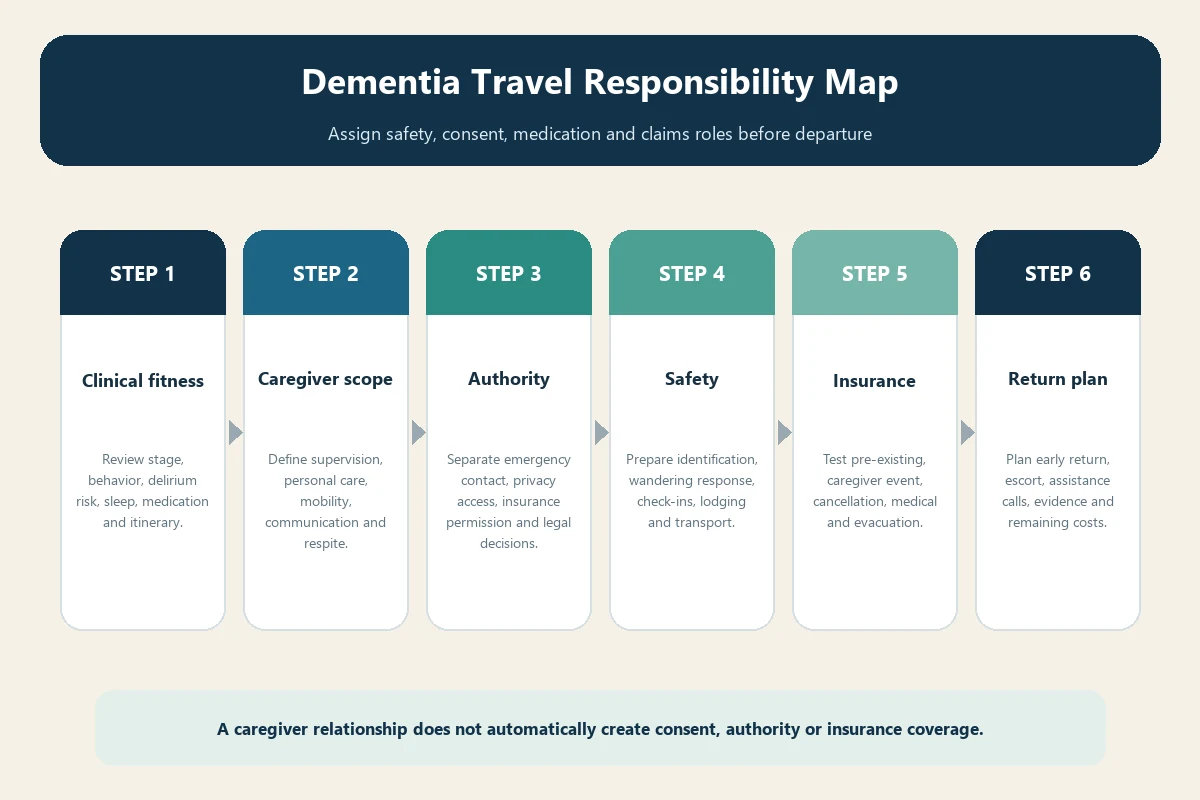
Ask the treating clinician how unfamiliar settings, disrupted sleep, crowds, security screening, long transfers, time zones, heat, altitude, and physical demands could affect the person. Consider the traveler’s ability to communicate needs, recognize companions, follow directions, manage a bathroom, eat, sleep, and tolerate changes.
A trip that was enjoyable two years ago may no longer fit. Choose the current person, not the family’s memory of earlier travel.
Name the caregiver’s actual duties
“Traveling together” is not a care plan. List who manages medication, identification, navigation, transfers, meals, hygiene, money, documents, check-in, nighttime supervision, emergency communication, and claims. Decide who can take over if the primary caregiver becomes ill.
Travel insurance usually does not pay a family member for routine caregiving. A professional aide’s costs, licensing, airfare, room, and liability must be arranged separately unless the contract explicitly covers a service.
Consent and decision-making authority
The traveler may be able to make some decisions and need help with others. Capacity is decision-specific and can change. Before travel, obtain legal advice on health-care directives, powers of attorney, privacy authorization, financial access, and recognition in the destination country.
An insurer, hospital, airline, or hotel may require its own authorization. A companion relationship alone does not guarantee access to medical information or claim authority.
Pre-existing-condition rules
Dementia and related care are known before purchase. The policy’s look-back period can include diagnosis, confusion, falls, wandering, agitation, medication changes, tests, therapy, hospitalization, or new supervision needs. A travel claim connected to those facts can be excluded unless a waiver applies.
A waiver typically requires timely purchase and other eligibility conditions. It removes an exclusion only for otherwise covered losses. Use the senior pre-existing-condition questions to review the certificate.
Medical ability to travel
Some policies require the traveler to be medically able to travel when coverage is purchased. The treating clinician assesses health; the insurer applies the contract. Preserve the clinical status and advice on the purchase date.
Buying after a new behavior, hospitalization, or recommendation not to travel may create a different result. Do not wait until cancellation is likely.
Simplify the itinerary
Favor direct travel, familiar routines, fewer hotels, predictable meals, rest, and flexible days. Avoid tight connections, overnight transfers, complex self-driving, and frequent room changes when those increase confusion. Verify accessible bathrooms, quiet space, room location, locks, elevators, and emergency exits.
Refundable bookings can be more valuable than an insurance claim for a foreseeable tolerance problem.
Identification and separation plan
Carry identification, accommodation address, caregiver contact, diagnosis or communication card, and a current photo. Consider an identification bracelet or enrollment in an available wandering-response program. The caregiver should hold duplicates without taking away the traveler’s dignity.
Choose a meeting method for airports, ports, museums, and rest stops. Tell travel staff only the information needed to help safely.
Medication continuity
Arrange enough U.S.-dispensed medicine, original labels, a written schedule, and a delay buffer within prescription and legal limits. Crossing time zones can affect dosing and sleep. The clinician or pharmacist should provide the plan.
Medicare Part D generally does not cover prescriptions bought outside the United States. Use the chronic medication guide to organize refills, storage, and foreign replacement.
Sudden confusion is not always dementia
An abrupt change can reflect infection, medication effect, dehydration, pain, stroke, injury, or another urgent problem. The caregiver needs clinical instructions for baseline behavior and emergency warning signs. Do not dismiss a sudden change or wait for insurer approval.
Carry a baseline summary so foreign clinicians can distinguish chronic impairment from new symptoms.
Accessibility and mobility
Dementia may coexist with balance, vision, hearing, continence, or mobility limitations. Request airport and rail assistance, accessible transport, and suitable rooms. A wheelchair or walker can reduce strain but requires proper fit and handling.
The mobility-aid insurance guide explains baggage and equipment claims. Accessibility service is not personal care supervision.
Airline, cruise, and tour communication
Tell the carrier or operator about required assistance without expecting staff to provide continuous supervision. Ask about boarding, seating, bathroom access, connection escorts, disembarkation, tendering, and emergency procedures. Determine whether the traveler can comply with safety instructions.
A tour guide is responsible for the group itinerary, not individual dementia care. Confirm the operator’s limits.
Original Medicare abroad
Original Medicare generally does not cover care outside the United States except for narrow foreign hospital and cruise situations. Medicare Advantage or Medigap may provide limited international emergency benefits, but routine supervision and personal care are different.
Verify emergency medical, ambulance, post-stabilization, medication, and evacuation coverage separately.
Travel medical coverage
A policy may pay eligible unexpected treatment, subject to the pre-existing-condition provision, deductible, coinsurance, maximum, exclusions, and coordination. Ask how sudden confusion, falls, infection, injury, medication problems, and behavioral emergencies are treated.
Routine memory care, supervision, respite, and planned assessment are generally not emergency medical benefits unless explicitly stated.
Direct billing and hospital communication
A foreign hospital may require a deposit and may not accept the caregiver’s authority automatically. Carry the legal and privacy documents recommended by counsel and the insurer’s assistance number. The direct-billing guide explains referrals and payment guarantees.
Record names, times, decisions, invoices, medical records, and proof of payment. Protect the traveler’s privacy.
Trip cancellation
Cancellation may apply when a covered medical change makes the traveler unable to depart. Dementia-related claims depend on the pre-existing-condition terms, waiver, purchase timeline, medical-ability condition, and clinician documentation.
A family decision that the trip is too difficult may not meet a covered reason. Refundable suppliers reduce this risk more directly.
Caregiver cancellation
If the essential caregiver becomes ill, coverage depends on whether that person is an insured traveler, traveling companion, family member, or another defined person and whether the illness is a covered reason. A paid aide quitting or becoming unavailable may not qualify.
Ask the insurer to address the caregiver scenario before purchase and build a backup caregiver plan.
Trip interruption and companion expenses
Interruption can pay eligible unused arrangements and additional transport after a covered event. A caregiver’s extra hotel, meal, flight, or bedside stay may have separate limits. The policy may require the insured’s hospitalization or medical necessity.
Our travel companion evacuation guide explains companion travel provisions.
Medical evacuation
Evacuation may be authorized when local care is inadequate. The endpoint is often the nearest appropriate facility, not a familiar memory-care provider or home hospital. Dementia-related supervision and agitation can affect crew and transport, but the insurer and medical teams decide the route.
Use the evacuation approval guide and confirm whether a caregiver or escort is covered.
If the traveler becomes separated
- Notify local emergency services and venue or carrier security immediately.
- Use the current photo, identification, last known location, clothing, and relevant medical risks.
- Contact the lodging and travel-assistance line.
- Preserve incident reports, transport, lodging, and communication records.
- Do not assume a search cost is covered; security, search and rescue, and trip delay follow different benefits.
Document packet
- Diagnosis, baseline function, communication, and recent-change summary
- Medicine, allergy, and schedule
- Treating clinician and pharmacy contacts
- Identification and current photo
- Consent, privacy, health-care, and financial authority documents
- Caregiver duty and backup plan
- Accessible transport and lodging confirmations
- Destination hospitals and emergency contacts
- Travel policy and Medicare-related cards
- Trip payments, refunds, and claim documents
Questions for the insurer
- How do dementia, recent changes, falls, and medication fit the pre-existing-condition definition?
- Is a waiver available and valid?
- What medical-ability requirement applies?
- Would sudden confusion or a fall be eligible?
- Does the policy cover routine supervision?
- What if the caregiver becomes ill or unavailable?
- Does interruption cover the caregiver’s extra costs?
- Can assistance arrange direct payment?
- What evacuation endpoint and companion benefit apply?
- Who may discuss and file the claim?
FAQ
Can a senior with dementia get travel insurance?
Possibly. Availability and coverage depend on condition, recent care, age, destination, supervision, and policy terms.
Does insurance pay for a caregiver?
Generally not for routine care unless the policy explicitly provides it. Companion expenses after a covered event may have a separate benefit.
Must dementia be disclosed?
Answer the application’s health questions accurately, including diagnosis, medication, symptoms, supervision, or hospitalization when asked.
Will evacuation bring the traveler home?
Not necessarily. Many policies use the nearest appropriate facility and require authorization.
Bottom line
Travel insurance for dementia starts with a person-centered caregiver and legal communication plan. Simplify the trip, protect medication and identity, assign responsibilities, and map emergency care. Then test pre-existing-condition, caregiver, cancellation, interruption, medical, and evacuation provisions against specific scenarios. Keep approvals in writing.
Sources
- Alzheimer’s Association — Traveling
- CDC Yellow Book — Travelers With Chronic Illnesses
- U.S. Department of Transportation — Passengers With Disabilities
- Medicare — Coverage Outside the United States
- U.S. Department of State — Travelers With Disabilities
- U.S. Department of State — Insurance Coverage Overseas
