
Travel insurance for seniors with severe allergies requires an epinephrine plan abroad, even when eligible emergency treatment may be covered. It does not guarantee an allergen-free flight, restaurant, hotel, cruise, or tour. A senior traveler needs a clinician-approved allergy action plan, lawful and temperature-safe epinephrine supply, translated communication, food and medication screening, and destination emergency care. The policy’s pre-existing-condition, medical, trip-loss, and evacuation provisions then determine payment.
This article is educational, not allergy, emergency, pharmacy, nutrition, legal, aviation, or insurance advice. The allergist or treating clinician must guide avoidance, epinephrine, rescue medicine, emergency thresholds, and travel fitness. Follow the prescribed action plan and seek emergency care for a serious reaction.
Key takeaways
- Insurance cannot eliminate exposure; build an avoidance and communication plan first.
- Carry clinician-prescribed epinephrine and rescue medicine in accessible, lawful, correctly stored form.
- Food, medicine, latex, insect, and environmental allergies create different destination scenarios.
- Allergy history and prior reactions can affect pre-existing-condition eligibility.
- Epinephrine use, ambulance, emergency care, hospitalization, trip interruption, and evacuation are separate claim components.
Reviewed: August 16, 2026.
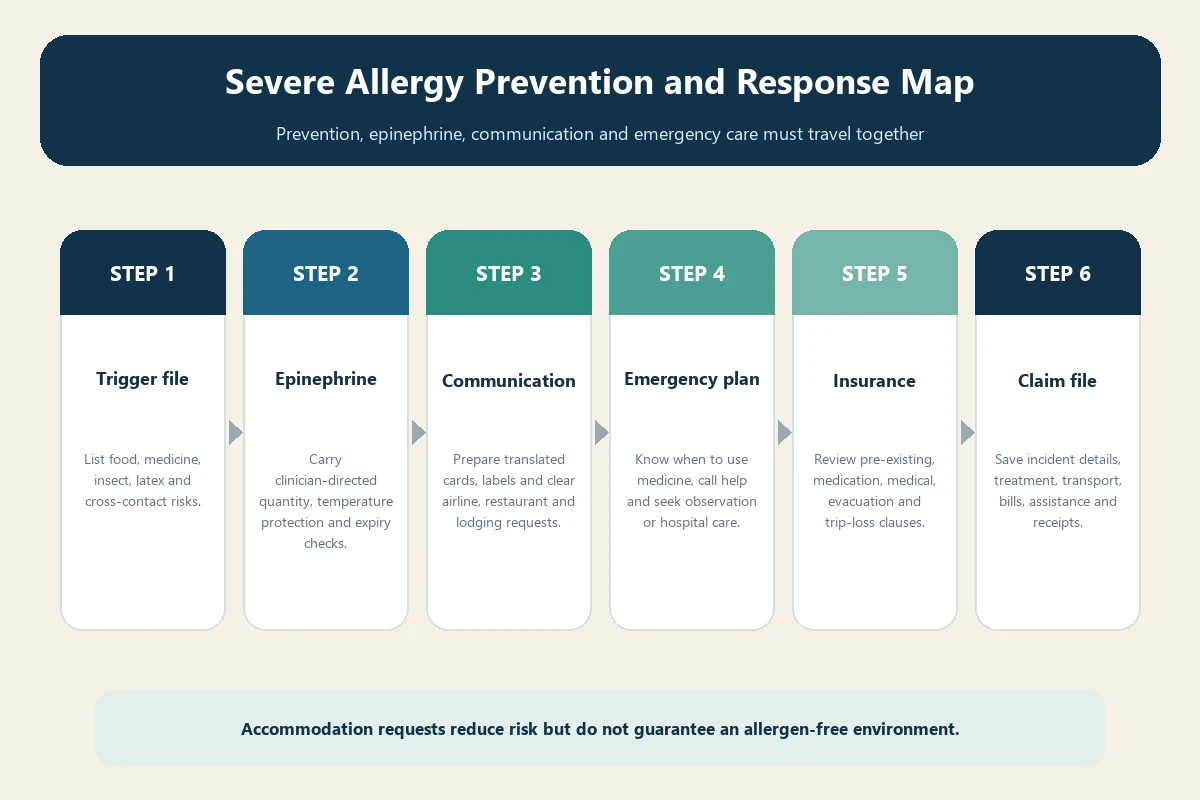
Define the allergy precisely
List the allergen, type of prior reaction, date, severity, treatment, hospitalization, testing, current prescription, and related asthma or cardiovascular conditions. Include food, medicine, insect venom, latex, and other triggers. An insurer may ask about diagnosis, reaction, treatment, or hospitalization rather than “allergy” generally.
Use exact names and common derivatives. A broad phrase such as “nut allergy” may be inadequate for kitchens or clinicians.
Clinical travel review
Ask the allergist or treating clinician whether the traveler is stable, how many prescribed auto-injectors or other medicines should be carried, how they must be stored, and what the emergency action plan requires. Review destinations where emergency response is slow, language barriers are significant, or the allergen is difficult to avoid.
Do not rely on an insurance assistance line for immediate allergy treatment instructions. Carry the clinician’s plan.
Pre-existing-condition rules
The allergy and prior reactions are known before purchase. The policy’s look-back can include symptoms, treatment, epinephrine use, emergency care, testing, prescription changes, or hospitalization. A later reaction may be excluded unless a waiver applies.
A waiver removes an exclusion only for an otherwise covered loss and can require purchase timing and medical ability to travel. Use the senior pre-existing-condition questions.
Epinephrine continuity
Carry the number of devices prescribed by the clinician, accessible rather than checked, with pharmacy labels and an allergy action plan. Check expiration, solution appearance as the manufacturer directs, storage temperature, and device instructions. Extreme heat, freezing, or direct sunlight can damage medication.
Ask the clinician or pharmacist how to handle a suspected temperature excursion or expired device. Do not assume a foreign brand, dose, or delivery system is interchangeable.
Airport security and border documents
TSA permits medically necessary medicines under its procedures, but the traveler should declare items as requested. Needles, liquids, cooling materials, and devices can require additional screening. Return and transit countries follow their own rules.
Carry original labels, a clinician letter when useful, generic medicine names, and the destination’s official medication guidance. The prescription medication travel guide helps organize the packet.
Airline communication
Notify the operating airline about the severe allergy and ask what accommodations it can provide. Airlines may change menus, announce requests, adjust seating, or allow preboarding under their policy, but no shared aircraft can be guaranteed allergen-free.
Bring safe food where permitted, clean the seating area as clinically advised, keep medicine accessible, and explain the action plan to the companion. A codeshare partner may have different procedures.
Restaurant and lodging communication
Use a professionally translated allergy card listing the exact allergen, hidden ingredients, cross-contact concern, and emergency message. Speak with a manager or chef when possible. A server’s confidence is not the same as a controlled kitchen process.
For lodging, ask about refrigerator needs, kitchen access, cleaning products, latex, pets, and emergency transport. Self-catering can reduce some uncertainty but adds grocery-label and equipment questions.
Cruises and tours
Contact the cruise or tour operator before booking. Ask how dietary requests are recorded, whether food is prepared in shared kitchens, what happens on excursions, where epinephrine is stored, and which medical facility responds. A ship medical center may stabilize but not provide advanced allergy or intensive care.
Bring a safe-food and medicine plan for ports and long transfers. Do not assume the cruise line’s onboard procedure extends to independent excursions.
Medication allergies
Carry a list of medicine allergies, reaction type, and safe alternatives identified by the clinician. Foreign brand names and formulations can differ. A hospital needs the generic ingredient and reaction, not only a U.S. brand.
Include contrast, antibiotic, pain medicine, adhesive, and latex information when relevant. Wear medical identification if recommended.
Insect and environmental allergies
Destination season, lodging, outdoor activity, and emergency response can change exposure. Ask the clinician about avoidance, prescribed medicines, and whether remote hiking, boating, or safari is appropriate. An adventure-activity exclusion can affect the insurance claim independently of the allergy.
Map the nearest emergency facility and transport route. Search and rescue before medical transport may be a separate benefit.
Original Medicare abroad
Original Medicare generally does not cover care outside the United States except in narrow foreign hospital and cruise situations. Anaphylaxis during ordinary overseas travel usually requires another payer.
Medicare Advantage or eligible Medigap may provide limited foreign emergency benefits. Verify ambulance, hospital, doctor, medication, post-stabilization, and evacuation separately.
Travel medical coverage
An emergency medical policy may cover eligible ambulance, emergency department, physician, medicine, observation, or admission, subject to pre-existing-condition rules, deductible, coinsurance, maximum, exclusions, and coordination.
Ask whether the insurer treats an allergic reaction as connected to a disclosed pre-existing condition and what the waiver changes. Routine epinephrine purchase and replacement are planned medication costs unless the policy says otherwise.
Direct billing and cash flow
A foreign hospital may require a deposit. Assistance can identify an appropriate facility, guarantee payment for an eligible event, or only give a referral. Use the direct-billing guide to compare the process.
Keep ambulance records, food or medication evidence when available, action-plan use, clinical records, itemized bills, proof of payment, and discharge instructions.
Trip cancellation
Cancellation may apply when a covered medical event makes the traveler unable to depart. A recent reaction, new diagnosis, prescription change, or clinician concern can be evaluated under the pre-existing-condition, waiver, and medical-ability rules.
A restaurant or airline declining a requested accommodation may not be a covered reason. Use flexible suppliers when the trip depends on a specific accommodation.
Trip delay
A delay can exhaust safe food, separate the traveler from checked supplies, or expose epinephrine to temperature risk. Delay coverage may reimburse eligible expenses after a trigger, but the immediate allergy plan must work without reimbursement.
Carry medicine and safe essentials, save the carrier notice and receipts, and contact the airline and assistance service.
Trip interruption
Interruption may cover eligible unused arrangements and additional transport after a covered reaction. A companion’s hotel, changed flight, or unused tour can follow separate limits. Ask who arranges the return and what medical certification is required.
Medical evacuation
Evacuation may be authorized when local care is inadequate. The endpoint is usually the nearest appropriate facility, not home. An allergic emergency may need rapid local ambulance rather than long-distance evacuation, followed by a separate post-stabilization decision.
Use the evacuation approval guide and evacuation claim checklist.
Five-scenario rehearsal
- Meal concern before eating: use the communication and safe-food plan.
- Reaction on an aircraft: follow the prescribed action plan and crew instructions.
- Epinephrine overheats: obtain clinician, pharmacist, or manufacturer guidance.
- Checked bag is delayed: use carried medicine and file the carrier report.
- Hospital recommends transfer: coordinate assistance and receiving-facility acceptance.
Document packet
- Allergen and reaction history
- Allergy action plan and emergency thresholds
- Epinephrine and medicine prescriptions
- Clinician, pharmacy, and manufacturer contacts
- Medical identification and translated allergy cards
- Airline, cruise, tour, and lodging confirmations
- Destination hospitals and emergency numbers
- Travel policy and Medicare-related documents
- Trip payments, refunds, and claim evidence
Use an allergy coverage ledger
Place every likely expense in the correct lane. Prevention includes safe food, translated cards, prescribed epinephrine, storage, and routine medicine. Emergency care includes eligible ambulance, physician, hospital, and administered medication. Trip loss includes a covered cancellation, unused arrangements, delay expenses, or additional return transport. Property includes a lost medicine bag only if the policy treats it as covered baggage or medical equipment.
This ledger prevents a medical maximum from being mistaken for an allergy-accommodation guarantee. Ask the insurer which provision would receive each claim and whether one payer must decide first. A strong plan may still leave routine medication, special meals, or an unavailable accommodation as personal costs.
Questions for the insurer
- How do the allergy and prior reactions fit the pre-existing-condition definition?
- Is a waiver available and valid?
- Would anaphylaxis be eligible under emergency medical coverage?
- Is routine epinephrine replacement excluded?
- Can assistance arrange direct payment?
- What if an airline or hotel cannot provide an accommodation?
- Does delay cover emergency food or medication expenses?
- What interruption and companion benefits apply?
- What evacuation endpoint and authorization apply?
- Which records and deadlines control the claim?
FAQ
Can severe allergies be covered by travel insurance?
Possibly. Coverage depends on disclosure, prior reactions, pre-existing-condition rules, waiver eligibility, and the policy.
Can epinephrine auto-injectors go through airport security?
They can be carried as medically necessary medicine under applicable procedures. Keep labels and declare items as requested.
Does travel insurance guarantee allergy-safe food?
No. Supplier accommodations and insurance reimbursement are different. No shared food environment can be assumed allergen-free.
Will evacuation fly the traveler home?
Not necessarily. Many benefits use the nearest appropriate facility and require authorization.
Bottom line
Travel insurance for severe allergies works after the avoidance and response plan is ready. Protect epinephrine, communicate precisely, plan safe food and destination care, and rehearse emergencies. Then test pre-existing-condition, medical, delay, cancellation, interruption, and evacuation provisions.