
A travel insurance claim payment by bank transfer or check requires more than selecting the fastest button. First confirm who the policy says should receive the benefit, then choose a method that supports that payee, currency, amount, account type, and country. Claim approval and successful disbursement are separate stages.
This U.S.-focused guide covers ACH or direct deposit, debit-card disbursement, digital options, and paper checks. Availability and timing vary by insurer and product. Never send banking information until you independently verify the claims administrator and payment channel.
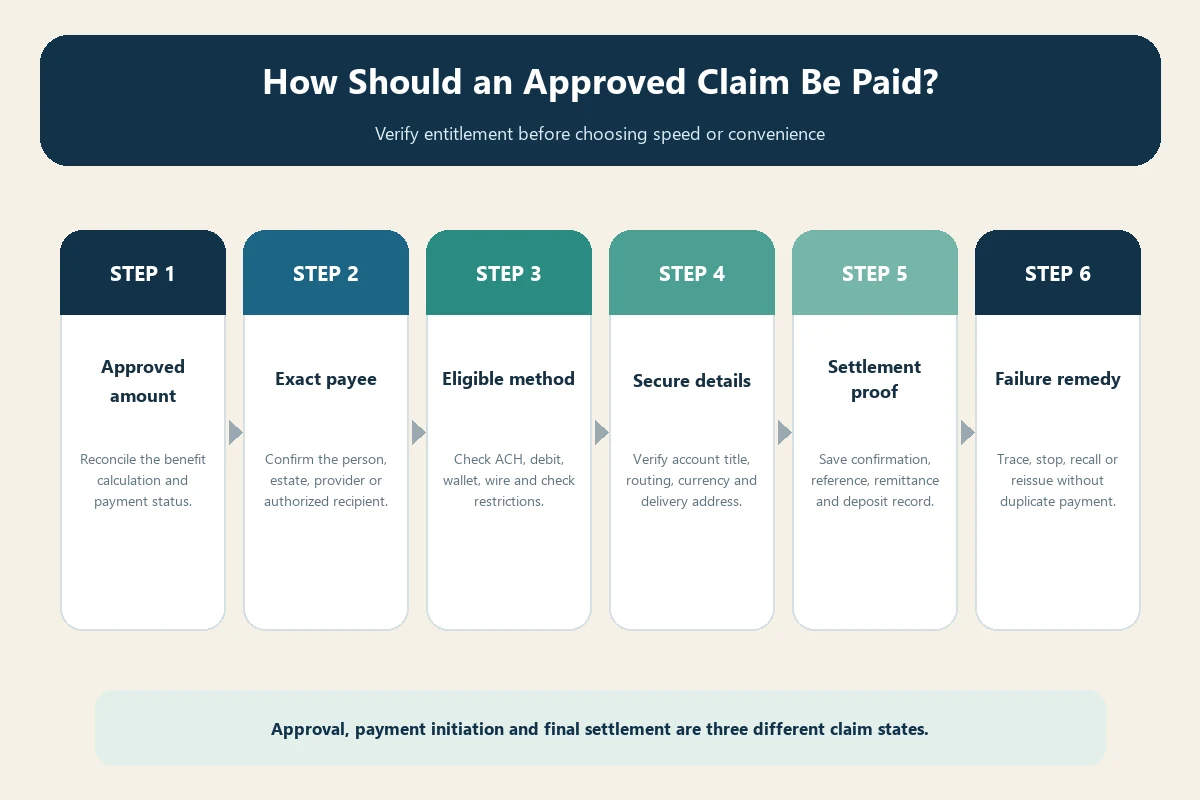
Start with the approved payment statement
Obtain a written explanation showing claim number, benefit, approved amount, deductions, currency, approved payee, and payment status. Reconcile it with the requested amount before entering account information. If the calculation is unclear, use our partial claim payment guide.
A message saying “your claim is approved” may precede payment enrollment. Record whether the status is approved, payment pending, initiated, settled, returned, stopped, voided, or reissued.
Identify the payee before the destination account
The insured traveler, expense payer, guardian, beneficiary, estate, medical provider, or another authorized recipient may be the proper payee depending on the benefit and policy. The person managing communications is not automatically entitled to receive funds.
Ask the administrator to state the approved payee name exactly. For a deceased traveler, follow the estate payment workflow. For a spelling or legal-name discrepancy, resolve it with the claim name mismatch guide before initiating payment.
Compare payment methods on the actual claim
| Method | Typical inputs | Questions to ask |
|---|---|---|
| ACH/direct deposit | Account holder, routing and account number | Personal or business account? Amount and country limits? |
| Debit disbursement | Eligible debit card and verified identity | Card and transaction limits? Fee? Expiration? |
| Zelle or wallet | Registered email or mobile number | Is the identity already enrolled to the correct account? |
| Paper check | Exact payee and deliverable mailing address | Delivery time, joint endorsement, stale date, stop/reissue? |
| Wire transfer | Account, bank, SWIFT and intermediary details | Currency, fees, supported countries, return risk? |
Do not assume every method appears on every claim. Limits may cause a large electronic payment to be converted to a check.
Get these answers before making an irreversible selection
Ask whether the payment-choice link expires, whether a selected method can be changed before initiation, and what happens if no choice is made. Confirm the maximum and minimum amount, supported account country, permitted account type, expected sender name, and whether a fee can be deducted. For a check, ask whether delivery is tracked and how long the instrument remains valid.
Also ask whether the administrator will issue one payment per claimant, one per benefit, or one combined settlement. That answer affects reconciliation and can prevent a family from mistaking a partial installment for the full decision. Save the written response with the approval, because the portal’s available buttons may not explain why a method is missing or why the payment was divided.
Understand published U.S. payment examples
Generali Global Assistance lists bank transfer, debit card, Zelle, PayPal, and check for eligible U.S. claim payments, with different estimated delivery times. Its process includes identity verification and a time-limited payment selection.
Allianz Travel Insurance says direct deposit may take two to five business days after approval, while a mailed check may take longer. It also describes electronic-payment limits and situations where a check may be used instead. These are examples, not promises for another insurer.
Verify the bank account type and title
Copy the routing number, account number, and account title from the bank’s official record rather than memory. Confirm checking versus savings and whether the routing number is for ACH, wire transfers, or both. Do not use a credit-card number in an ACH field.
Ask whether the administrator accepts a joint personal account when only one joint owner is the payee. If the approved payee is an estate, trust, business, minor, or provider, do not assume a personal account is acceptable.
Keep reimbursement ownership separate from convenience
A family organizer may prefer one deposit, but multiple insured travelers can have separate covered losses and payees. Document who paid each expense and how the insurer allocated the benefit. Our family claim allocation guide prevents household totals from being routed without ownership support.
If an alternate payee is needed, request the administrator’s official authorization form. Record who authorizes the change, the legal capacity used, and whether the change affects only delivery or also benefit entitlement.
Use the insurer’s secure enrollment channel
Start from the insurer or administrator’s official website or a verified claim portal. Confirm an unexpected enrollment email by calling the published number, not the number in the message. Check the claim number and approved amount before continuing.
Our claim payment phishing guide provides a separate sender, link, and bank-change verification process. Never send full account credentials, password, PIN, or one-time login code to an adjuster.
Review the final screen before authorization
- Approved payee matches the account holder or authorized alternative.
- Routing number is correct for the selected transfer type.
- Account number and checking/savings selection are correct.
- Currency and expected net amount are stated.
- Fees, limits, and estimated delivery are understood.
- Email, phone, and mailing address are current.
- A confirmation or reference number will be generated.
Save a redacted confirmation that shows the last digits rather than storing unnecessary full bank details in the general claim folder.
Paper checks require their own controls
Confirm the exact payee line, mailing address, mailing date, delivery method, check number, amount, and stale-date rule. A “care of” mailing line helps delivery but does not change the payee. Do not endorse a check until the bank confirms how it handles multiple payees or estate language.
If the check is lost, sent to an old address, damaged, or incorrectly named, request stop payment and reissue in writing. Ask whether the old check is void and obtain the new issue date and number.
Track an electronic payment after initiation
Record the initiation date, payment reference, destination last digits, expected settlement range, and originating entity shown on the remittance advice. Check the account ledger, not only a notification email. Weekend, holiday, bank-review, and intermediary processing can affect timing.
Use our claim status follow-up guide to ask whether the transfer was merely scheduled or actually released.
Diagnose a failed direct deposit
Ask for a factual status: rejected before initiation, returned by receiving bank, account closed, invalid routing, name or account-type issue, exceeded limit, compliance review, or processing error. Request the return date and trace or reference number where available.
Do not repeatedly re-enter the same data without identifying the failure. Allianz explains that failed electronic disbursements may result in a paper check; the actual remedy depends on the administrator.
Request a payment trace without exposing credentials
Provide the claim number, approved amount, payment date, method, payee, and confirmation number. Share only the minimum account identifier requested through a secure channel. Ask the sender for its payment trace and the bank for its incoming-payment search requirements.
A trace addresses delivery, not the coverage calculation. Keep payment-trace correspondence separate from any appeal about the approved amount.
Handle wrong-account or wrong-payee instructions immediately
Contact the administrator through a verified channel as soon as the error is discovered. Ask whether the payment can be stopped or recalled and what written correction is required. Then contact the bank using its official support process.
Do not promise that a recall will succeed. Preserve the submitted instructions, confirmation screen, timestamps, calls, bank responses, and final disposition.
Reconcile fees and currency
A claim may be calculated in U.S. dollars even when an expense or destination account uses another currency. Ask which exchange-rate date applies, whether the sender or intermediary deducts fees, and what amount the recipient should expect.
Compare the remittance advice with the amount credited. A bank fee or conversion difference is not automatically an underpayment by the insurer, but it should be documented before the file is closed.
Prevent duplicate payment and recovery errors
If a check arrives after an electronic deposit, do not negotiate both. Notify the administrator and ask which instrument is valid. Likewise disclose later supplier refunds or other-insurance payments that affect net loss.
Keep the approved calculation, payment record, deposit confirmation, and any refund reconciliation together. Our claim supplementation guide explains how to report a later financial change.
Payment file checklist
- Approval and benefit calculation
- Exact approved payee and supporting authority
- Selected method and eligibility confirmation
- Redacted enrollment confirmation
- Remittance advice and payment reference
- Bank credit or deposited-check evidence
- Trace, stop, return, or reissue records if needed
- Final reconciliation with refunds and other payments
A U.S. Chubb travel claim form illustrates why payee capacity, account title, routing details, and payment choice belong in the claim record. Always use the form issued for your own policy.
Final review
Confirm the benefit amount, payee, account eligibility, method limits, currency, fees, and delivery details before authorizing payment. Then save the confirmation, monitor the stated settlement period, and escalate with a traceable status request if funds do not arrive.
The fastest option is only useful when it reaches the right recipient. A strong payment workflow connects the policy’s entitlement decision to a verified payee, supported destination, secure channel, and complete settlement record.
