
When a travel insurance claim is reassigned to a new examiner, the claim does not automatically restart. The practical risk is a weak handoff: attachments may be present but poorly labeled, phone commitments may not appear in the notes, and an earlier request may still look open even after you answered it.
This guide shows U.S. travelers how to preserve the record, verify the new owner, reconcile open items, and respond without flooding the file with duplicates. The issued policy, administrator instructions, and applicable state rules control the actual claim.
Understand what may have changed
“New examiner” can describe several different events. The previous employee may have changed roles or left. A workload may have been redistributed. The file may have moved to a medical, baggage, fraud, recovery, appeal, payment, or complex-claims unit. An insurer may also use a third-party administrator while remaining the underwriting insurer.
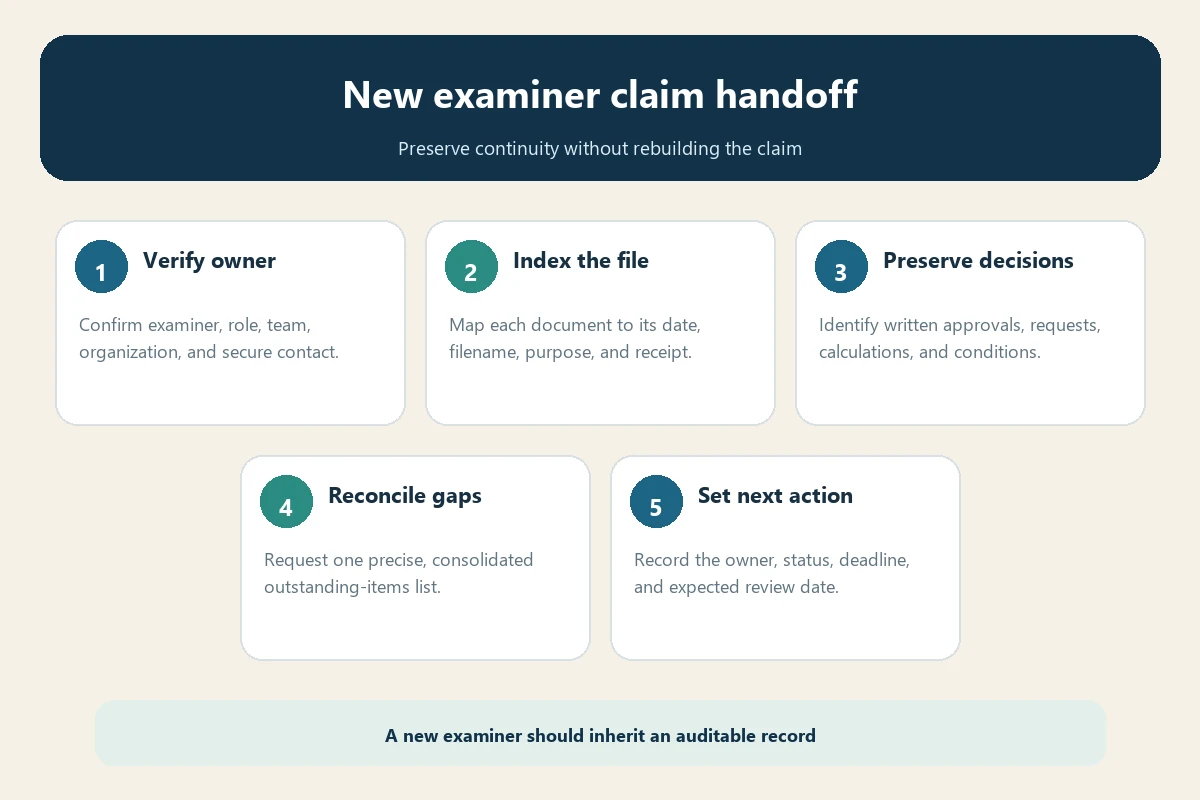
Ask for the full name, role, organization, direct contact channel, supervisor or team, and effective transfer date. Then confirm whether the claim number, administrator, insurer, policy interpretation, submission portal, and deadlines remain the same. Do not send sensitive records to a new address until you verify it through the official portal, policy contact, or published claims number.
Create a one-page handoff ledger
Prepare a compact index the new examiner can audit. It should not argue the entire claim. Include:
- claim number, policy number, insured traveler, benefit, and loss date;
- the original submission date and completeness confirmation, if any;
- each later request, response date, filename, and delivery receipt;
- written approvals, denials, calculations, or accepted facts;
- unresolved questions and the person currently responsible for each;
- the latest stated deadline, promised review date, and payment status.
Link each ledger row to one stable filename. The claim record-retention guide explains how to preserve the issued policy, correspondence, receipts, and final disposition.
Verify that the file transferred, not just the claim number
Ask the new examiner to confirm access to the major document groups rather than simply saying, “Do you have my file?” List the claim form, policy, itinerary, incident evidence, medical or carrier records, itemized invoices, payment proof, refunds, other-insurance decisions, authorizations, and prior correspondence as applicable.
| Handoff check | Useful confirmation | Weak answer |
|---|---|---|
| Ownership | Named examiner, team, effective date | “Someone will review it” |
| Documents | Files visible with dates and page counts | “The portal has uploads” |
| Prior decisions | Decision letter or note identified | “I will look into it” |
| Open items | Consolidated list tied to claim facts | Old generic checklist resent |
| Timing | Next action, owner, and expected date | No defined step |
If the examiner cannot locate a file, use the document upload troubleshooting guide to verify format, destination, receipt, and an approved alternate channel.
Preserve prior statements by their authority level
Not every earlier statement has the same effect. Separate an automated status, customer-service explanation, assistance authorization, examiner request, coverage decision, calculation, and formal appeal outcome. Preserve the exact wording, sender, date, conditions, and attachments.
A phone comment may explain a next step but may not amend the policy or constitute a final benefit decision. Send a same-day written summary: who spoke, what was discussed, what each party agreed to do, and the deadline. Ask for correction if your summary is inaccurate.
Do not ask the new examiner merely to “honor everything the old examiner said.” Instead, identify the specific written fact or decision: a document was accepted, a benefit was approved subject to conditions, an amount was calculated, or more evidence was requested. Ask whether that item remains in effect and request the governing reason for any change.
Distinguish a fresh review from repeated-document failure
A reassigned examiner may legitimately identify an unresolved fact. The key question is whether the request is new, narrower, or a duplicate. Compare wording, date range, traveler, expense, and benefit. If it repeats an answered request, attach the relevant row from your request-response matrix and delivery proof.
The repeated document requests guide helps distinguish nonreceipt, unreadable files, insufficient content, version conflicts, and a new review stage. Do not resend the entire archive every time ownership changes.
Ask for one consolidated outstanding-items list
Request a written list that states the missing document or fact, why it is needed, the acceptable format, the relevant date range, and the response deadline. If nothing remains outstanding, ask the examiner to confirm that the file is complete for review and identify the next step.
Allianz’s U.S. claims-process page describes uploading supporting documents and later review by a claims examiner. Travel Guard’s document page organizes evidence by claim type. These carrier examples illustrate why “all documents received” and “enough information to decide the benefit” are related but different statuses. Follow your own administrator’s current instructions.
Use a written introduction to the new examiner
Re: Claim [number]. I understand that you became the assigned examiner on [date]. Please confirm that you can access the attached handoff index and the listed files, including [key groups]. The prior record reflects [specific written decision or accepted item] dated [date]. The remaining items currently shown are [list], and I responded on [dates] under confirmations [IDs]. Please identify any precise unresolved fact or missing file, confirm the current claim status, and provide the next action and expected review date. I will follow the policy and current written claim instructions.
Attach the index, not a disorganized mailbox export. If the examiner asks for a new copy, label it as a resubmission and retain both receipts.
Work through a reassignment example
Suppose the first examiner requested an airline cancellation notice and proof of the supplier refund. You submitted both on July 10. On July 16, the examiner wrote that the documents were received and that the expense calculation would follow. A new examiner takes ownership on July 22 and sends the original generic checklist again.
Do not reply that the claim was already approved unless the July 16 message actually says that. Instead, send the handoff ledger showing the two filenames, July 10 upload receipt, July 16 acknowledgment, and the unresolved calculation. Ask the new examiner to confirm access and state whether any field in those records is insufficient. This preserves the earlier acknowledgment without turning it into a coverage decision it was not.
If the new examiner confirms that both files are readable but needs a final airline settlement showing a later refund, that is a new evidence gap. Add a new ledger row and respond to it. If the examiner cannot see the July 10 uploads, mark the resubmission with the original and new confirmation IDs. In both cases, the chronology remains intact.
If a promised calculation date passes during the transfer, ask whether the reassignment changed the expected review date and why. Preserve the earlier estimate, but treat it as an estimate unless the policy, law, or formal notice gives it a different status.
Track deadlines through the transfer
Record policy notice, proof-of-loss, document-response, appeal, and limitation dates separately from an examiner’s estimated review date. Do not assume reassignment extends your deadline. If ownership is unclear, respond through the established official channel and state that the submission is intended to preserve the deadline.
For status requests, use the travel claim status follow-up guide. Ask for the last completed action, present status, open dependency, next owner, and expected date. That produces a more useful record than repeated messages asking only whether there is an update.
Handle a changed administrator carefully
A new individual examiner is not the same as a new claims administrator. If a notice says another company now handles the claim, verify the change through the insurer or established portal. Ask whether claim number, privacy authorization, payment instructions, appeal address, and prior submissions carry over.
Do not provide bank details in response to an unexpected reassignment email. The claim payment scam guide explains how to verify domains, telephone numbers, payment requests, and changed banking instructions.
When to escalate a failed handoff
Contact a supervisor when no examiner is identified, the new examiner cannot access material files, documented decisions disappear without explanation, deadlines pass without a defined action, or the file is repeatedly reassigned without continuity. Provide the handoff ledger and ask for one accountable owner.
If internal channels do not resolve the problem, follow the policy’s complaint procedure and the appropriate regulator’s process. The NAIC state insurance department directory provides official state contacts. Requirements and timing vary by jurisdiction; describe the facts and attach the record rather than asserting a universal deadline.
Do not confuse an examiner with your representative
The claim examiner evaluates the submission for the insurer or administrator. The examiner is not the traveler’s advocate, attorney, public adjuster, medical adviser, or financial adviser. Travel claims also use different roles from property-loss claims, so generic advice about hiring a public adjuster may not fit a travel benefit.
For complex disputes, estates, incapacity, significant medical records, suspected fraud, or legal deadlines, consider qualified advice appropriate to the claim and state. Continue preserving the record while obtaining help.
New examiner handoff checklist
- Verify the new examiner’s identity, organization, role, and secure channel.
- Confirm claim number, administrator, benefit, and transfer date.
- Send a one-page ledger tied to stable filenames and receipts.
- Identify prior written decisions and their conditions.
- Ask the examiner to confirm access to each major document group.
- Request one consolidated outstanding-items list.
- Record the current status, next action, owner, and expected date.
- Preserve every policy and appeal deadline during the transfer.
- Escalate with facts if ownership or continuity remains unclear.
A clean handoff protects both sides from reconstructing the claim from memory. The goal is not to force an immediate outcome; it is to ensure the new examiner inherits the same evidence, decisions, open questions, and deadlines that existed before reassignment.
