

The reliable way to compare Europe travel insurance policies is to place the state-specific certificates side by side and record each benefit’s trigger, limit, deductible, sublimit and exclusion. Compare price only after the coverage fields are normalized. A quote card, star rating or “comprehensive” label cannot show whether the plan fits your countries, health needs, prepaid cost and activities.
Key takeaways
- Use the certificate issued for your state of residence and intended purchase date.
- Compare benefit triggers and definitions before comparing dollar limits.
- Write down the page number supporting every result.
- Normalize medical, evacuation, cancellation, delay and baggage terms.
- Mark unanswered questions “clarify”; do not fill gaps with assumptions.
Start with a trip specification, not a quote
A policy is suitable only in relation to a particular trip. Before opening a comparison site, write a one-page trip specification:
- state of residence for every traveler;
- traveler ages on the relevant date;
- departure and return dates, including overnight travel;
- every country, transit point, island and cruise port;
- eligible prepaid nonrefundable cost;
- medical conditions, recent treatment and medication changes;
- planned activities, vehicles and sports;
- existing US health, homeowners, auto and credit-card protection; and
- the largest loss you could not comfortably absorb.
Use the multi-country Europe itinerary checklist if the route crosses borders. It helps prevent a quote that covers the main destination but misses a side trip, activity or overnight return date.
Obtain the correct documents
For each plan, save the quote, schedule of benefits, full certificate and every endorsement. Confirm that the documents match the traveler’s state of residence. Insurance forms can differ by state, and a marketing summary may use broader wording than the certificate.
Record:
- insurer and administrator;
- plan name and form number;
- state and certificate version;
- quote date and premium;
- coverage dates;
- free-look or review period; and
- customer-service answer and date for every clarification.
Our guide to reading a travel insurance policy explains the hierarchy: the schedule gives the numbers, definitions give terms their meaning, benefit sections set triggers, exclusions remove coverage and endorsements change the form.
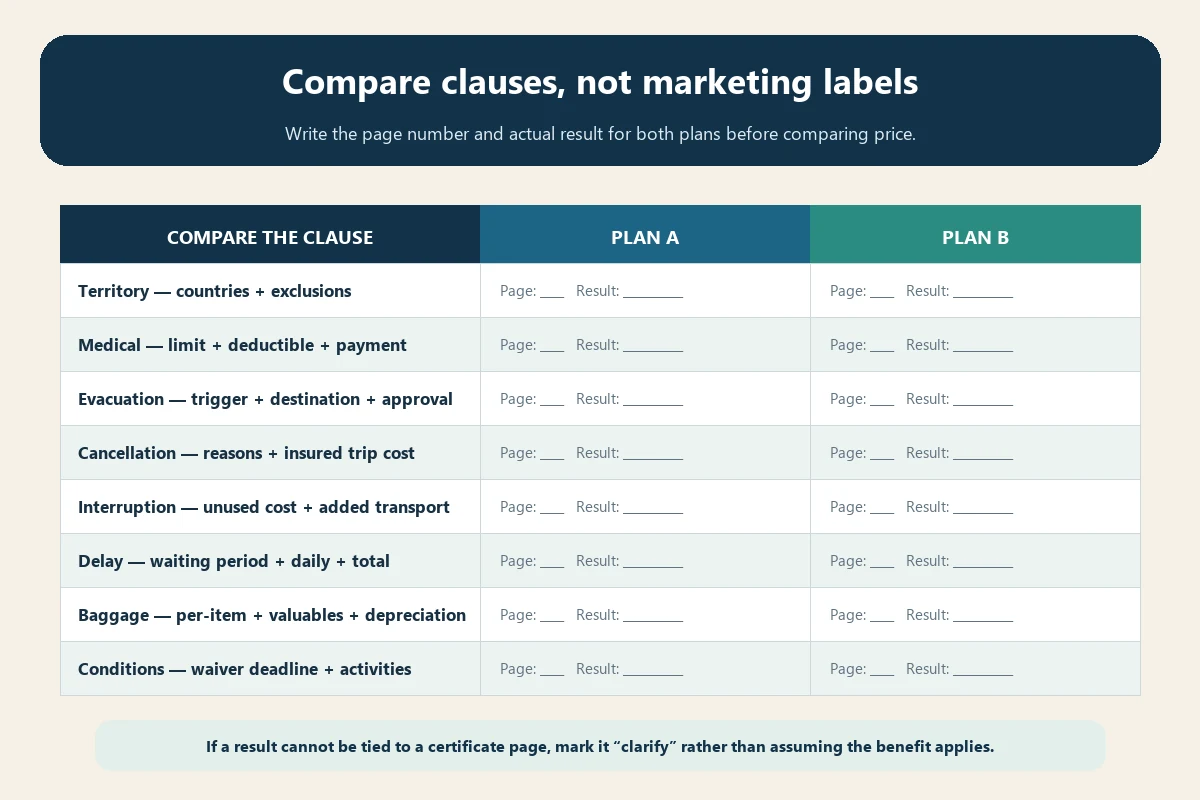
The eight-field Europe policy comparison
1. Territory and destination restrictions
Copy the geographic definition. List every country in the itinerary and any excluded country or region. Then record advisory, war, civil-unrest, sanctions and known-event wording. “Europe” is not a standardized territory, and Schengen is not a substitute for the certificate.
If the route involves current risk information or multiple legal groupings, use the Europe country exclusions and advisories guide to separate territory from cause-of-loss exclusions.
2. Emergency medical coverage
Write more than the maximum. Record:
- primary or secondary status;
- deductible and how often it applies;
- coinsurance;
- preauthorization rules;
- payment or reimbursement process;
- pre-existing condition language;
- emergency dental, prescriptions and therapy sublimits; and
- excluded activities or providers.
Plan A may show a lower medical maximum with direct-payment assistance, while Plan B shows a higher maximum but requires the traveler to pay and claim. Neither is automatically better. Match both to the exposure framework in the Europe coverage limits guide.
3. Medical evacuation and repatriation
Record the limit, but also answer:
- Who decides that evacuation is medically necessary?
- Is prior approval required?
- Does transport go to the nearest suitable facility or another destination?
- Are search and rescue separate?
- Are a medical escort, companion visit or return of dependents included?
- Is return of remains a separate sublimit?
The CDC notes that an insurer generally controls the medical-evacuation decision. A large number without workable approval and destination terms can be less useful than it appears.
4. Trip cancellation
Compare the list of covered reasons, not only “100% of trip cost.” Record how illness, a non-traveling family member, weather, terrorism, jury duty, supplier default and home damage are defined. Check the pre-existing condition waiver and its purchase deadline.
Then verify how points, vouchers, supplier refunds and later trip payments affect insured cost. If the certificate requires all eligible costs to be insured, an incomplete amount can affect more than the maximum payment.
5. Trip interruption
Separate unused trip cost from added transportation. A plan may calculate them under one combined maximum or under different terms. Record whether the benefit can pay to return home, rejoin the trip or both. Check class-of-service rules and how the original ticket credit is handled.
6. Trip delay and missed connection
Write down:
- minimum delay hours;
- covered causes;
- daily reimbursement cap;
- total cap;
- eligible meals, lodging and transport;
- carrier-proof requirements; and
- whether separate-ticket or cruise connections qualify.
A plan with a larger total may still pay less for one overnight if its daily limit is smaller. Compare the actual likely expense, not the total in isolation.
7. Baggage and personal property
Record the total baggage maximum, per-item cap, valuables sublimit, depreciation method and carrier-first requirement. Check electronics, cameras, jewelry, sports gear and medical devices separately. Also compare the baggage-delay waiting period and whether it applies only on the outbound journey.
8. Conditions, waivers and activities
Use this final row to capture conditions that can change the whole comparison:
- pre-existing condition waiver deadline;
- requirement to insure the full trip cost;
- medical ability to travel at purchase;
- maximum trip duration;
- age limits or benefit reductions;
- skiing, hiking, cycling, diving or motorbike rules;
- work or study exclusions; and
- state-specific changes.
A deductible is one of these conditions, not the whole medical comparison. Use the Europe travel insurance deductibles guide to compare per-trip, per-person and per-incident wording.
Label each result: must-have, useful or self-insured
A comparison becomes easier when every field has a role. Mark a benefit must-have when an uncovered loss could cause serious financial or practical harm. Emergency medical care for a traveler without confirmed overseas health cover is a common example. A high evacuation limit may be must-have on a remote island itinerary, while the same traveler may accept a modest baggage limit.
Mark a benefit useful when it would reduce disruption but the traveler could absorb the loss. A larger trip-delay allowance, lower baggage waiting period or rental-equipment benefit can fit this group. Compare the added premium with the realistic expense, not the maximum theoretical payout.
Mark a risk self-insured only when the traveler has deliberately decided to pay it. A $200 baggage deductible may be acceptable to someone carrying ordinary clothing. A six-figure medical or evacuation exposure is a different decision. Record the reason for every label so price does not quietly turn a must-have benefit into an unexamined gap.
How to compare price fairly
Do not divide the plans into “cheap” and “expensive” until the benefit design is normalized. Use this sequence:
- Remove a plan that does not cover a must-have destination, traveler or activity.
- Resolve unclear eligibility and pre-existing condition questions.
- Compare catastrophic medical and evacuation exposure.
- Compare the net trip cost and disruption budget.
- Identify duplicate credit-card or health-plan benefits.
- Calculate the maximum deductible and likely coinsurance.
- Only then compare premium.
A $40 premium difference can be irrelevant if one plan leaves a material activity excluded. A $400 difference can be difficult to justify if the added benefits duplicate protection you already have. The guide to travel insurance cost drivers explains why age, trip cost and selected benefits can move quotes.
Worked comparison: same headline, different result
Assume two policies each advertise $250,000 in emergency medical coverage.
| Field | Plan A | Plan B |
|---|---|---|
| Deductible | $0 | $250 per incident |
| Payment | May arrange a guarantee of payment | Reimbursement after traveler pays |
| Pre-existing waiver | Available if deadline and trip-cost rules are met | Not included in the quoted form |
| Planned hike | Included below the stated altitude | Requires an activity upgrade |
The medical maximum does not decide the comparison. The relevant traveler may value waiver eligibility and the activity term more than the deductible. Another traveler without a pre-existing condition or planned hike may reach a different result. The example is a method, not a product recommendation.
Red flags in a comparison
- No full certificate is available before payment.
- The quote does not identify the underwriting insurer.
- The document is for a different state or plan version.
- A benefit is described with marketing language but no defined trigger.
- Customer-service answers cannot be tied to the certificate.
- The seller guarantees a claim result.
- A large limit hides a small per-item, daily or service sublimit.
- The policy excludes the trip’s main activity or destination.
Use the standard travel insurance exclusions guide to check medical, conduct, activity and property risks. If a benefit already exists on a card, compare its activation rule and limits with our credit-card versus standalone policy guide.
Questions to send the insurer
- Which certificate and state endorsement apply to this quote?
- Are all listed countries and activities eligible?
- How often does the medical deductible apply?
- Can the assistance team arrange direct hospital payment?
- Where would an approved evacuation take the traveler?
- Does the pre-existing condition waiver apply to this purchase date and trip cost?
- How are points, vouchers and supplier refunds valued?
- Which document proves a delay or missed connection?
Save the response with the certificate. A chat transcript cannot amend the policy, but it can reveal a misunderstanding before purchase and create a useful record of what was asked.
Sources and methodology
This worksheet was checked against the NAIC travel insurance consumer guide, the CDC Yellow Book travel insurance chapter, the US Department of State insurance checklist, and the California Department of Insurance guide to policy documents. The examples are illustrative and do not describe a particular product. The state-specific certificate determines coverage.
Editorial note: This article provides general educational information for US travelers. It does not rank or recommend an insurer and is not medical, legal or financial advice.
Preparing to purchase? Follow the Europe trip insurance checklist to record trip facts, verify existing benefits, audit the certificate and save the right evidence before checkout.
