

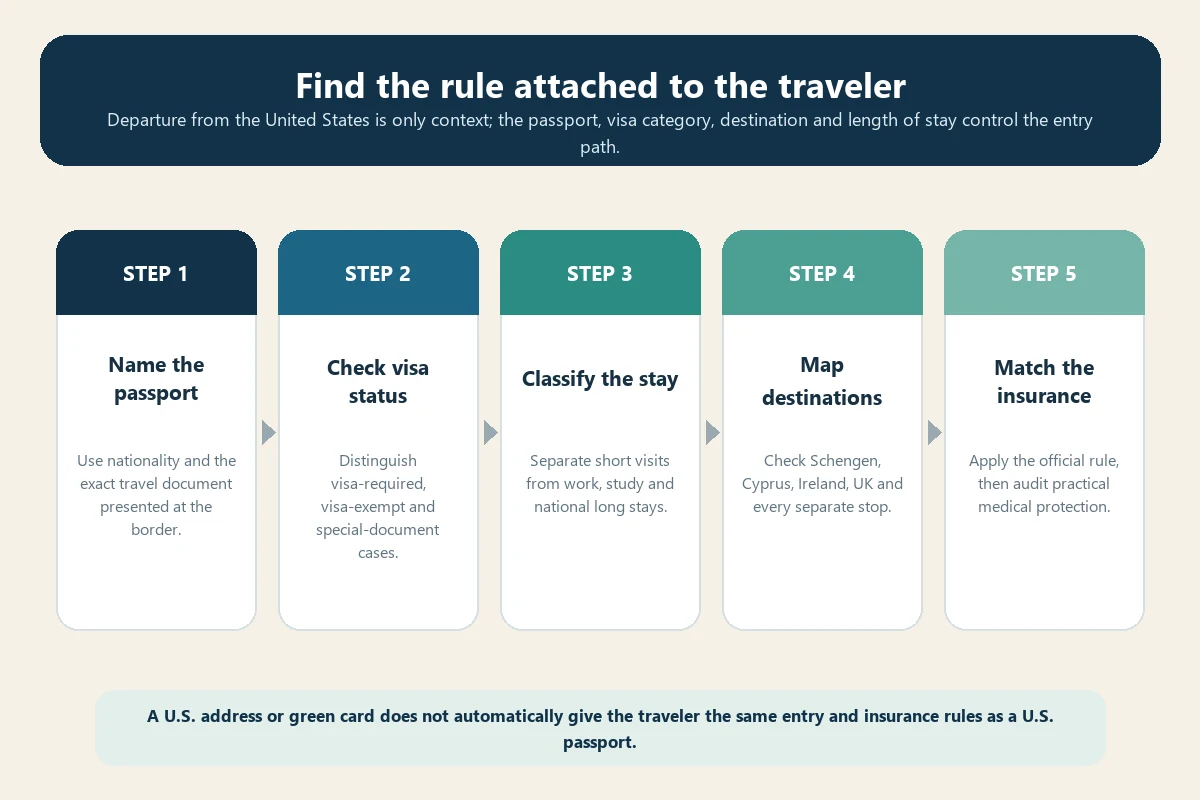
Europe entry insurance requirements by nationality should be checked against the passport or travel document used for the trip, not only the traveler’s U.S. address or departure airport. A U.S. citizen, a U.S. green-card holder using another country’s passport and a dual citizen using an EU passport can leave on the same flight yet follow different visa and insurance paths.
Key takeaways
- Nationality and the exact travel document usually determine whether a short-stay Schengen visa is required.
- Ordinary short-stay visa applicants generally need compliant travel medical insurance under Article 15.
- Visa-exempt travelers do not become visa applicants merely because they live in the United States.
- Long-stay, work, study, residence and special-document cases can follow national or separate EU rules.
- Insurance that is not an entry-file requirement may still be valuable for medical and evacuation costs.
Rules reviewed August 16, 2026. Visa-exemption lists and national procedures can change. Confirm the live rule with the destination’s official authority.
Why nationality matters more than departure city
An airline itinerary shows where a journey begins. It does not establish citizenship. A traveler can reside in Texas, hold a green card and present an Indian, South African or other passport. Another traveler can reside in the same state and present a U.S. passport. A dual national may be required or strongly advised to use a particular passport for parts of the journey.
The European Commission’s visa policy page points to separate lists of nationalities whose citizens require a visa and those exempt for qualifying short stays. The underlying Regulation (EU) 2018/1806 organizes those nationalities in Annex I and Annex II, with document-specific qualifications and special cases.
Use the green-card holder guide if U.S. residence and a foreign passport apply. The dual-citizen insurance guide covers passport selection and conflicting document identities.
A passport-first classification table
| Traveler profile | First rule to check | Insurance consequence |
|---|---|---|
| U.S. passport, qualifying short visit | Visa exemption and ETIAS timing | No uniform-visa insurance file; practical coverage remains optional |
| U.S. resident, visa-required passport | Consulate and Visa Code | Compliant medical insurance generally belongs in the application |
| EU or Schengen citizen using that passport | Citizen movement and document rules | Not a third-country Schengen visa insurance case |
| Long-stay student, worker or family applicant | National visa or residence rules | Different health-insurance standard may apply |
| Refugee, stateless or special travel document | Document issuer, destination and exemption | Do not infer the rule from U.S. residence alone |
Visa-required short stays
For an ordinary uniform-visa application, Article 15 of the Visa Code requires adequate and valid travel medical insurance. It addresses expenses connected with medical repatriation, urgent medical attention, emergency hospital treatment or death. Coverage must generally apply across the Member States for the intended stay or transit, with a €30,000 minimum.
That rule is tied to the visa application, not the U.S. airport. The applicant generally buys insurance in the country of residence, although the Code allows purchase elsewhere when necessary and permits another person to insure the applicant. Consular instructions can add documentary detail, such as required certificate wording, insurer eligibility or original signatures.
The Schengen insurance requirements guide turns the legal rule into a certificate checklist. The buying from the United States guide covers state eligibility, payment currency and support hours.
Visa-exempt short stays
A visa-exempt traveler does not submit a uniform-visa application and therefore does not provide the Article 15 certificate as part of that nonexistent application. U.S. passport holders currently qualify for visa-free tourism or business visits in the Schengen area for up to 90 days in any 180-day period, subject to entry conditions.
The U.S. Department of State’s Europe travel page describes that short-stay framework for U.S. citizens. It also notes the planned late-2026 ETIAS launch. Until the official EU system opens, no ETIAS application is collected.
Visa exemption is not medical coverage. The traveler still needs to ask whether a domestic health plan pays abroad, whether evacuation is covered and how much prepaid trip cost is at risk. Insurance can be prudent without becoming a government application requirement.
ETIAS adds another authorization layer
The official EU ETIAS eligibility page lists visa-exempt nationalities and exemptions. It also explains that some recognized refugees, stateless persons, school-trip participants and residence-document holders require individual analysis. The travel document and destination set matter together.
ETIAS does not turn every visa-exempt traveler into a visa applicant. The current application-information page does not list an insurance certificate. Use the official EU site for launch status and application fields, then make a separate coverage decision from the traveler’s health plan and itinerary.
Long stays, work and study are different
The 90-in-180-day short-stay framework does not answer a semester, employment contract, family-reunification move or retirement residence. National authorities can require health insurance with different benefits, duration, deductibles, providers or proof formats. A short-stay €30,000 certificate may be insufficient even when it looks familiar.
The long-stay visa insurance guide explains how to separate entry-phase travel coverage from resident health coverage. Applicants should use the consulate and immigration authority for the exact visa type rather than extrapolating from a tourist checklist.
Destination boundaries also change the answer
“Europe” is not a single immigration system. Ireland and the United Kingdom apply their own rules. Cyprus participates in ETIAS planning but is not yet a full Schengen member. European microstates and overseas territories can raise route-specific questions. A connection that enters a country is different from staying airside.
List each country, airport, port and overnight stop. Then check the official entry requirement for the passport being used. A policy’s territorial definition is a separate contract check; a plan marketed for Europe may define territory differently from an immigration authority.
Dual citizens and passport choice
A dual U.S.-EU citizen may be exempt from ETIAS when traveling with the relevant European passport, while the U.S. passport follows the visa-exempt third-country path. The official ETIAS page tells dual nationals of a participating European country or Ireland to use that European travel document for the trip.
Keep bookings, authorization records and insurance documents consistent with the selected travel identity. A certificate under one spelling or passport number can create friction even if the person is the same. Ask the insurer to reissue a corrected certificate; do not alter a PDF manually.
Five questions for a U.S.-based household
- Which passport will each traveler present? Record nationality, number and expiry.
- Is the visit short, long, work, study or transit? Purpose can change the required permission.
- Which countries are actually entered? Include connections and side trips.
- Does a visa, ETIAS or exemption apply? Use official sources for each traveler.
- What insurance is legally required and practically needed? Document these as two separate answers.
Families should classify every traveler separately
A family booking is not one immigration identity. A child may have a different passport, a parent may be a dual national and a grandparent may travel on a residence document. Age can also affect an ETIAS fee or a consulate’s document list without changing the underlying nationality. Build one row per person with passport, visa or exemption, coverage dates and certificate name.
When one policy covers the household, check that each insured appears exactly as required and that the territory and dates cover everyone’s route. A single family certificate may be convenient, but convenience does not correct a missing traveler or a passport mismatch. Carry consent and guardianship documents when the destination requires them; those are entry documents, not insurance benefits.
Common classification mistakes
- Assuming everyone departing the United States follows U.S.-passport rules.
- Treating a green card as a passport or EU visa waiver.
- Applying a short-stay insurance certificate to a national long-stay visa.
- Ignoring the passport actually used by a dual citizen.
- Treating the European Union, Schengen area, ETIAS area and geographic Europe as identical.
- Confusing “not required for entry” with “no financial need for insurance.”
Frequently asked questions
Do green-card holders use U.S.-citizen Europe rules?
Not automatically. The passport or travel document, destination, purpose and length of stay determine the entry path. U.S. residence remains relevant to where and how a policy can be purchased.
Do all nationalities need €30,000 of insurance?
The €30,000 rule belongs to the ordinary Schengen short-stay visa framework. Visa-exempt and national long-stay cases should not be reduced to that one rule.
Does an EU passport remove the need for private insurance?
It can change the immigration path, but it does not eliminate medical or trip risk. Public-health entitlements and private coverage require their own analysis.
Can one family have different requirements?
Yes. Family members can hold different passports, residence documents or visa statuses. Classify each person before choosing a shared policy.
Where should the traveler verify the rule?
Use the European Commission, the official destination authority and the consulate handling the exact visa type. Use insurer documents only for contract terms, not immigration interpretation.
This guide is educational and is not legal, immigration or insurance advice. Official authorities and issued policy documents control.
