

Proof of travel insurance at a border in Europe is useful to carry when a traveler is insured, but it is not a universal standalone entry document for every visitor. Schengen visa applicants usually submit insurance proof during the visa process. At the external border, officers assess the applicable entry conditions and may ask for supporting documents about the stay.
Key takeaways
- Travel medical insurance is generally a Schengen visa application requirement, not a blanket requirement for every visa-exempt visitor.
- An EU policy communication states that holding insurance is not an entry condition checked at external borders.
- Border officers can still verify passport, visa or authorization, purpose, length, lodging, return plans and sufficient means.
- A visa holder should carry the issued certificate because it supports consistency and provides assistance contacts.
- Answer the question actually asked and rely on current official destination guidance.
Border guidance reviewed August 16, 2026. Entry practices and national instructions can change. This page does not guarantee admission.
Is travel insurance checked at the Schengen border?
There is no sound basis for saying that every traveler must show an insurance certificate at every Schengen external border. The European Commission’s 2021 communication on travel medical insurance distinguishes the visa-file requirement from entry checks and states that holding the insurance is not an entry condition checked at EU external borders.
That does not mean documents never matter. A traveler must meet the conditions that apply to the passport, visa, authorization, purpose and stay. Border authorities decide entry. An officer can request supporting evidence and resolve inconsistencies. The safest practical approach is a compact, accurate folder rather than a legal claim that one document guarantees admission.
The Schengen insurance requirements guide covers the application stage. The insurance-proof rejection guide explains why an incomplete certificate can fail before travel.
Visa application and border entry are different decisions
| Stage | Main question | Typical insurance role |
|---|---|---|
| Visa application | Should a visa be issued for the intended trip? | Article 15 proof generally forms part of the file |
| Carrier check | May the traveler board with the presented documents? | Carrier may review destination documentation; private policy is not boarding permission |
| External-border check | Does the traveler meet entry conditions now? | Certificate can support consistency but is not the universal entry condition |
| Medical incident | Will the policy arrange or reimburse a covered service? | Contract terms and incident facts decide the claim |
A visa also does not create an unconditional right of entry. Circumstances can change between issuance and arrival. The border decision examines the traveler and trip presented on that day.
What the Schengen Borders Code focuses on
Article 6 and Annex I of the Schengen Borders Code address entry conditions and supporting evidence. The framework includes a valid travel document, any required visa, justification of purpose and conditions of stay, sufficient means, and security or alert checks. Annex I gives examples such as invitations, lodging evidence, organized-trip confirmation, travel plans and return tickets.
The list varies by purpose. A business traveler may carry an invitation and meeting evidence. A student may carry enrollment information. A tourist may use accommodation, itinerary and return evidence. Officers apply the rules to the case; an exhaustive binder can be less useful than a small organized set that is easy to explain.
Why a visa holder should still carry the policy certificate
Carrying the certificate is low-cost and practical. It shows that the evidence used in the visa file remains available. It also gives the traveler the policy number, coverage dates, insurer identity and assistance contact needed during an emergency. If a route or date changed, a revised certificate can help explain the current trip.
Use the Schengen certificate audit to check the insured name, dates, territory, amount and required benefits. Do not edit the PDF. Ask the insurer to issue a corrected version and carry the document actually submitted or formally updated.
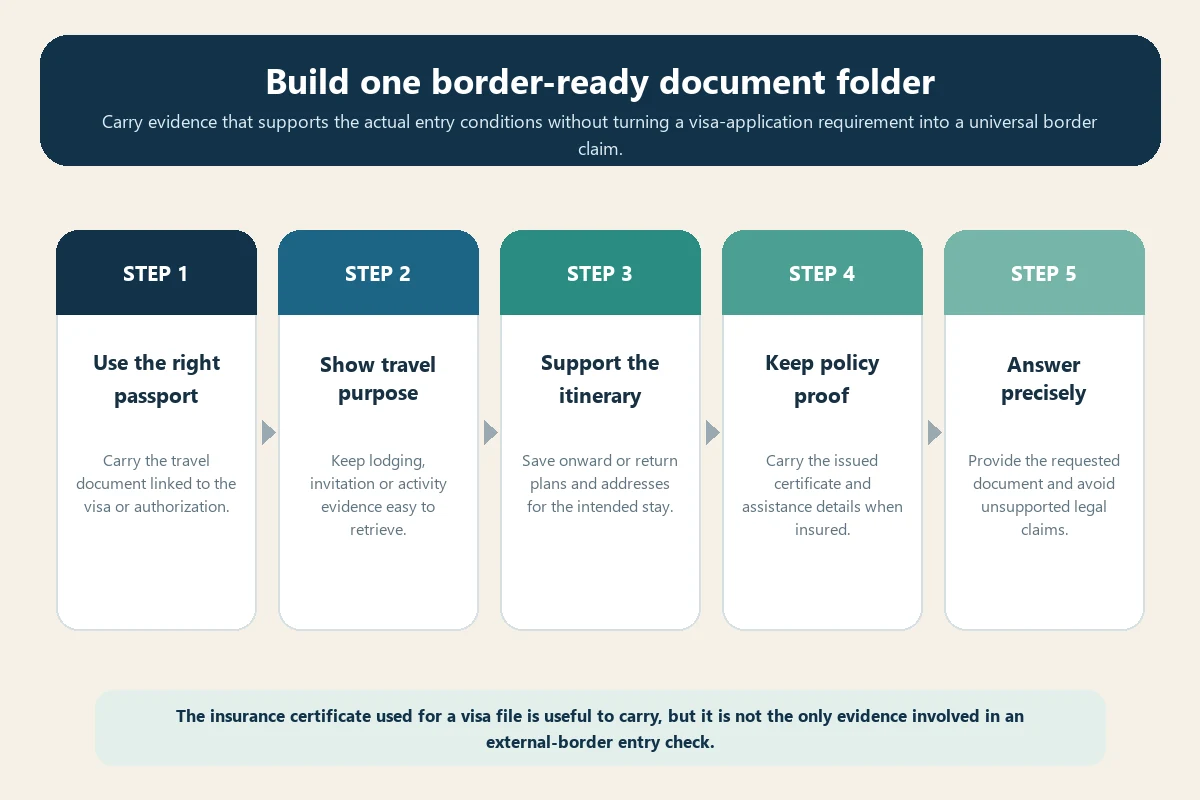
A practical border-ready folder
Keep digital copies available offline and carry paper where a dead battery, poor signal or damaged screen would create a problem. The folder may include:
- the passport or travel document used for the visa or authorization;
- the visa, residence document or authorization record when applicable;
- lodging confirmations or a host invitation and address;
- onward or return plans and a concise itinerary;
- evidence of funds when relevant to the entry conditions;
- travel insurance certificate, policy number and assistance details;
- documents supporting business, study, family or event purpose.
Protect personal data. Do not hand a stranger an unlocked phone containing unrelated financial or identity records. At an official checkpoint, retrieve the requested item and follow lawful instructions.
Visa-exempt travelers and ETIAS
Eligible visa-exempt travelers do not submit a uniform-visa insurance certificate. When ETIAS begins, the authorization will be linked to the travel document. The official ETIAS explanation says authorization does not guarantee entry and border guards will still verify the entry conditions.
The current ETIAS application information page also warns that applicants may be requested to provide relevant supporting documents each time they cross an external border. That broad reminder should not be rewritten as “ETIAS requires insurance.” The application list itself does not include an insurance certificate.
Route, dates and re-entry questions
A traveler can leave the Schengen area for the United Kingdom, Ireland or another destination and later re-enter. Each external crossing can involve another check. Carry continuous evidence when the itinerary has multiple entries and make sure the policy territory covers every destination for which protection is expected.
The territorial coverage guide distinguishes 29-country Schengen validity from broader Europe protection. The insurance dates guide explains why overnight flights and border-crossing dates can differ from hotel dates.
What to do if an officer asks for insurance
- Stay calm and clarify. Ask which document or information is needed.
- Present the issued certificate. Use the original digital or paper version, not an edited file.
- Explain the trip accurately. Keep answers consistent with lodging, return and purpose documents.
- Do not argue from a blog. A general article cannot decide an individual border case.
- Record the outcome later. If entry is refused or delayed, preserve written documents and seek qualified help.
The U.S. Department of State’s Europe page says the U.S. government can provide information but cannot influence a foreign government’s admission decision. Travelers should use official destination guidance before departure.
Carrier checks are not border rulings
An airline, ferry or bus company can review travel documents before boarding because it may bear responsibilities when a passenger lacks permission to travel. Its staff can request evidence through the carrier’s procedure, but that review is not the final sovereign admission decision. A traveler can pass a carrier check and still face questions at the border, or resolve a carrier question with documentation before departure.
Keep the passport, visa or authorization and route documents together at check-in. If staff requests insurance, present the issued certificate and ask which destination rule the system is applying. Escalate politely through the carrier when a rule appears mismatched to the passport. Do not buy an unknown policy at the gate merely to end a conversation without verifying what problem it is meant to solve.
Insurance proof does not prove claim coverage
A certificate summarizes selected facts. It does not display every exclusion, definition, deductible, sublimit or authorization condition. A border officer’s acceptance of a document is not a claims decision, and a consulate’s acceptance does not obligate payment for an excluded incident.
Carry the assistance number and full policy as well as the certificate. During a medical event, seek urgent care first and contact the assistance service as soon as practical. Keep itemized bills, medical reports, prescriptions and proof of payment.
Common border-document mistakes
- Claiming every visa-exempt visitor must show €30,000 of insurance.
- Leaving the certificate in an inbox that cannot be opened offline.
- Carrying a certificate with old dates after an itinerary change.
- Using a passport different from the one linked to the visa or authorization.
- Having insurance but no lodging, purpose or return evidence.
- Assuming a visa, ETIAS or policy guarantees entry.
Frequently asked questions
Must every U.S. citizen show travel insurance at a Schengen border?
No blanket Schengen rule makes the Article 15 visa-insurance certificate a universal entry document for visa-exempt U.S. visitors. Check the specific destination and trip.
Should a Schengen visa holder carry the certificate?
Yes. It is practical evidence from the visa file and contains information needed during an insured incident, even though it is not the only border document.
Can a border officer refuse entry despite a valid visa?
A visa does not guarantee admission. The traveler must still satisfy the applicable entry conditions at the border.
Is a phone copy enough?
Digital evidence can be convenient, but an offline copy and a paper backup reduce battery and connectivity risks. Follow any official document-format instruction.
Does ETIAS require insurance at the border?
The current ETIAS application list does not include insurance. ETIAS authorization and border entry remain separate, and travelers may be asked for supporting documents relevant to the applicable entry conditions.
This guide is educational and not legal or immigration advice. Border authorities and current official rules control each admission decision.
