

Schengen insurance for long stay visa applications is not governed by one universal policy formula. A stay beyond 90 days normally uses a national visa or residence route. The destination country may demand comprehensive health insurance, require a locally authorized insurer, or specify cover for the full intended residence period. Start with the exact visa category and its current official checklist. Do not buy a short-stay product first and hope it fits.
Key takeaways
- A short-stay Schengen visa and a national long-stay visa solve different immigration needs.
- The familiar Article 15 travel medical rule applies to Schengen visa applicants, not automatically to every national visa.
- Some long-stay routes reject ordinary travel insurance and ask for resident-style health insurance instead.
- Country, purpose, duration and U.S. consular jurisdiction can change the document checklist.
- Verify the insurer, benefits, exclusions, dates and post-arrival obligations before paying.
First decide whether the trip is short stay or long stay
The Schengen area has a common framework for short visits, usually up to 90 days in any 180-day period. Longer study, work, family and residence plans usually begin under national law. The EU Immigration Portal directs non-EU travelers to country-specific information for stays exceeding 90 days. Its guidance also distinguishes long-stay visas and residence permits from the rules used for short visits.
This distinction controls the insurance research. A traveler taking a 60-day course may need the familiar short-stay evidence. A student enrolling for an academic year may need a national study visa and comprehensive health cover. A remote worker, retiree or spouse may face another national standard. The destination, not the marketing name on a policy, determines which path matters.
Use the Schengen visa insurance requirements guide if the actual application is for a short-stay Schengen visa. For a national route, treat that guide as background only and open the responsible country’s official instructions.
Why the €30,000 rule may be the wrong test
Article 15 of the EU Visa Code describes adequate travel medical insurance for Schengen visa applicants. It addresses repatriation, urgent medical attention, emergency hospital treatment and death. It also establishes a €30,000 minimum. That is a useful baseline for the visa type covered by the Code.
A national long-stay application can ask a different question: will this person have health coverage comparable to a resident for the intended stay? The answer may involve outpatient care, routine treatment, waiting periods, copayments, deductibles, exclusions, local authorization and an entire year of validity. A travel policy can exceed €30,000 and still fail those conditions.
Spain offers clear official examples. The Spanish Consulate in Washington study-visa instructions require public or private health insurance from an entity authorized to operate in Spain. The page says travel insurance is not accepted. Its telework visa instructions likewise call for qualifying health cover rather than an ordinary travel plan. These are category-specific examples, not a rule for all Europe.
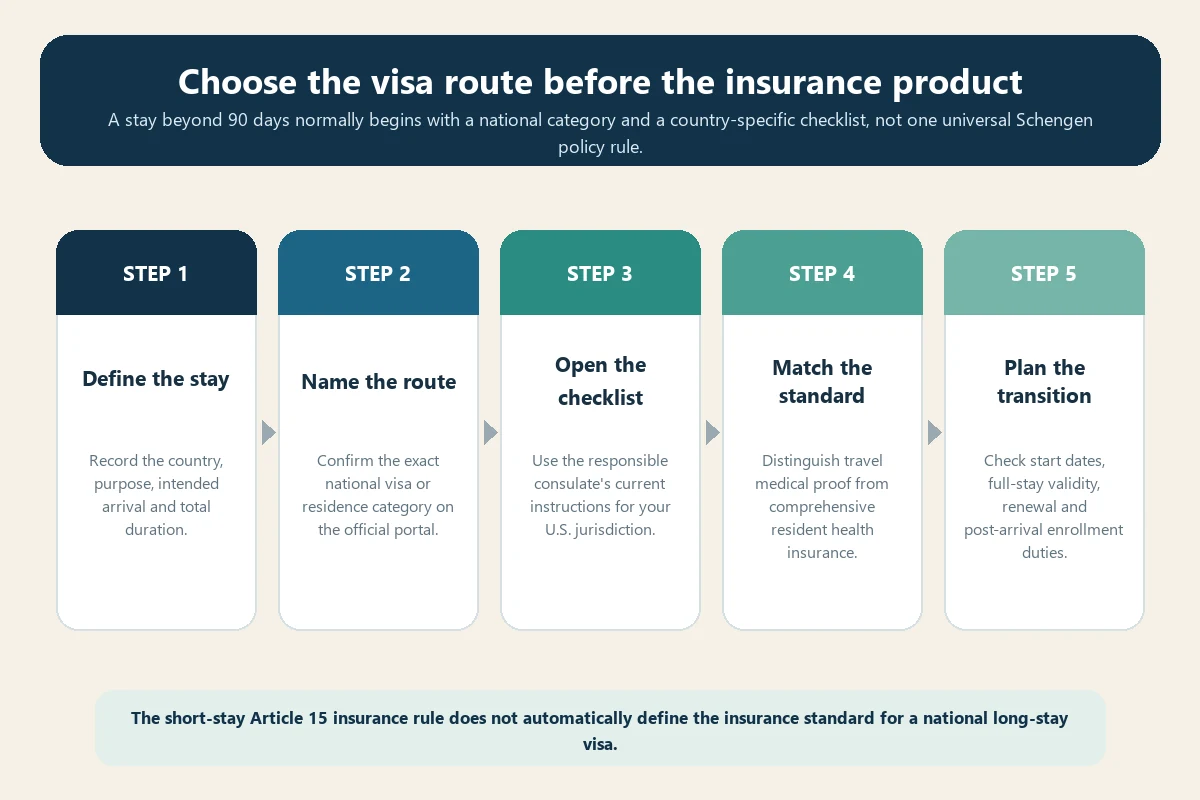
A country-first research method for U.S. applicants
Build a one-page requirement sheet before requesting quotes. Record the following:
- Destination country: use the country of intended residence, not every country that may be visited later.
- Exact route: study, employment, remote work, family reunification, retirement or another named category.
- Intended duration: include arrival, the full residence period and any required buffer.
- Responsible authority: confirm the consulate or application center serving the applicant’s U.S. residence.
- Insurance wording: copy each condition from the official checklist without paraphrasing it into a travel-policy feature.
- Post-arrival step: note whether the traveler must enroll in a national, employer or university system later.
Check the page’s update date and download a clean copy. Consular pages can change. A forum post, insurer landing page or checklist from a different city may be outdated or aimed at another jurisdiction. If the instruction is unclear, ask the responsible authority a narrow written question and retain the reply.
How to translate official wording into policy tests
| Checklist phrase | Question for the insurer | Evidence to request |
|---|---|---|
| Valid for the entire stay | Can one certificate show all required dates without a mid-stay renewal? | Dated certificate plus cancellation and renewal terms |
| No copayment or deductible | Does any covered service leave the member responsible for a fixed or percentage amount? | Schedule of benefits and cost-sharing page |
| Equivalent to public health cover | Are routine, specialist, hospital and ongoing services included at the required level? | Full policy wording and official compliance letter |
| Authorized in the destination | Which legal entity underwrites the plan, and is it permitted to operate there? | Insurer identity, license detail and destination confirmation |
| No coverage limit | Are there annual, condition-specific or service-specific caps? | Benefits table, sublimits and exclusions |
Do not accept a salesperson’s general assurance as the only evidence. Ask for the exact certificate that will be issued and the contractual sections supporting every answer. Our insurance certificate audit helps check identity and dates, while the Europe policy comparison worksheet records limits and exclusions. Apply both to the national checklist, not instead of it.
Plan the start date and the post-arrival transition
A long-stay timeline can contain several stages: travel to Europe, entry under the visa, a residence-card appointment, enrollment in a local system and later renewal. The same insurer may not cover all stages. A student plan may begin on the first day of classes, leaving orientation week uncovered. An employer plan may begin after registration. A private policy may be used for the visa but need replacement after residence begins.
Draw the complete date line before choosing coverage. Use the Schengen insurance dates method for flights and border days, then add national milestones. Confirm what happens if the visa appointment moves, approval is delayed or arrival changes. Check whether a policy can be shifted without canceling and repurchasing.
France illustrates the difference in document routes. The official France-Visas FAQ explains that a long-stay visa marked as such supports different mobility and validation steps than a short-stay visa. The insurance document should therefore be checked against the specific France-Visas wizard result, not a generic Schengen checklist.
Territory, side trips and return visits
A resident-style health plan may be strong inside the destination yet limited elsewhere. A traveler may also visit neighboring countries, return to the United States during a break or travel before the visa start date. Test these movements separately. Ask whether emergency care, evacuation and assistance work across the itinerary and whether leaving the residence country suspends any benefits.
The EU guidance for people already in the EU notes that a long-stay visa or residence permit issued by a Schengen country may support short travel to other Schengen countries under the 90-in-180 framework. That mobility permission does not itself expand a health policy’s territory. Use the multi-country Europe coverage guide to test side trips.
Frequent mistakes that cause weak applications
- Shopping by the phrase “Schengen compliant.” The label may address only a short-stay minimum.
- Using the wrong consulate’s checklist. Jurisdiction, category and document format can differ.
- Buying only for the flight dates. A long-stay route may require cover for the full requested residence.
- Ignoring exclusions. A high headline limit does not cure excluded routine care or existing conditions.
- Assuming renewal will be automatic. Age, residence, claims and maximum-duration rules may affect renewal.
- Confusing travel assistance with insurance. A service hotline is not evidence that medical costs are insured.
If a current policy will end before the required period, review the Schengen insurance extension guide. For a national application, obtain written confirmation that an extension or renewal structure satisfies the official full-period rule.
Long-stay insurance document checklist
Before the appointment, confirm that the file includes the correct insured name, passport details if requested, destination, policy dates, insurer identity and contact details. Add the benefit schedule, exclusions, proof of payment and any country-specific compliance certificate. If the policy has translations or stamped originals, follow the authority’s format instructions.
Open every document after downloading it. Check that no page is blank, cropped or password-protected. Compare the dates with the application form and accommodation record. Make one indexed copy for the appointment and one secure digital copy for travel. Carry the assistance number separately from the main file.
Frequently asked questions
Is a long-stay visa the same as a multiple-entry Schengen visa?
No. A multiple-entry Schengen visa remains a short-stay instrument even if its validity spans years. A national long-stay visa supports a country-specific purpose and residence period. Read the multiple-entry insurance guide for the short-stay lifecycle.
Will any policy with €30,000 medical coverage qualify?
Not necessarily. That amount is associated with the short-stay Visa Code standard. A national route may require broader health coverage, a particular insurer status, no cost sharing or a longer term.
Should the policy cover every Schengen country?
For short-stay visa insurance, the common rule addresses the Member States. A national residence policy may focus on the destination, while separate travel protection covers side trips. Follow the exact official wording.
When should an applicant buy the policy?
After confirming the visa category and requirements, but early enough to obtain compliant evidence before filing. Check refund and date-change terms in case the appointment or arrival changes. The insurance timing guide provides a decision sequence.
This guide explains document and insurance research. It is not legal, medical or coverage advice. Visa rules and policy terms can change, so verify them with the responsible authority and insurer.
