

A medical evacuation insurance war exclusion can affect treatment and transport even when a schedule separately names terrorism or political evacuation. The right analysis is not “war is excluded” or “security evacuation is included.” It is a clause-by-clause test of the event, causal connection, preserved benefits, geography, timing, authorization, and ability to operate.
A traveler can be injured during hostilities without every charge having the same legal or factual cause. A limited terrorism maximum does not necessarily cover war. A political-evacuation clause can move an eligible person from danger without paying the person’s medical bills. This guide is educational, not insurance, legal, medical, security, sanctions, or government advice. Follow official safety instructions during conflict.
Key takeaways
- Copy every event named by the exclusion; labels overlap imperfectly.
- Trace direct and indirect causation against each charge and benefit.
- Find any express exception or preserved benefit instead of assuming one.
- Advisory timing, active participation, sanctions, and prior knowledge can create separate limits.
- Coverage cannot create access through closed airspace, borders, roads, or unsafe territory.
Reviewed August 16, 2026. War, hostilities, warlike operations, civil war, uprising, insurrection, terrorism, political unrest, military action, travel warning, direct threat, sanctions, and place of safety are document-specific terms.
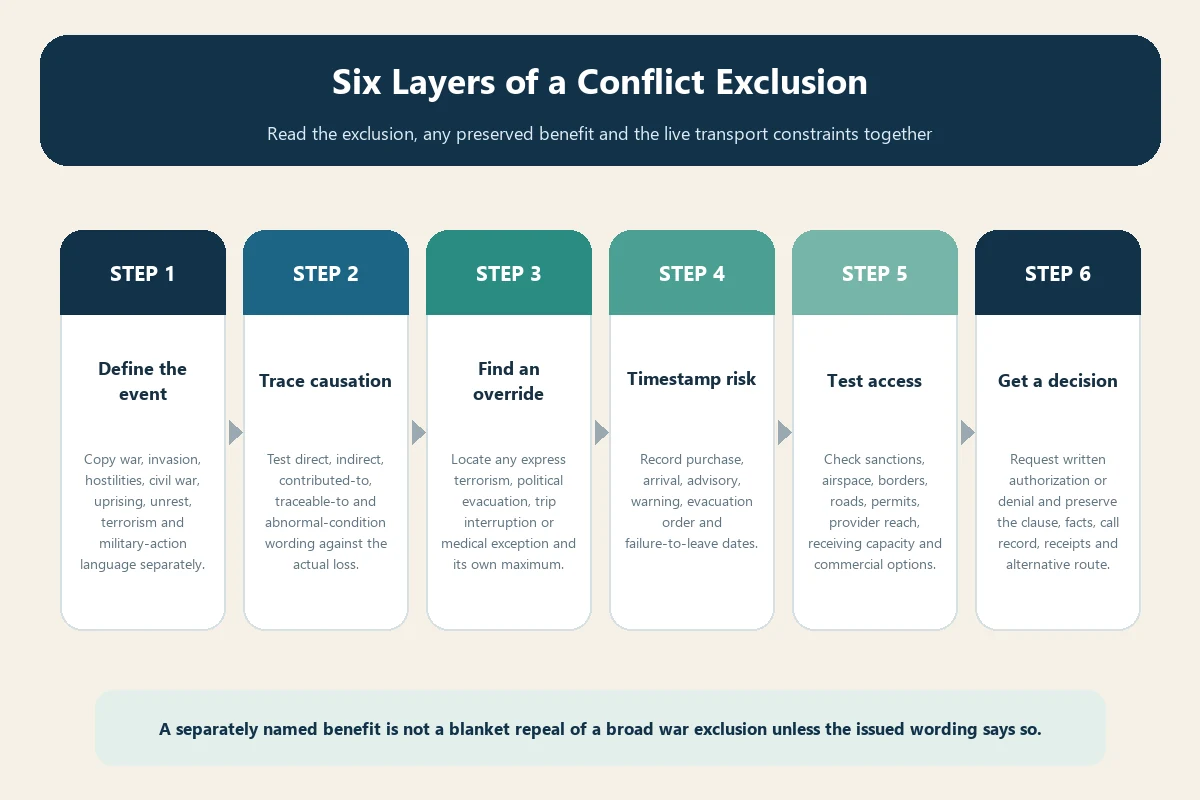
Read the exclusion in six layers
| Layer | What to copy | Why it matters |
|---|---|---|
| Event | Every named conflict or security condition | The policy may define categories differently |
| Causation | Direct, indirect, contributed to, traceable to, during | The breadth of the connection can change the result |
| Override | Express exception or preserved benefit | A narrow benefit can survive only on its stated terms |
| Timing | Purchase, arrival, advisory, event, order, departure | Known-risk and failure-to-leave rules can apply |
| Access | Sanctions, routes, providers, borders, receiving capacity | A contractual benefit can still be impossible to deliver |
| Decision | Authorization, denial, reason, evidence, appeal | The live case needs a documented determination |
The medical versus political evacuation guide separates clinical transport from a security departure. Article 195 goes deeper into what happens when a broad conflict exclusion and a narrower benefit appear in the same document.
The event list can be much wider than declared war
A war clause can name invasion, foreign-enemy hostilities, warlike operations whether declared or not, civil war, mutiny, riot, uprising, insurrection, insurgency, rebellion, revolution, military power, martial law, or weapons events. Another certificate may use a shorter list. A membership agreement can have its own limitation.
One 2026 IMG sample contract illustrates broad plan-specific wording under “War; Military Action.” It separately addresses terrorism and separately lists political evacuation. That structure is not proof of another plan’s coverage, but it demonstrates why the table of contents, benefit summary, full provisions, definitions, and exclusions must be read together.
Causation language determines the reach
Some exclusions apply only when war directly causes the loss. Others extend to losses indirectly related to, contributed to by, traceable to, or arising in connection with the excluded event. Some describe consequences occurring during abnormal conditions unless the insured proves independence. These phrases can create a broader dispute than the headline label suggests.
Build a factual chain for every charge. Was the patient injured by an attack, or did an unrelated illness occur while conflict existed? Did the conflict close the only capable hospital, delay treatment, cancel the authorized flight, or make a receiving route inaccessible? Do not decide the legal result yourself. Give the insurer the full sequence and ask which exact language supports its decision.
A terrorism benefit is not automatically war coverage
Terrorism can be defined by the actor, intent, target, official designation, location, advisory, and time. A benefit summary may place a maximum on otherwise eligible terrorism-related charges while the war clause excludes different events. Civil unrest, state military action, missile strikes, rebellion, and generalized hostilities may not fit the plan’s terrorism definition.
Ask four questions: What is the defined terrorist act? Which benefits remain available? What maximum and advisory conditions apply? Does the exclusion expressly yield to that benefit? “Terrorism included” without these answers is not a medical evacuation decision.
Political evacuation can survive on narrow terms
A political or security benefit can have its own trigger, notification window, destination, provider control, maximum, and exclusions. The same 2026 sample contract uses government-order, country-of-residence, contact, approval, and prior-advisory conditions for its political provision. Another form can use civil unrest, imminent danger, expulsion, or an optional security upgrade.
The IMG Travel SE sample contract is a second product-specific example. Its political or security wording refers to formal recommendations to leave and provider-arranged movement. It also contains pre-arrival advisory and other limitations. Never transfer its trigger or time window to a different plan.
Medical treatment and medical transport remain different questions
Even if an injury is not barred, evacuation still needs its own coverage grant: medical necessity, covered condition, approved facility, stability, route, mode, coordination, and maximum. A covered hospital charge does not automatically approve an air ambulance. A security extraction does not automatically cover treatment after arrival.
The evacuation approval guide separates a physician’s recommendation from the insurer’s benefit determination and the transport provider’s operational decision. Keep those records separate in a conflict case.
Membership rules can contain another war limitation
The July 2026 MedjetAssist annual rules give a current membership-specific example. They state that the program is membership, not insurance, and list war, invasion, or civil war among general limitations. They also reserve provider decisions over timing and mode and can limit services in countries with higher State Department advisories.
This does not establish how another membership responds. It shows that buying a transport membership alongside insurance does not automatically fill a war gap. Compare both contracts, effective dates, destination rules, security upgrades, and exclusions.
Advisories create a second timeline
Record the policy or membership purchase, effective date, traveler’s arrival, advisory level and region, security alert, event, official order, request for help, offered departure, and actual movement. Wording can look backward from arrival or purchase, require contact after an order, or limit someone who stays after a warning.
The State Department high-risk-area guidance warns that U.S. assistance can be limited or unavailable and travel within the country can be too unsafe. An advisory is important safety evidence, but whether it is a policy trigger, exclusion, or neither depends on the issued wording.
Country and regional scope must be exact
A warning may cover a whole country, a province, a border area, an airspace, or a time-limited event. The patient can be outside the conflict zone while the required route passes through it. A plan can use destination country, host country, scheduled destination, or area of coverage differently.
The country exclusions and advisories guide provides a territory worksheet. Add the patient’s coordinates, treating hospital, possible airports, ground corridor, connection points, receiving hospital, citizenship, visas, and every advisory region.
Sanctions and legal restrictions are an independent gate
A provider may be unable to pay a vendor, enter an area, hire an aircraft, or deliver a service when sanctions or laws prohibit the transaction. The existence of a benefit does not waive U.S., foreign, aviation, border, export-control, or payment restrictions. Ask the insurer or membership provider how any sanctions clause applies; do not attempt to route around a restriction.
Operational restrictions also include closed airspace, unavailable aircraft, no overflight permission, curfews, unsafe roads, fuel shortage, damaged airports, border closure, and no receiving bed. The destination guide explains why a named endpoint is not useful until access and acceptance exist.
Active participation can be a separate exclusion
Some forms distinguish an innocent traveler from someone who planned, coordinated, participated in, or committed an excluded act. Criminal conduct, weapons, military duty, protest activity, failure to maintain documents, or ignoring a required departure can have separate language. State the facts accurately and avoid conclusions that belong to the insurer, lawyer, or authority.
Keep identity, employment or duty status, itinerary, official instructions, location history, incident report, medical records, and communications. Do not omit uncomfortable facts; incomplete information can delay or undermine the determination.
Government departure does not cure an insurance exclusion
The U.S. Department of State’s crisis guidance says private U.S. citizens may receive departure assistance when commercial options are unavailable and conditions permit. It also says in-country transport is generally unavailable, movement is normally to a nearby safe location, onward costs belong to the traveler, and coordinated transportation is generally reimbursable.
That route is not an insurer’s political benefit or medical evacuation. Conversely, an insurance denial does not prove government movement will be available. Maintain commercial, provider-arranged, government, shelter-in-place, and medical-care-in-place options as separate contingencies.
Build a charge-by-charge conflict ledger
- Exact event and exclusion language, including causation phrases
- Any express exception, terrorism limit, political benefit, or security upgrade
- Medical diagnosis, injury mechanism, treatment, stability, and transport recommendation
- Purchase, effective, arrival, advisory, event, order, call, and departure timestamps
- Patient, hospital, airport, corridor, border, and destination locations
- Sanctions, airspace, road, carrier, permit, vendor, and receiving-capacity constraints
- Case number, written authorization or denial, cited clauses, appeal deadline, and evidence request
- Separate totals for treatment, medical transport, security movement, lodging, trip change, and onward travel
Use a precise call script
“Which event in the war or military-action exclusion applies?” “What causal wording connects it to this specific charge?” “Does an express benefit or exception remain available?” “What terrorism or political definition is being used?” “Which advisory date and region matter?” “Do sanctions or access prevent performance?” “Who must arrange the route?” “What written decision, evidence, and appeal rights apply?”
The evacuation-versus-rescue membership guide is useful if a second service agreement is involved. Compare the exact stage each contract covers; do not assume one will reimburse the other’s self-arranged movement.
The practical conclusion
A medical evacuation insurance war exclusion must be tested against the actual event and charge, not against a headline. Read the broad exclusion, causal language, definitions, benefit summary, terrorism provision, political or security section, advisories, sanctions, authorization rules, and access conditions as one system.
The safest planning conclusion is conservative: do not rely on a limited benefit to erase an exclusion unless the issued document expressly says it does. Seek a written determination early, preserve every fact and timestamp, and maintain a route that does not depend on contractual coverage creating physical access through an active conflict.
