

Europe travel insurance for holiday markets should protect the paid journey around the markets, not the expectation that every stall or event will open. Most market visits depend on winter flights, tightly timed rail trips and short hotel stays. Build coverage around nonrefundable costs, medical needs, transport disruption and documented closures while keeping free-entry market experiences separate from financial loss.
Key takeaways
- Confirm each market’s operating dates before making nonrefundable bookings.
- A canceled free-entry market may create disappointment but no ticket loss.
- Short itineraries need delay limits sized to the next usable train or flight.
- Rail tickets, hotels and tours retain separate refund and cancellation rules.
- Cold illness, theft and baggage claims use different benefits and evidence.
Verify the market calendar before buying insurance
“Christmas market season” is not one fixed period across Europe. Opening days, hours and closing dates vary by city and sometimes by individual square. Some events end before December 25, while others continue under a winter-market format.
Create a market record before paying for transport:
- official event name and organizer;
- street or square address;
- opening and closing dates;
- daily operating hours;
- ticketed reservations or timed activities;
- weather, safety or capacity terms; and
- the organizer’s official update channel.
If a traveler books after the published closing date, insurance cannot turn the planning error into an unforeseen event. Save the official calendar with the booking file.
Insure the financial trip, not the holiday atmosphere
A market trip may include a free public event, a nonrefundable hotel, advance rail fares, a paid food tour and transatlantic flights. Only the eligible prepaid, nonrefundable exposure belongs in the cancellation calculation.
| Component | Record | Potential loss |
|---|---|---|
| Free-entry market | Official schedule and closure notice | No admission price; related travel costs require their own covered reason |
| Timed market activity | Ticket and refund terms | Nonrefundable ticket value if the policy cause applies |
| Hotel | Rate and cancellation deadline | Eligible nonrefundable room cost |
| Rail segment | Ticket type and carrier | Unrefunded fare plus qualifying disruption expenses |
| Walking or food tour | Operator terms and meeting point | Unused prepaid amount after supplier recovery |
The distinction matters because trip insurance reimburses defined financial losses, not the subjective value of missing a festive experience. Use the Europe trip insurance checklist to update cost as hotel and tour penalties change.
Plan rail day trips as ticket relationships
Holiday-market itineraries often use one city as a base for day trips. A traveler might hold an intercity ticket, a local connection and a reserved evening train back. Those can be one protected journey or several separate contracts.
For every day trip, record:
- whether all segments appear on one ticket;
- the minimum connection time;
- the final return service;
- reservation requirements;
- refund and rebooking conditions; and
- the cost of an overnight stay if the final train is missed.
The European Commission rail passenger-rights page explains the current framework for delays, cancellations and missed connections on covered journeys. National exemptions and ticket structure can affect the remedy.
Our Europe train insurance guide covers through-tickets and carrier remedies. When tickets are separate, the separate-ticket connection guide shows where responsibility can stop.
Size delay coverage to a short itinerary
Losing one day of a four-day trip can feel severe, but the claim is based on eligible expenses and benefit limits. Compare the delay waiting period with the actual route. A benefit that starts after a long delay may not respond to a shorter disruption even if the traveler misses the market.
Estimate the cost of:
- one night near the station or airport;
- reasonable meals during the wait;
- local transport to the replacement lodging;
- the next available ticket; and
- unused prepaid activities at the destination.
Then compare covered causes, per-day caps and total limits. The trip delay reimbursement guide provides a waiting-period worksheet.
Winter weather must cause a covered effect
Snow, ice, high wind or ordinary winter rain may affect plans, but the weather label alone does not prove a claim. The useful evidence is a carrier cancellation, documented delay, official closure, unusable accommodation or covered medical event.
Save the carrier alert, station notice, official market update and hotel response. If the market closes but trains and lodging still operate, standard trip cancellation may not reimburse the entire vacation. If a carrier cancels, request its refund or rerouting before claiming the remaining loss.
The weather-delay insurance guide explains the difference between a forecast and a measurable transport effect.
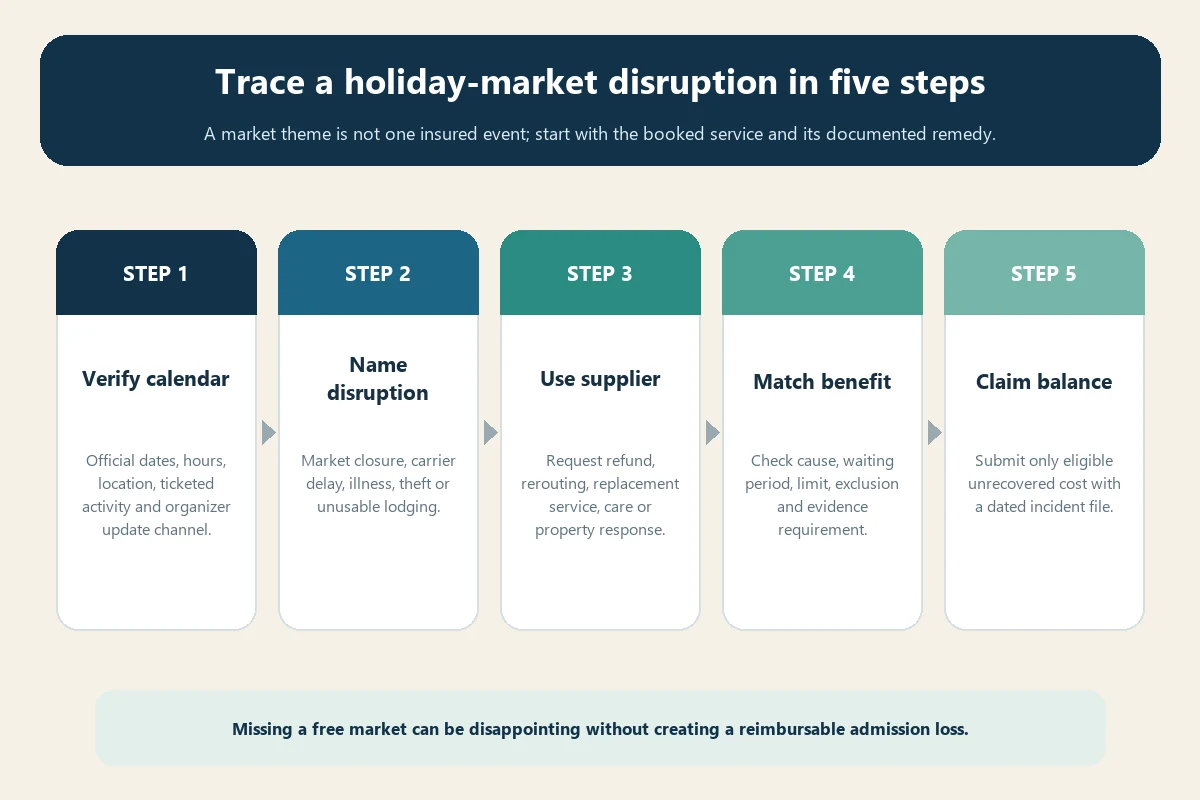
A market closure is not always a trip cancellation
An organizer may close one market because of wind, crowd control, security or a local decision while the surrounding city remains accessible. Determine what was actually paid and what still operates.
Ask:
- Was admission or a related activity prepaid?
- Did the organizer refund or reschedule it?
- Did an official order affect the hotel or destination?
- Did a common carrier stop operating?
- Does the certificate list the event under cancellation or interruption?
If only a free market closes, a replacement attraction or a nearby market may preserve the trip. A voluntary decision to go home is different from a policy-defined trip interruption. Review the trip cancellation coverage guide before making an expensive change.
Cold illness and ordinary winter illness are medical questions
The CDC Yellow Book guidance on cold illness in travelers describes risks from cold exposure and the importance of preparation. Crowded indoor and outdoor travel also requires ordinary attention to respiratory illness and chronic conditions.
Compare emergency medical coverage, deductible, assistance access, pre-existing-condition terms and evacuation. Bring medication in carry-on luggage, save generic drug names and know where to obtain care during evenings and public holidays.
The U.S. Department of State advises considering travel health and medical evacuation coverage because US health insurance may not follow the traveler abroad. The Europe coverage-limits guide helps compare those benefits independently from the short trip’s price.
Protect purchases without overstating baggage coverage
Market purchases may include fragile, valuable or cash-like items. Baggage policies often apply per-item limits, category sublimits, exclusions and proof requirements. Cash, gift cards, food, alcohol, antiques or unattended property may receive limited or no coverage.
Keep itemized receipts, photograph higher-value purchases and place fragile or essential property in carry-on baggage when permitted. Do not leave bags unattended at a stall, station or café. If theft occurs, report it to the appropriate local authority and carrier within required timeframes.
The baggage delay and lost luggage guide separates carrier liability, replacement essentials, documentation and policy sublimits.
Check holiday operating hours for assistance and care
A trip that crosses public holidays can encounter reduced pharmacy, clinic, bank and transport hours. This is an operational issue rather than automatic insurance coverage.
Before departure, save the insurer’s 24-hour assistance number, policy number, local emergency numbers and backup payment method. Confirm medication supply and verify that the return train or airport transfer actually operates on the holiday date.
For a multi-city route, add one buffer before the transatlantic flight. The value of a buffer is practical loss prevention; it does not change the certificate’s missed-connection definition.
Example: four markets in six days
A traveler books six nights split between Munich and Vienna, with rail day trips to two smaller cities. The markets are free, but the hotels are nonrefundable, the intercity train is advance purchase and a food tour requires payment.
A winter storm cancels the morning day-trip train. The carrier offers a refund, and the market remains open. The traveler chooses to stay in Munich and visits another market. There is no lost market admission. The claim file, if any, begins with the food-tour refund rule and reasonable unrecovered delay expenses—not the value of the missed atmosphere.
If the storm instead cancels the final train to Vienna and causes an overnight delay, the traveler documents rerouting, the carrier’s assistance, the hotel receipt and the unused Vienna booking. The policy then evaluates the remaining expenses under its delay or interruption terms.
Build a holiday-market claim file
- official market calendars and closure notices;
- flight, rail and hotel confirmations;
- tour and timed-activity tickets;
- carrier delay or cancellation confirmation;
- refund, rerouting and credit responses;
- medical records and itemized bills;
- police or carrier reports for theft or baggage loss; and
- a dated incident timeline with receipts.
Frequently asked questions
Does insurance cover a canceled Christmas market?
Only if the facts meet a covered benefit. A free market closure may create no admission loss, while paid activities, transport and lodging each require their own refund and coverage analysis.
Will insurance pay if snow delays my train?
It may cover eligible delay expenses when the cause, waiting period and ticket satisfy the certificate. Use carrier remedies first and keep the delay confirmation.
Should I insure free market visits?
There is no admission cost to declare. Insure eligible nonrefundable flights, hotels, rail, tours and other paid components surrounding the visit.
Are gifts bought at the market covered as baggage?
Coverage depends on item category, proof, custody, per-item limits and exclusions. Read baggage sublimits before buying valuable, fragile or cash-like items.