

Medical evacuation insurance and a natural disaster do not create one automatic flight home. A storm, earthquake, wildfire, flood, volcanic eruption, or similar event can create at least five different problems: a patient needs urgent medical transport, a traveler is in physical danger, paid lodging becomes unusable, a booking is disrupted, or a government organizes departure. Each problem can activate different wording.
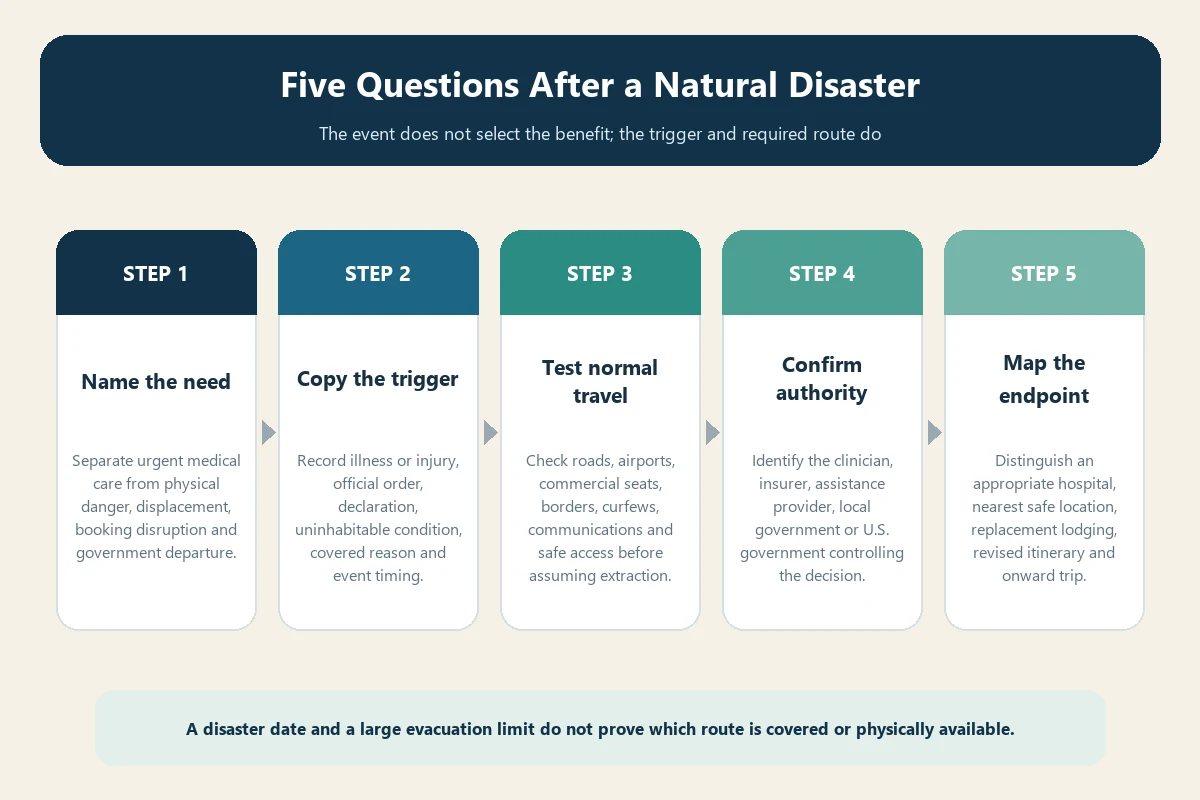
The useful medical evacuation insurance natural disaster question is therefore not “is the disaster covered?” Ask which person needs to move, why, from where, to what destination, under whose authority, and after which dated event. This guide is educational, not medical, insurance, emergency-management, legal, or government advice. Follow local authorities in an emergency.
Key takeaways
- A disaster is context; medical evacuation still needs a covered clinical trigger.
- Natural-disaster evacuation can be a separately named non-medical benefit.
- Official declarations, orders, uninhabitable conditions, normal transport, and timing can matter.
- Closed roads and airports can prevent an authorized move from operating.
- Government departure assistance is not a guaranteed or free trip home.
Reviewed August 16, 2026. Natural disaster, named storm, covered illness, medical necessity, uninhabitable, evacuation order, imminent bodily harm, normal means, safe location, and destination country are document-specific terms.
Begin with five separate paths
| Path | Trigger question | Likely endpoint |
|---|---|---|
| Medical evacuation | Does a covered illness or injury require medically necessary transport? | Appropriate medical facility |
| Natural-disaster evacuation | Has defined danger and an official condition activated separate wording? | Nearest safe location or permitted return |
| Trip cancellation or interruption | Has a listed event forced a covered trip change? | Revised itinerary or reimbursement |
| Emergency lodging | Has an order displaced the traveler from paid accommodation? | Temporary safe accommodation |
| Government departure | Is official transport available to eligible citizens? | Usually a nearby safe location |
The medical versus political evacuation guide uses the same separation for security events. A disaster must also be mapped benefit by benefit; one route does not inherit another route’s maximum or destination.
Medical evacuation starts with illness or injury
A hurricane can close a hospital, but the medical benefit does not respond merely because a hurricane exists. The insured person generally must have a covered illness or injury and need transport to appropriate care. Medical teams can assess local capability, urgency, stability, route, mode, receiving capacity, and whether movement is safer than continued treatment in place.
One 2026 IMG sample contract illustrates this difference. Its emergency medical evacuation section requires a covered medical occurrence, local treatment limitations, physician recommendation, advance approval, company coordination, and transport to a qualified hospital. Its natural-disaster evacuation provision is separate. This is one plan-specific example, not a market rule.
Natural-disaster evacuation starts with physical danger
A separately named disaster-evacuation benefit can focus on extraction from an unsafe place rather than transport to medical treatment. The same IMG sample describes a route to the nearest safe location and, if its conditions are met, an economy return after the evacuation. It uses conditions involving a government order, an uninhabitable location, inability to leave normally, inability to obtain timely commercial transportation, company contact, and advance approval.
Another IMG Travel SE sample contract uses different plan-specific wording: an officially declared disaster area, uninhabitable or dangerous conditions, a time window, provider-arranged movement, and provider control of means and timing. The contrast is the lesson. Copy the issued form instead of importing a trigger from another product.
Track the event before and after policy purchase
Natural-disaster claims can turn on several clocks. Record the policy purchase and effective dates, trip deposit, scheduled departure, arrival in the affected area, forecast or watch, named-storm date, disaster declaration, evacuation order, accommodation closure, carrier cancellation, assistance call, and actual movement.
A trip-cancellation section can use a foreseeability rule that differs from a disaster-evacuation section. A hurricane becoming named can matter to one plan; an official order or declaration can matter to another. “It happened during the trip” is not a complete timeline.
Uninhabitable has to be proven, not assumed
Damage near a resort does not necessarily make the booked accommodation or destination uninhabitable under a certificate. Some wording requires a governmental authority to order evacuation. Other wording lets the company determine whether the insured location meets its definition. Loss of power, water, access, structural safety, sanitation, or legal occupancy may support the record, but the definition controls.
Keep the order, declaration, address, booking confirmation, property notice, dated photos, utility or access notices, and every refund or credit. The Japan disaster travel guide shows why earthquake, tsunami, transport, medical, and itinerary problems need separate evidence even in the same incident.
Normal transport is a coverage and operations test
Some disaster wording requires proof that the traveler cannot leave through ordinary commercial arrangements. Check whether the operating airline can rebook, whether another airport or land border is open, and whether the traveler can safely reach it. Record road closures, curfews, fuel, ferry or rail status, airspace restrictions, border rules, visas, payment access, and communication outages.
Do not travel through floodwater, wildfire, damaged structures, unrest, or closed roads to satisfy a paperwork theory. Local emergency instructions control immediate safety. An insurer can approve a benefit while terrain, weather, authorities, or equipment make the authorized route temporarily impossible.
Medical infrastructure failure changes the clinical question
A disaster can leave the patient stable while the treating facility loses power, oxygen, imaging, surgery, blood products, dialysis, intensive care, medication, water, staff, or evacuation access. Document what care is required, what remains available, what cannot be provided, how long the gap is expected to last, and which receiving facility has confirmed capability.
The evacuation destination guide explains why the nearest suitable facility can differ from the traveler’s preferred hospital. The approval guide separates the treating physician’s recommendation from the assistance team’s covered-route decision.
Advance authorization still matters during chaos
Emergency conditions do not automatically convert a provider-arranged benefit into open reimbursement for any self-booked aircraft, vehicle, hotel, or escort. Contact the assistance number as soon as safely possible. Give the policy number, exact location, patient status, danger, official order, route closures, local contacts, documents, and communication limitations.
Ask who is arranging each segment, what may be self-arranged, the authorized maximum, destination, approved mode, safe-location costs, required updates, and what happens if communications fail. The pre-authorization guide provides a record structure for the case number, decision, scope, conditions, and denial.
Trip disruption can pay without extracting anyone
Trip cancellation or interruption can reimburse eligible prepaid losses and added travel costs after a listed event. Emergency lodging can reimburse a defined daily amount after a mandated evacuation. Neither benefit necessarily provides a rescue team, ambulance, airfield access, medical escort, or secure movement.
Confirm whether the covered reason is a natural disaster, carrier cessation, destination uninhabitability, mandatory evacuation, accommodation damage, weather delay, or another defined event. Copy the waiting period, distance, duration, purchase-date, supplier-refund, and documentation rules separately.
Government assistance is a fifth route
The U.S. Department of State’s crisis-response guidance advises leaving by regular commercial transportation when it is safe and available. It says the government generally cannot provide in-country transport. When commercial options are unavailable and conditions allow, it may facilitate departure to a nearby safe location.
The same guidance says coordinated transportation is normally reimbursable, travelers generally arrange lodging and onward travel after the safe-location handoff, and capacity can be limited. The State Department travel checklist recommends medical and evacuation coverage but makes clear that the U.S. government does not pay citizens’ medical bills or unexpected travel costs.
Use this disaster case file
- Issued policy, schedule, endorsements, definitions, and exclusions
- Event timeline: purchase, arrival, forecast, named event, declaration, order, call, and movement
- Patient diagnosis, required care, stability, local capability, and physician contact
- Exact address, accommodation status, government notices, and proof of uninhabitability
- Road, airport, carrier, border, curfew, communication, and commercial-option evidence
- Assistance case number, written authorization, destination, mode, maximum, and conditions
- Safe-location lodging, onward travel, receipts, refunds, credits, and government debt forms
- Family, medication, device, accessibility, document, and pet contingency plans
Ask one question for every path
“What covered medical condition requires transport?” “What defined disaster condition activates non-medical evacuation?” “Which listed reason changes the trip?” “What order supports emergency lodging?” “What government assistance is actually announced?” Then ask the same operational questions for each: who decides, who arranges, where the route ends, what is unavailable, what must be paid, and what proof closes the file.
The CDC travel-insurance page distinguishes trip disruption, travel health, and medical evacuation coverage. That separation remains useful during a disaster because a single headline event can create several claims without merging their triggers.
Remote locations need an earlier fallback decision
An island, mountain town, desert road, or rural coast can lose its only practical route long before the traveler needs an air ambulance. Identify alternate roads, ports, airfields, fuel points, shelters, hospitals, and communication methods before the forecast window closes. Record which option is safe for an ordinary traveler and which requires organized medical support.
The remote-islands evacuation guide shows how a short local boat or aircraft leg can control the whole medical route. During a natural disaster, the same dependency affects non-medical movement. Decide in advance what evidence or authority will cause an early commercial departure, when the traveler should shelter in place, and when the assistance provider must redesign the case around a different endpoint. That fallback is a safety decision first and a reimbursement question second.
The practical conclusion
Medical evacuation insurance does not respond to a natural disaster as one all-purpose benefit. Start with the live need: clinical treatment, escape from physical danger, trip change, temporary accommodation, or government departure. Match that need to its own definition, dated trigger, authority, route, destination, authorization, access constraints, maximum, and evidence.
A resilient plan has alternatives. It identifies the safest available commercial exit, a provider-arranged route if coverage and access align, medical care in place if movement is unsafe, and funds for safe-location and onward costs. The goal is not to force every disaster into “medical evacuation.” It is to activate the correct path early enough for it to work.