

A Schengen visa insurance claim while traveling begins with safe medical care and an assistance call, not with the visa certificate. The certificate helped document compliance before the trip. The full policy, medical facts, authorization rules, bills and deadlines determine whether the insurer arranges service or reimburses an expense.
Key takeaways
- Use local emergency services first when care cannot wait.
- Contact the policy’s assistance line as soon as reasonably possible and open a case.
- Ask whether the provider will bill directly or the traveler must pay and seek reimbursement.
- Collect medical reports, itemized invoices, prescriptions, receipts and communication records.
- Visa compliance does not override exclusions, deductibles, sublimits or authorization provisions.
This guide describes a general workflow, not a promise of coverage. Emergency numbers, health systems and policy procedures vary by country and insurer.
Emergency care comes before paperwork
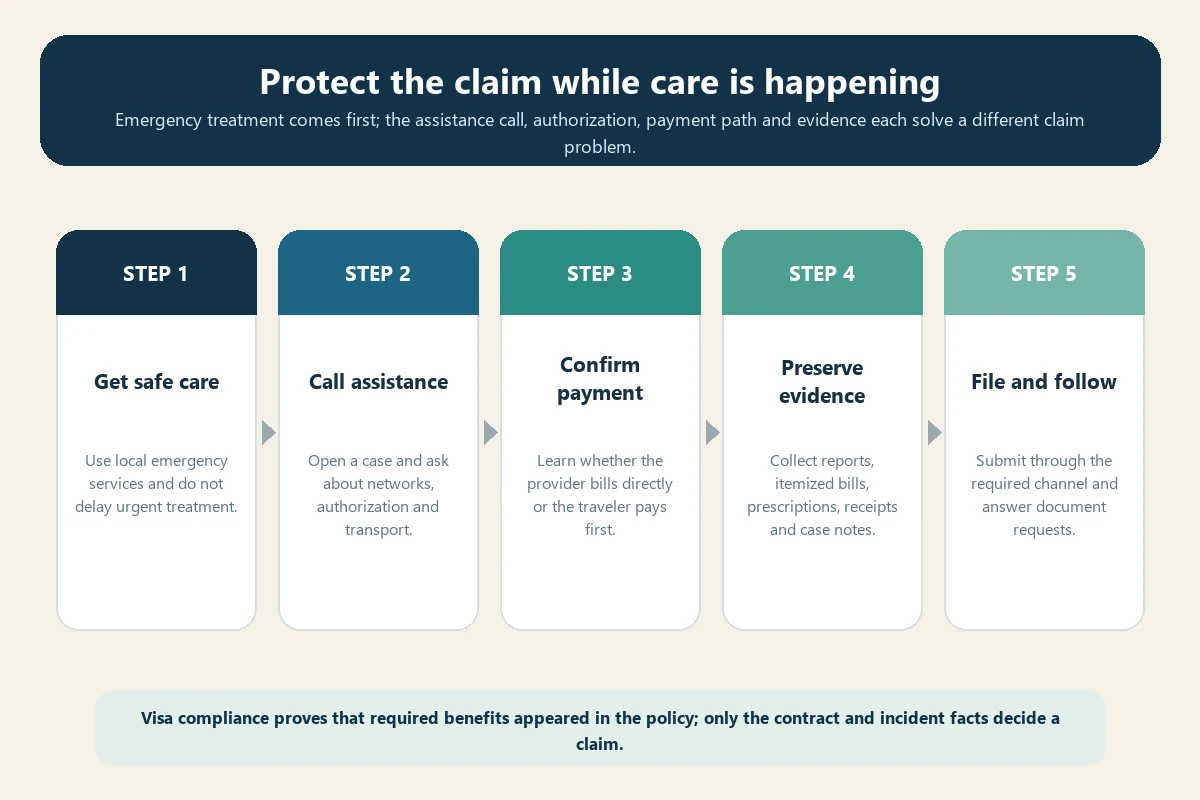
Call the local emergency number or go to appropriate care when delay could worsen the condition. A policy may request prompt notice, but no traveler should postpone urgent treatment solely to locate a certificate or obtain a claim form. When the situation is stable, contact the assistance service and document what happened.
The U.S. Department of State’s health-abroad guidance recommends understanding overseas coverage before travel and carrying insurance information and claim forms when the plan is accepted abroad. It also warns that many U.S. plans do not pay for special medical evacuation back to the United States.
Keep the insurer’s 24-hour number in the phone and on paper. The assistance-line versus claims guide explains why the emergency coordinator and reimbursement team can have different jobs.
What the Schengen certificate does—and does not do
Article 15 of the Visa Code describes the required travel medical functions for an ordinary visa application: medical repatriation, urgent medical attention, emergency hospital treatment or death, across the relevant Member States, with a €30,000 minimum.
A certificate usually summarizes the insured name, policy number, dates, territory, amount and benefits. It does not reproduce every definition. It may not show whether a provider must be preauthorized, whether the plan is secondary, how an existing condition is treated, which sports are excluded or how a deductible applies.
The certificate audit guide helps travelers verify the proof before departure. For a claim, open the full wording and schedule in addition to the certificate.
Open an assistance case
Give the representative the policy number, insured name, location, callback details and a concise medical summary. Ask for a case number. Record the time, representative’s name and instructions. If the first call cannot connect, preserve the call log and try the listed alternatives.
Ask five direct questions:
- Is there a network clinic or hospital nearby?
- Does this service require prior authorization?
- Can the insurer issue a payment guarantee or arrange direct billing?
- Which documents must the provider and traveler produce?
- What deadline and channel apply to the formal claim?
Assistance can locate care, communicate with providers, monitor a case or arrange transport, depending on the plan. Opening a case is not the same as claim approval. Avoid treating a helpful telephone statement as a final coverage decision unless the insurer confirms it in writing.
Direct billing versus reimbursement
| Payment path | What happens | Main risk to manage |
|---|---|---|
| Direct billing | Provider seeks payment or guarantee from insurer | Guarantee may cover only authorized services or an estimated amount |
| Traveler pays first | Traveler settles the bill and files for reimbursement | Cash or credit exposure and document quality |
| Primary insurance | Travel plan responds before another applicable plan, subject to terms | Provider still may demand payment at service |
| Secondary insurance | Other health coverage is submitted first | Need explanation of benefits, denial or proof of payment |
A payment guarantee is not always a blank check. Ask which dates, services and amount it covers. The provider may still request a deposit for services outside the guarantee. Keep every receipt, including card and currency records.
The primary medical coverage guide explains order of payment. The label affects coordination but does not guarantee cashless treatment.
Build the evidence file in real time
Medical records are easier to collect before leaving the facility. Ask for a report that states symptoms, diagnosis, treatment and dates. Request an itemized bill rather than only a card receipt. Keep prescription orders and pharmacy receipts. If the documents use another language, preserve the originals and ask the insurer whether a translation is needed.
The claim file may include:
- policy certificate and full schedule;
- assistance case number and written authorization;
- medical report, diagnosis and discharge summary;
- itemized provider, ambulance and pharmacy invoices;
- proof of payment and currency conversion;
- other-insurer explanation of benefits or denial;
- travel dates, passport entry evidence and itinerary;
- incident report when an accident, carrier or police record applies.
Photograph documents before handing originals to another party. Write the local currency and payment method beside each receipt, and retain the card statement when it becomes available. If a companion interprets a conversation, record the medical provider’s own written diagnosis rather than relying only on the companion’s summary. Ask the assistance team how to submit large files securely; ordinary email may not be appropriate for sensitive medical records.
A simple incident timeline can prevent contradictions. List symptom onset, first treatment, every assistance contact, authorization, payment and discharge in local time. If the traveler crosses a border during follow-up care, note the location of each service because territory and provider records may differ.
The travel claim documentation guide provides a broader filing checklist. Save clean scans with descriptive filenames and keep the originals.
Medical evacuation and repatriation
Do not arrange a private air ambulance solely because the traveler prefers a home hospital. Policies commonly make the assistance or medical team responsible for deciding medical necessity, destination and transport method. Emergency evacuation to the nearest suitable facility can differ from repatriation home after stabilization.
The CDC’s travel and medical evacuation insurance guidance explains why evacuation coverage and assistance planning matter when local care is limited. The Schengen repatriation guide separates medical return from return in the event of death.
If transport is discussed, ask who authorizes it, where the patient will go, what medical escort or equipment is included and which limit applies. Obtain decisions in writing when feasible.
Existing conditions and exclusions
A visa-compliant certificate can coexist with an exclusion for a known condition, an activity, intoxication, noncompliance with medical advice or travel against a warning. The contract controls the claim. Do not hide medical history or reshape the incident description to fit coverage.
Provide the requested treating records and answer accurately. If a decision relies on an exclusion, request the exact clause and factual basis. A claim denial should be reviewable against the issued wording.
How to submit the formal claim
- Download the current claim form from the insurer or secure portal.
- Use the assistance case number but do not assume the case itself is the claim.
- Complete every applicable field and mark truly inapplicable fields clearly.
- Attach legible records, itemized bills and proof of payment.
- Submit before the policy deadline and save confirmation.
- Respond to requests with a dated cover note and document list.
The National Association of Insurance Commissioners’ travel insurance overview describes common travel-insurance products and links consumers to state insurance departments. For a U.S.-regulated policy, identify the actual underwriting insurer and the state connected to the purchase.
If the claim is denied or underpaid
Ask for the complete decision, calculation and policy sections. Compare the reason with the timeline, authorization, diagnosis, receipts and other coverage. A missing record may be curable. A contractual exclusion needs a different response from a mathematical error or an unprocessed attachment.
Use the claim-denial reasons guide to organize an appeal. Stay factual, identify the disputed clause and attach only relevant evidence. Escalate through the insurer’s complaint procedure and an appropriate regulator when warranted.
Common mistakes during the trip
- Delaying urgent care while trying to obtain preauthorization.
- Calling assistance but never filing the formal claim.
- Leaving the clinic with only a credit-card receipt.
- Assuming direct billing means every service is approved.
- Arranging expensive transport without the required authorization.
- Discarding originals after uploading low-quality photos.
- Submitting to a secondary plan before the primary plan responds.
Frequently asked questions
Will the Schengen certificate make the insurer pay?
No. It summarizes visa-relevant policy facts. Coverage depends on the full contract, incident, authorization and evidence.
Must I call before seeing a doctor?
Follow the policy when the situation allows, but do not delay urgent emergency care. Contact assistance as soon as reasonably possible afterward.
What if the hospital will not bill the insurer?
Ask the assistance team about a guarantee. If the traveler must pay, obtain an itemized invoice, medical report and proof of payment for reimbursement.
Is an assistance case number a claim number?
Not necessarily. Confirm whether a separate claim form or portal submission is required.
Can a visa-compliant plan exclude my condition?
Yes. Visa-document compliance and contractual coverage are different layers. Read definitions and exclusions before travel.
This educational guide is not medical, legal or insurance advice. Seek appropriate emergency care and follow the issued policy and official local instructions.
