

Whether dual citizens need Schengen travel insurance as a visa document depends on the passport and legal travel path used for the journey. An EU citizen traveling with a valid EU passport or national identity card follows the EU-citizen route, not the Schengen short-stay visa route. A dual non-EU citizen should check whether the chosen passport is visa-required or visa-exempt. In every case, optional medical and evacuation cover remains a separate risk decision.
Key takeaways
- List every citizenship and valid travel document before checking visa or insurance rules.
- EU citizenship creates a different entry-document path from a non-EU short-stay visa application.
- For two non-EU passports, visa status follows the nationality and document actually used.
- Keep bookings, visa records and insurance certificates aligned to one travel identity.
- No visa-insurance mandate does not mean no medical or evacuation risk.
Start with citizenship, then choose the travel document
“Dual citizen” is not one Schengen category. It can describe an EU and U.S. citizen, a U.S. citizen plus a visa-required nationality, or two non-EU nationalities with different visa treatment. The traveler needs a document map, not a generic insurance answer.
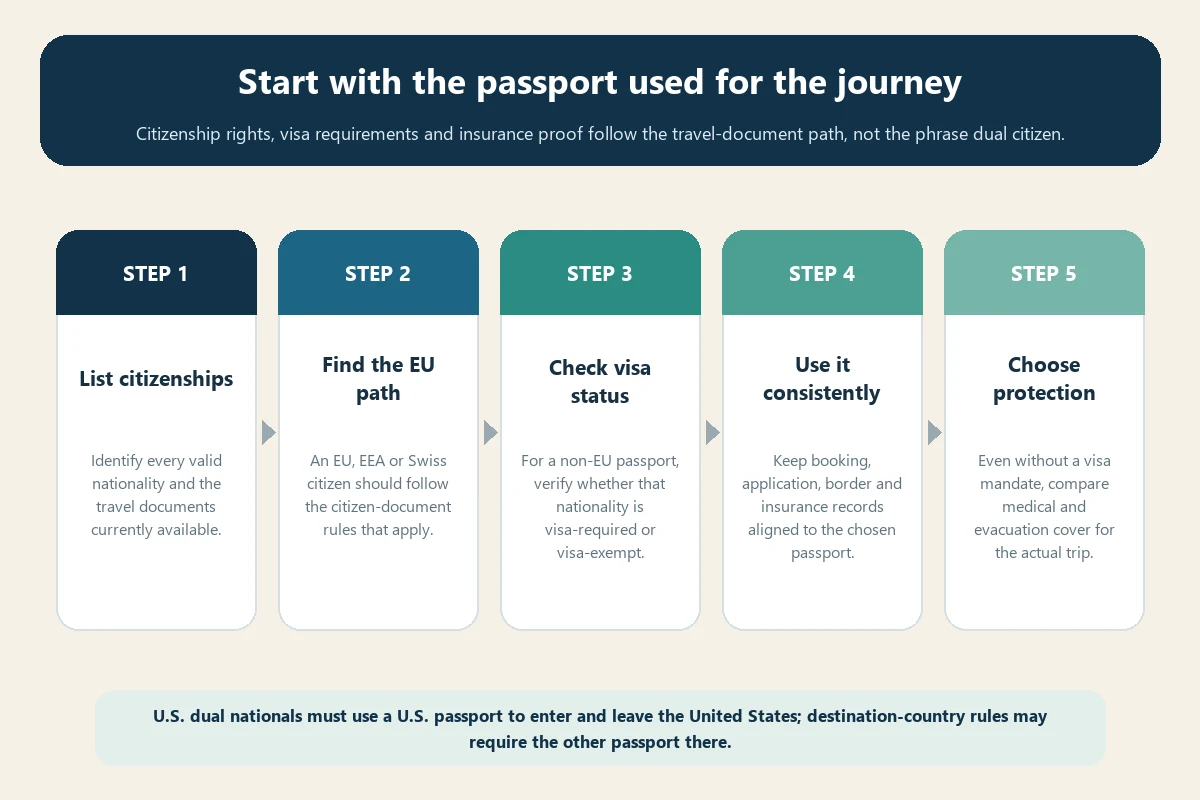
- List both citizenships and the valid passports or national identity cards available.
- Identify whether one citizenship is EU, EEA or Swiss.
- If both are non-EU, check the current visa rule for each passport nationality.
- Choose the lawful document path for the destination and use it consistently.
- Only then determine whether an insurance certificate is mandatory for a visa application or optional for risk protection.
EU Regulation 2018/1806 is the legal list of third-country nationalities that are visa-required or visa-exempt for qualifying short stays. It organizes the rule by nationality, which is why the passport choice matters.
Decision table for common dual-citizen situations
| Citizenship combination | Travel-document starting point | Visa insurance document? |
|---|---|---|
| EU/EEA/Swiss plus any other citizenship | Use the valid citizen passport or ID under the applicable citizen rules | Not a Schengen visa-application requirement on the citizen path |
| U.S. plus another non-EU citizenship | Use the U.S. passport for U.S. exit and entry; check destination rules for the other passport | Usually not for a qualifying short Schengen visit on the U.S. passport, but verify current rules |
| Visa-exempt non-EU plus visa-required non-EU | Check whether the visa-exempt passport can lawfully be used for the complete journey | Not as a visa filing if traveling on the exempt path; optional cover remains |
| Two visa-required non-EU nationalities | Select the passport used for the application and border crossing | Generally yes, under the responsible consulate’s rules |
The table is an orientation tool, not a substitute for current official instructions. Residence cards, family-member rights, refugee travel documents and long-stay permits can create additional routes.
Dual EU citizens: use the EU-citizen path
The EU’s Your Europe guidance for EU nationals says an EU national can travel in EU and Schengen countries with a valid passport or national identity card under the applicable free-movement rules. A person who is also a U.S., Canadian, Indian or other national does not lose EU citizenship for the journey.
On that citizen path, the traveler is not applying for a short-stay Schengen visa, so a Schengen-compliant insurance certificate is not a visa-application document. Travel medical insurance can still be valuable for treatment, evacuation, repatriation, trip disruption or gaps in public and private health coverage.
Do not assume citizenship alone produces a usable travel document. The EU passport or ID must be valid under the applicable rules. If it is expired or unavailable, contact the issuing country’s consulate before travel rather than relying on the second passport and arguing citizenship at airline check-in.
Dual U.S. citizens: two border systems can require two passports
The U.S. Department of State’s dual-nationality guidance states that U.S. dual nationals must enter and leave the United States on a U.S. passport. It also notes that a country of the other nationality may require its passport for entry or exit there.
This can produce a two-document trip without producing two identities:
- use the U.S. passport for the U.S. border process;
- use the destination-required passport where that country’s law requires it;
- show the airline the documents needed for both departure and destination checks;
- keep the same name and biographical data reconciled across bookings; and
- tie any visa and insurance certificate to the passport used for that application path.
A U.S./EU dual citizen should normally prepare the valid U.S. passport for return to the United States and the valid EU document for the EU-citizen travel path. A U.S./non-EU dual citizen should check whether the other country treats the traveler as its citizen and demands its passport.
Two non-EU citizenships with different visa status
Suppose one passport nationality appears on the visa-exempt list and the other appears on the visa-required list. If the traveler can lawfully use the exempt passport for the complete Schengen journey, there is no Schengen visa application and therefore no visa-certificate mandate for that trip. The traveler should keep that passport consistent through carrier, entry and exit records.
The official Your Europe guidance for non-EU nationals states that a non-EU national needs a valid passport and may need a visa depending on nationality. The European Commission’s visa application guide provides the current route to the country lists and consular authorities.
Do not apply for a visa in one passport and then arrive using only the other. A visa is connected to the travel document on which it was issued. If the selected passport changes after application, ask the issuing authority what must be done.
When both passports are visa-required
If both nationalities require a visa, choose the passport that will be used for the application and travel after checking validity, destination acceptance and any personal legal obligations. The insurance certificate should identify the same applicant accurately. Where the certificate includes a passport number, it should match the application document.
Follow the baseline in the Schengen visa insurance requirements guide: adequate medical coverage, the required benefits, the relevant territory and the complete intended period. Use the certificate audit to check identity and document fields before submission.
Name differences and transliteration
Dual citizens may have different surname order, diacritics, middle names or transliterations across two passports. Use the name on the passport selected for the Schengen travel path. Enter other citizenship and aliases truthfully wherever the official form asks for them, but do not ask an insurer to blend two identities into an invented name.
Before purchase, send the insurer the exact passport-format name and ask how it will appear on the certificate. If a passport number is optional, do not add the wrong one merely to fill a field. If it is required, verify every character against the selected document.
Does visa-exempt mean insurance is unnecessary?
No. It means insurance is not being submitted to satisfy a Schengen visa-application rule on that travel path. The financial risk remains. A medical emergency, evacuation or repatriation can be expensive, and domestic health coverage may have limited overseas benefits.
Compare:
- emergency medical and hospital limits;
- medical evacuation and repatriation;
- pre-existing-condition rules;
- primary versus secondary payment;
- deductibles and copayments;
- sports, work and activity exclusions;
- countries excluded from the territory; and
- assistance access and claims documentation.
The U.S.-to-Europe medical insurance guide explains these benefits for a U.S. purchase context. Dual citizenship does not automatically create policy eligibility, so verify residence and trip-origin definitions separately.
Citizenship and insurance residence are different
An insurer may price or restrict a product based on the buyer’s country or state of residence, not every passport held. A dual citizen living permanently in New York may need a plan available to New York residents. A dual citizen living in France may not be eligible for that same U.S. product even while holding a U.S. passport.
Confirm the contract’s definition of residence, home country and covered trip. Also check whether visiting a country of citizenship triggers a home-country limitation. The multi-country Europe insurance guide helps test the whole route rather than only the main destination.
One identity record for the trip
Create a short reconciliation sheet before booking:
- passport used to leave and reenter the United States;
- passport or ID used for the Schengen travel path;
- name used on airline, rail and lodging reservations;
- visa number and passport, if a visa is required;
- insurance certificate name and any document number;
- citizenships disclosed on official forms;
- policy residence and home-country definitions; and
- offline copies of both documents.
If the itinerary changes to include the traveler’s other country of nationality, recheck its entry and exit law. The country exclusions guide can be used for the separate insurance-territory review.
Mistakes to avoid
Using citizenship and residence interchangeably
A passport proves nationality; a residence document proves a different status. Visa need can follow nationality while consular jurisdiction and policy eligibility follow residence.
Carrying the correct passport but booking under a different name
Minor formatting differences can trigger carrier or document questions. Reconcile names before payment and ask the issuer to correct mistakes on an original certificate.
Assuming the more convenient passport is always lawful
Countries can require their citizens to use national passports. Confirm the law of each citizenship country and the destination. Convenience is not the legal test.
Buying visa insurance when no visa is being filed
A visa-compliant medical plan may still be suitable, but compare it as insurance rather than buying a certificate solely because the label says Schengen. Benefit quality and eligibility matter.
Switching passports mid-process without notifying the authority
If a visa or travel authorization is tied to one document, a change can invalidate the record or require an update. Follow the issuer’s official correction procedure.
Final passport-first checklist
- Are both citizenships and documents identified?
- Is one citizenship EU, EEA or Swiss?
- Which passport will be used for each border?
- Does the chosen non-EU nationality require a visa?
- If a visa is required, does the application use the same passport?
- Does the insurance certificate match that identity and itinerary?
- If no visa is required, has optional medical protection still been compared?
- Does the policy accept the traveler’s actual residence?
- Are bookings and document names reconciled?
- Are both passports available where destination and U.S. rules require them?
Add the results to the Europe trip insurance checklist so document, itinerary and policy records stay aligned.
The practical answer
Dual EU citizens generally do not need Schengen insurance as a visa document when traveling under their EU-citizen rights with the valid citizen document. Dual non-EU citizens should check the visa status of the passport actually used. If that path requires a visa, obtain compliant proof; if it is visa-exempt, compare insurance for protection rather than paperwork. Keep U.S. and destination passport obligations separate and consistent.
General educational information, not legal, visa, medical or insurance advice. Nationality, passport and entry rules can change and can differ for family members, residence-card holders and special documents. Confirm the current official rules for every citizenship and destination before travel.
Residence and nationality are not interchangeable. Use the Europe insurance requirements by nationality guide to identify the rule attached to the passport, visa type and length of stay.
