

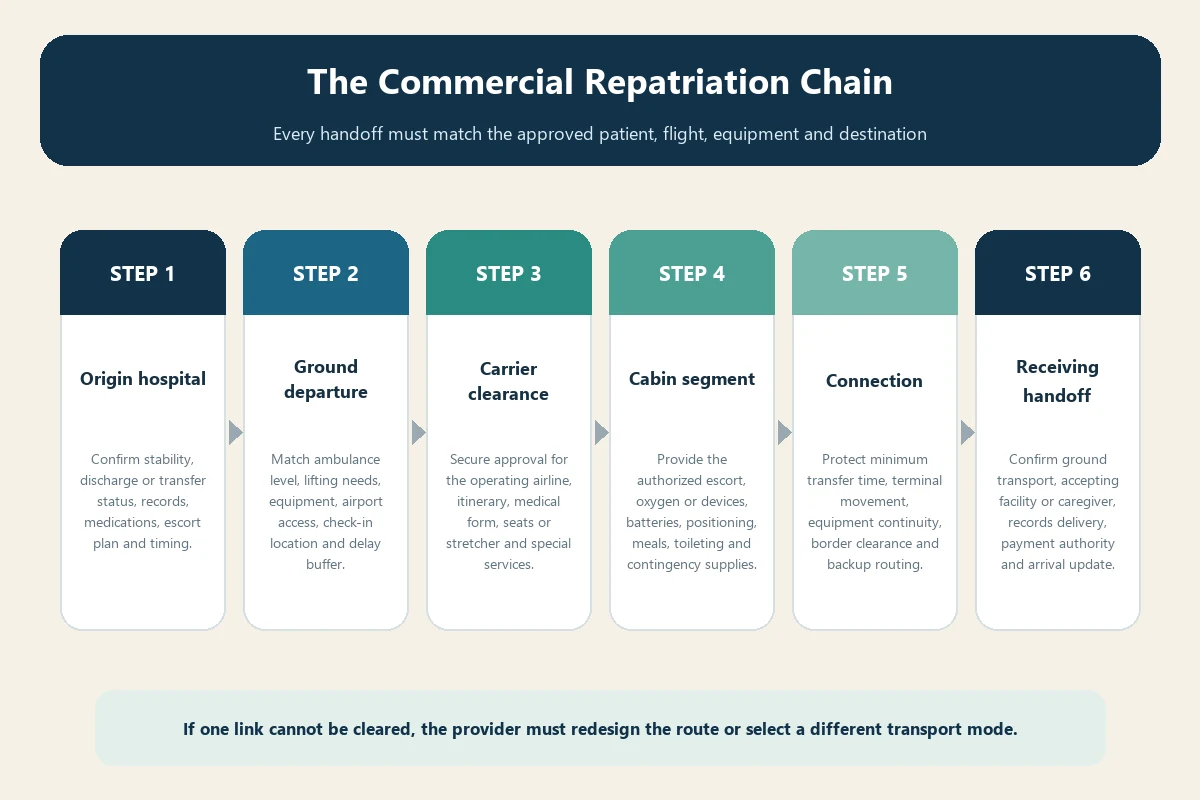
Medical repatriation by commercial flight is a door-to-door transport operation, not an ordinary ticket with a nurse added. The patient, clinical timing, airline medical clearance, seat or stretcher configuration, escort, oxygen, equipment, ground ambulances, connections, border documents, receiving care, and payment authority must all align.
A scheduled airline can be the appropriate mode for some stable patients and unsuitable for others. Commercial transport does not mean unassisted transport, and an air ambulance is not automatically safer or covered. This guide explains the planning questions; it is not individualized medical, airline, insurance, legal, or transport advice.
Key takeaways
- Decide the route and care level before purchasing tickets.
- Obtain approval from the operating airline for the exact patient and itinerary.
- Match the cabin setup and escort to every anticipated care task.
- Protect oxygen, equipment, ground transfers, connections, and receiving care as one chain.
- Keep a funded contingency for clinical or schedule changes.
Reviewed August 16, 2026. Commercial medical escort, fit to fly, MEDIF, stretcher, medical oxygen, portable oxygen concentrator, stable for transport, continued inpatient hospitalization, air ambulance, and repatriation are provider, carrier, clinical, regulatory, or contract-specific terms.
Map the complete commercial chain
| Stage | Critical decision | Failure example |
|---|---|---|
| Origin hospital | Stability, records, medications, escort, release | Patient changes before departure |
| Ground departure | Ambulance, lifting, equipment, airport access | Vehicle or terminal cannot support transfer |
| Carrier clearance | Medical form, itinerary, seat or stretcher | Operating airline has not accepted the case |
| Cabin segment | Escort, oxygen, devices, positioning, care | Support cannot continue through flight |
| Connection | Time, terminal move, border, equipment continuity | Handoff or battery margin fails |
| Receiving handoff | Ground transport, facility or caregiver, records | No accepted endpoint exists |
The international hospital-transfer guide explains facility acceptance and clinical handoffs. A commercial flight adds airline, cabin, airport, connection, and passenger-service dependencies between those endpoints.
Choose the mode from the patient and route
Possible modes include ordinary seated travel with assistance, a seated patient with a medical escort, multiple or upgraded seats, a commercial stretcher, ground ambulance, or medically dedicated aircraft. The appropriate choice depends on stability, cabin tolerance, required interventions, position, infection, urgency, route, airport access, airline capability, and receiving plan.
Do not select by headline price alone. The evacuation cost guide shows why origin access, aircraft or tickets, clinical crew, permits, ground legs, destination, and delays create the real cost. A cheaper cabin segment can fail if the surrounding chain cannot support it.
A current provider example shows the mode test
The July 2026 MedjetAssist annual rules provide one provider-specific example. They describe scheduled commercial airline transport with an authorized medical escort when the member’s condition permits and medically dedicated aircraft when the member cannot return commercially, subject to the membership’s other criteria.
The same rules describe inpatient status, stability assessment, receiving acceptance, ground access, provider-selected timing and mode, and business-class commercial transport if available. Medjet states that it is membership, not insurance. These terms must not be generalized to another membership or policy.
Fit-to-fly clearance precedes ticketing
The treating team should document diagnosis, recent procedures, stability, oxygen, mobility, pain, infection status, medication, toileting, nutrition, wounds, drains, behavioral needs, and risk of deterioration. The assistance medical team then designs the support plan. The operating airline decides whether it will accept that plan.
The evacuation approval guide separates treating-clinician advice, assistance-provider authorization, and operational transport decisions. Do not treat a discharge note as carrier acceptance.
U.S. medical-certificate rules are specific
Current 14 CFR 382.23 generally prevents a carrier from requiring a passenger with a disability to have a medical certificate except in specified circumstances. It permits one for stretcher or incubator travel, medical oxygen, or reasonable doubt that the passenger can complete the flight safely without extraordinary medical assistance.
The rule also addresses a physician statement, certificate timing, communicable conditions, and additional review after a significant adverse change. The operating carrier’s form, deadlines, and international legal obligations still need to be confirmed for the exact itinerary.
Seated medical escort transport has limits
A seated patient must tolerate the planned position and total duration, including ground waiting and connections. The plan can involve adjacent seats, an upgrade, assistance to board, an aisle chair, transfer support, limited walking, pressure relief, limb positioning, accessible lavatory planning, medication, meals, hydration, and rest.
List each care task and assign it to the patient, companion, medical escort, airline service, or ground team. Cabin crew are not a substitute for a dedicated clinical escort. The travel-companion guide explains why a personal companion and medical escort are distinct roles.
Commercial stretcher transport changes the aircraft
A stretcher case can require removal or blocking of multiple seats, approved stretcher equipment, restraints, privacy, medical clearance, clinical staffing, airport lifting, and substantial preparation. Availability depends on airline, route, aircraft, load, airport, and local rules. A flight or aircraft substitution can invalidate an approved setup.
Confirm body dimensions, weight, position, spinal or limb precautions, pressure care, monitoring, oxygen, suction, power, infection precautions, escort seats, companion travel, baggage, and loading method. Never buy a standard ticket and assume a stretcher can be added later.
Oxygen planning spans the entire journey
The FAA’s medical-oxygen page says passengers cannot carry personal compressed or liquid oxygen for onboard use, airlines are not required to offer oxygen service, and portable oxygen concentrators follow separate rules. Ground oxygen must be planned independently at the hospital, in vehicles, through airports, during layovers, and after landing.
The FAA’s portable-oxygen-concentrator guidance explains device acceptance criteria. Confirm the exact model, required settings, batteries, watt-hours, spare-battery protection, continuous runtime, delay margin, power assumptions, and who changes or monitors the device.
Every device needs an aviation plan
Ventilators, CPAP, suction, feeding pumps, monitors, mobility aids, batteries, syringes, sharps, medications, refrigerated supplies, and implanted or external devices can face carrier, security, power, hazardous-material, or border rules. Create a device inventory with manufacturer, model, dimensions, weight, battery, consumables, prescription, operator, and backup.
The IATA Medical Manual portal describes the manual as an airline-medicine resource covering passenger health and cabin operations. Use the operating airline’s medical desk for the actual acceptance decision; a general reference cannot reserve equipment or space.
The medical escort plan must be explicit
Choose escort qualifications from anticipated tasks and escalation risk. A nurse, paramedic, physician, respiratory clinician, or critical-care team can have different competence, licenses, medication authority, equipment, and employer protocols. Confirm language skills and access to the patient during every segment.
Specify observation frequency, medication schedule, oxygen or device management, mobility, transfers, toileting, nutrition, wound care, pain plan, behavior or cognition, sleep, infection precautions, and emergency thresholds. Define who calls the transport physician and who can recommend diversion.
Origin ground transport is not just a taxi
Determine whether the patient needs a basic or advanced ambulance, wheelchair vehicle, ordinary car, lifting team, oxygen, monitoring, medication, or escort continuity. Confirm hospital discharge time, route, traffic, airport check-in location, terminal clearance, curb-to-seat assistance, stairs or jet bridge, and a delay buffer.
The patient’s documents, medications, equipment, valuables, and clinical summary must travel with the responsible person. The pre-authorization guide helps separate approved provider-arranged segments from costs the traveler may have to pay.
Connections multiply risk
A connection adds deplaning, terminal distance, border or security processing, equipment movement, battery consumption, escort duty time, missed-flight exposure, and possible overnight care. A published minimum connection time is not necessarily a safe medical connection.
Confirm airside versus landside movement, visa and transit rules, wheelchair or aisle-chair handoff, ambulance access if needed, medical room availability, oxygen continuity, food and medication schedule, baggage responsibility, and rebooking authority. Prefer a route that reduces handoffs when clinically and operationally appropriate.
Receiving care must be ready before departure
For continued inpatient treatment, secure an accepting physician, available bed, clinical records, payment pathway, and destination ambulance. For a home discharge, identify the responsible caregiver, accessible environment, medication supply, equipment delivery, follow-up appointment, and emergency plan.
The home-country guide explains why an airport, country, residence, and hospital are different endpoints. The commercial itinerary must end at the place actually authorized and prepared to receive the patient.
Insurance and membership payment rules differ
A travel policy may reimburse eligible costs, require provider arrangement, pay vendors directly, limit the destination, or exclude self-arranged transport. A membership may arrange and pay covered services but refuse reimbursement for what the member books independently. Health insurance can govern treatment at the receiving facility without funding transport.
Ask for a written benefit decision naming tickets, seat blocks, stretcher, escort, oxygen, devices, ambulances, lodging, companion, changes, missed connections, and the receiving endpoint. Record deposits, cancellation terms, refunds, credits, and who bears cost if the patient changes before departure.
Build a disruption plan before boarding
Define what happens after fever, bleeding, new oxygen need, uncontrolled pain, confusion, equipment failure, absent escort, canceled flight, aircraft change, missed connection, closed border, lost bed, or ambulance delay. Keep assistance, clinician, carrier medical desk, ground teams, receiving facility, family, and payment contacts together.
Carry essential medication, supplies, records, and approved equipment with the responsible party rather than relying on checked baggage. Maintain enough consumables and power for a realistic delay. Stop and re-assess rather than forcing an obsolete plan.
Use this commercial transport manifest
- Patient identification, diagnosis, current condition, clinical summary, and fit-to-fly documents
- Assistance case, authorization, mode, escort, destination, approved costs, and conditions
- Operating carrier, medical approval, flight numbers, seats or stretcher, services, and contacts
- Oxygen, devices, batteries, medication, consumables, documents, and backup supplies
- Origin hospital release, ground vehicle, airport access, lifting, check-in, and delay buffer
- Connection times, terminal handoffs, visas, border process, equipment continuity, and rerouting plan
- Destination ground transport, accepting facility or caregiver, records, payment, and arrival update
- Clinical-change, cancellation, aircraft-swap, failed-equipment, and lost-receiver contingencies
The practical conclusion
Medical repatriation by commercial flight can be efficient and clinically appropriate when the patient is stable, the carrier accepts the exact plan, the escort and equipment match the care tasks, and both ground ends are ready. It is not a shortcut around medical or aviation review.
Design the chain from the receiving endpoint backward, obtain written approvals before spending, and recheck every dependency close to departure. If one link fails, the coordinator must redesign the route, delay safely, or choose a different mode. The strongest commercial plan is the one that remains medically, operationally, legally, and financially complete from bed to handoff.
Returning mortal remains is a legal, consular, insurance, mortuary and transport sequence—not simply an airline booking. Use the repatriation of remains process travel insurance guide to map the roles, approvals, documents, handoffs, costs and receiving arrangements from first notification through final delivery.
