

Local burial travel insurance is not one standard product. In some travel medical certificates, a local burial or cremation benefit is a limited alternative when an insured person dies abroad. In other arrangements, a funeral travel-protection plan pays to transfer remains after a death away from home. Life insurance, domestic burial insurance, prepaid funeral contracts, and return-of-remains coverage are different products.
This guide is about a named travel-insurance or travel-medical benefit for lawful disposition near the place of death. It explains how a U.S. family or legal representative can compare that option with returning a body or returning ashes. It is educational, not insurance, funeral, legal, tax, medical, religious, or consular advice.
Key takeaways
- Confirm the product class and issued certificate before relying on the words “burial coverage.”
- Local burial or cremation is often an alternative with its own lower maximum.
- Family authority, local law, release status, and insurer approval must align before spending.
- Preparation and basic disposition may qualify while ceremonies, plots, travel, or memorial items do not.
- Compare three complete routes, not isolated funeral-home prices.
Reviewed August 16, 2026. “Local burial,” “local cremation,” “return of mortal remains,” “home country,” “place of burial,” “reasonable expenses,” and “approved in advance” are document-specific terms.
Identify which product is being discussed
| Product or benefit | Primary purpose | Common misunderstanding |
|---|---|---|
| Travel medical local burial or cremation | Limited disposition near the place of death | Assumed to fund a full funeral |
| Return of mortal remains | Prepare and transport a body or ashes to a defined endpoint | Assumed to include every funeral expense |
| Funeral travel-protection plan | Coordinate transfer after death a stated distance from home | Assumed to be trip insurance |
| Life or burial insurance | Pay a death benefit under its own contract | Assumed to arrange overseas logistics |
| Prepaid funeral contract | Fund specified services with a funeral provider | Assumed to work internationally |
The broad repatriation-of-remains guide explains how return coverage is usually structured. For local disposition, begin with the schedule of benefits and definitions in the issued certificate. A marketing page or family memory of “repatriation included” is not enough.
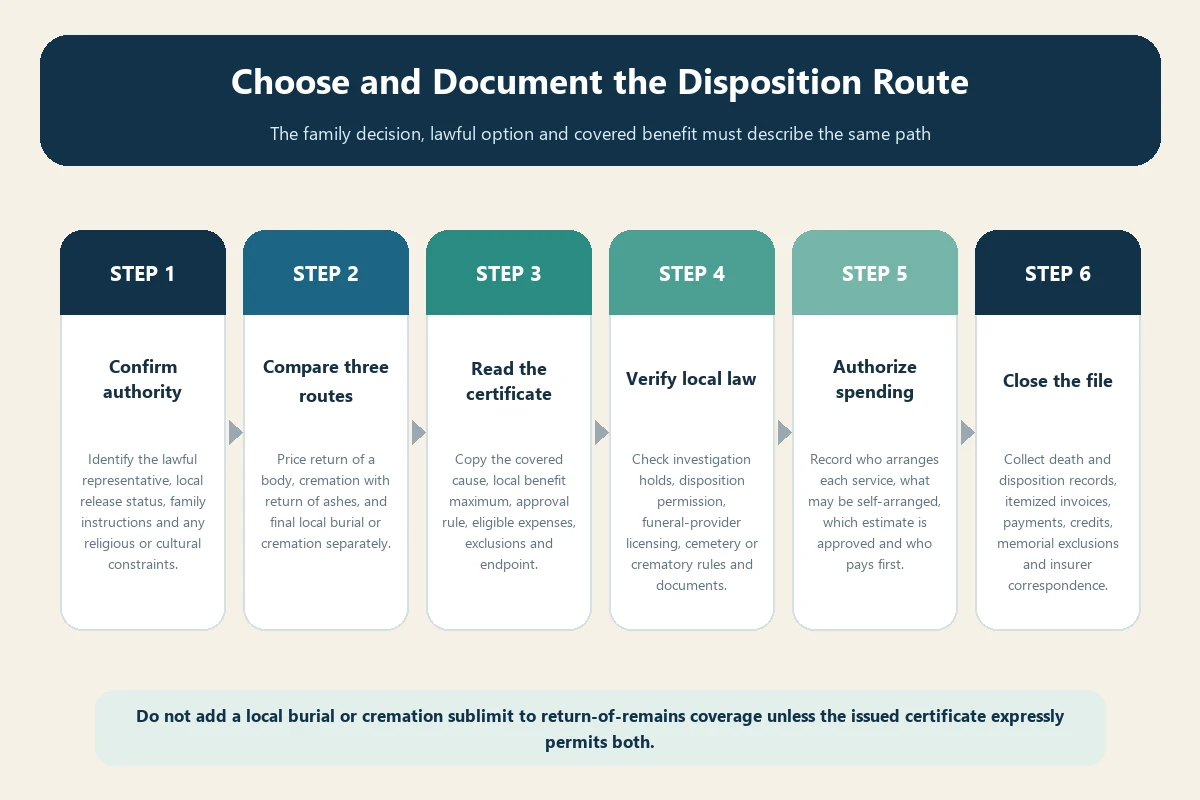
Compare three routes before selecting one
Ask for written, itemized estimates for returning a prepared body, cremating locally and returning ashes, and completing a final local burial or cremation. Each estimate should include local removal, storage, investigation-related delay, preparation, container, government documents, translation, consular work, ground transport, international carriage if any, receiving services, and final disposition.
A lower local quote is not automatically the family’s best or covered choice. Religious practice, family wishes, an existing burial plot, destination law, timing, ability to travel, and the deceased person’s written instructions can matter. Treat the benefit maximum as a financing constraint, not a decision maker.
Read local disposition as an alternative unless stated otherwise
One 2026 IMG Global Medical Insurance sample contract shows a return-of-mortal-remains maximum and a smaller local burial or cremation maximum, with advance company approval. IMG’s Explorer benefit page also illustrates age-banded medical benefits and a separately presented local disposition amount within one plan family. These are product-specific examples, not universal limits.
Copy whether the local amount is “in lieu of,” “instead of,” “up to,” or included within another maximum. Do not add two numbers unless the certificate expressly allows both. Also check whether local cremation plus return of ashes falls under the local benefit, return benefit, or a blended provision.
Confirm that the death falls within the certificate
Coverage can depend on the insured person’s eligibility, effective dates, covered area, trip purpose, period of coverage, cause of death, and general exclusions. A benefit heading does not override an excluded pre-existing condition, hazardous activity, intoxication clause, war exclusion, illegal act, or travel outside the covered territory.
Use the travel medical exclusions guide to copy the actual causation language. Do not make a medical or coverage conclusion from the death certificate alone. Send the available facts to the insurer and ask for its written determination.
Establish who can authorize disposition
The traveling companion, person holding the policy card, beneficiary, and lawful representative may not be the same person. Local law determines who can instruct the funeral provider, while the insurance contract determines who may report or pursue a claim. Confirm next-of-kin priority, power of attorney limitations after death, executor status, and any written disposition instructions with appropriate local professionals.
Record the representative’s identity, relationship, contact information, legal authority, and exact instruction. If relatives disagree, the insurer cannot resolve family authority merely by choosing the least expensive route. Do not ask a funeral provider to proceed until the authority question is settled.
Local law controls what is possible
The State Department’s death-abroad guidance explains that burial or cremation must follow U.S. and foreign law and that options depend on local facilities, customs, and practice. A local government may require an autopsy, delay release, restrict cremation, require embalming for export, or impose a specific cemetery or documentation process.
Ask the embassy or consulate for its current country-specific disposition information and list of funeral homes. The list is assistance, not a guarantee, endorsement, or payment promise. Verify licensing, written estimates, language, currency, taxes, storage charges, cancellation terms, and the authority that will issue each record.
Understand the public-health boundary
The CDC’s human-remains import guidance concerns bringing remains into the United States. It distinguishes cremated remains, embalmed remains, non-embalmed remains, and certain infectious-disease cases. A final local burial may avoid U.S. import, but return of ashes or later transfer still has destination and carrier requirements.
If the family chooses cremation with return of ashes, confirm the cremation certificate, urn or container, carrier rules, security screening, customs declarations, and who will carry or ship them. “Cremation abroad” and “final local cremation” may describe different endpoints if the ashes are returned home.
Call the assistance company before signing
Give the policy number, deceased person’s identity, location, local authority, release status, lawful representative, available disposition choices, funeral-home estimate, requested endpoint, and time pressure. Ask for a case number, named contact, secure upload method, applicable benefit, maximum, authorization, approved provider, direct-payment possibility, and permission for family-arranged services.
The evacuation decision-authority guide concerns a different benefit, but its role separation is useful here. A funeral director can say what is operationally possible; a consular officer can explain process; the family selects lawful disposition; and the insurer decides coverage under its contract.
Build an eligible-expense ledger
| Expense group | Question for the insurer | Evidence |
|---|---|---|
| Removal and storage | Covered from which date and for how long? | Dates, reason for delay, itemized daily charges |
| Preparation | Which services are necessary for the chosen route? | Provider description, authority or carrier requirement |
| Disposition | Does basic burial or cremation qualify, and to what maximum? | Authorization, invoice, certificate |
| Documents | Are permits, translations, and official fees eligible? | Official receipts and issued records |
| Transport | Does the local benefit include ground movement or return of ashes? | Route, provider, receipts, delivery |
| Memorial items | Are ceremony, flowers, obituary, urn, or marker excluded? | Separate optional lines |
Separate necessary disposition costs from choices that enhance a ceremony. The policy may pay only reasonable expenses up to a cap. Ask whether taxes, tips, exchange fees, family travel, lodging, meals, a burial plot, cemetery maintenance, permanent monument, obituary, flowers, clergy, reception, livestream, or later U.S. memorial are excluded.
Do not confuse “local” with any location the family chooses
Local can mean the country, city, or area of death, depending on the wording and available facilities. Moving remains across a border to a culturally preferred place may become repatriation or another uncovered transfer. A burial near a vacation property may not qualify if the certificate defines a different destination.
The home-country definition guide shows why residence, nationality, and family preference can point to different countries. Ask the insurer to identify the approved local endpoint in writing before choosing a provider.
Document the reason for the selected route
Keep the family’s signed instruction, disposition estimate, alternate-route estimates, local-law limitation, investigation status, religious or cultural constraint communicated to providers, insurer authorization, and any reason return was impossible or declined. This record protects against a later assumption that the family selected a costly service without comparison.
Do not over-document private family reasoning for the insurer. Provide what is necessary to establish authority, the covered option, and the expense. Store identity, health, death, and payment records securely.
Coordinate other funds without assuming double payment
Possible resources include travel insurance, travel medical insurance, a funeral travel-protection program, life insurance, employer benefit, union or association benefit, prepaid funeral contract, credit-card benefit, supplier refund, and family funds. Each has its own trigger and may pay a provider, reimburse the estate, or make a general cash payment.
Disclose other insurance, refunds, or credits when the claim form requests them. A travel policy that indemnifies actual expenses may reduce payment for amounts recovered elsewhere. The general claims-documentation guide explains why proof of payment and other settlements belong in the file.
Collect the closeout packet
- Issued policy, schedule, endorsements, application, and declaration
- Local death certificate, translation, release, and lawful-representative evidence
- Family disposition instruction and insurer authorization
- Funeral-provider license or identifying details, contract, and itemized estimate
- Burial or cremation certificate and any transport or delivery record
- Invoices, receipts, bank or card evidence, currency conversion, refunds, and credits
- Consular correspondence and records relevant to the chosen route
- Claim form, secure-submission receipt, deficiency requests, response, and final decision
The State Department’s international travel checklist makes clear that the U.S. government does not pay unexpected costs abroad. A consulate may help transmit instructions or identify local resources, but the family and insurer still need a documented financial plan.
Use a calm decision sequence
- Report the death and determine release status.
- Confirm the lawful representative and family instruction.
- Open the assistance case and copy the issued benefit.
- Obtain itemized estimates for all lawful disposition routes.
- Confirm local law, provider, endpoint, documents, and timing.
- Get written authorization and payment instructions before contracting.
- Preserve disposition records, itemized financial proof, and other recoveries.
- Submit the claim and answer deficiencies through the secure channel.
The practical conclusion
Local burial travel insurance should be evaluated as a specific benefit, not a comforting label. Identify the contract, lawful representative, covered cause, disposition route, maximum, approval requirement, eligible expenses, endpoint, and evidence. Compare full routes before a family commits to one.
A respectful process keeps family wishes central while separating them from coverage assumptions. The insurer’s contribution may be limited; the consulate’s role is assistance rather than payment; and local authorities control release and lawful disposition. Written decisions and itemized records let those roles work together without turning a difficult family choice into an avoidable coverage dispute.
