

The repatriation of remains process in travel insurance is a chain of legal, consular, mortuary, transport, and claim decisions. After a death abroad, the family cannot simply buy a cargo booking and send a body home. Local authorities must register and, when required, investigate the death; a lawful representative must choose a disposition; the insurer or assistance company must confirm its role; funeral professionals prepare the remains; export and entry documents must align; and a receiving funeral home must be ready.
This guide maps that sequence for a U.S. family or legal representative. It is educational, not insurance, funeral, public-health, legal, tax, or consular advice. Local law, the issued insurance certificate, the cause and circumstances of death, nationality, transit countries, carrier rules, and the family’s lawful authority can change the path.
Key takeaways
- Call local authorities, the appropriate consular post, and the policy’s assistance line before committing money.
- Return of a body, cremation with return of ashes, and local disposition are different routes.
- A foreign death certificate, consular shipping documents, and a Consular Report of Death Abroad serve different purposes.
- Advance authorization, separate limits, exclusions, and reasonable-expense rules can control insurance payment.
- The physical shipment needs an approved sender, packaging, carrier, ground transfers, and a receiving funeral home.
Reviewed August 16, 2026. “Next of kin,” “legal representative,” “home country,” “place of burial,” “return of mortal remains,” “local burial,” “reasonable expenses,” and “approved in advance” are document-specific terms.
First, separate the process from the benefit
The existing repatriation-of-remains benefit guide explains common covered services, limits, and exclusions. The process question is narrower: who must do what, in what order, and which record proves each handoff? A valid return may proceed even when insurance does not pay. Conversely, an insured benefit cannot operate until local authorities release the remains and transport is legally possible.
| Workstream | Decision owner | Evidence to preserve |
|---|---|---|
| Local legal process | Police, hospital, civil registry, coroner, or prosecutor | Identity, death record, release, and investigation status |
| Consular support | Embassy or consulate | Instructions, mortuary documents, lists, and consular report |
| Insurance | Insurer or assistance administrator | Case number, authorization, option, maximum, and exclusions |
| Preparation | Licensed local funeral professional | Itemized services, preparation certificate, and packaging record |
| Transport | Accepted shipper, carrier, and ground providers | Air waybill, permits, route, delivery, and payment |
| Receipt | Receiving funeral home and legal representative | Acceptance, final delivery, reconciliation, and claim file |
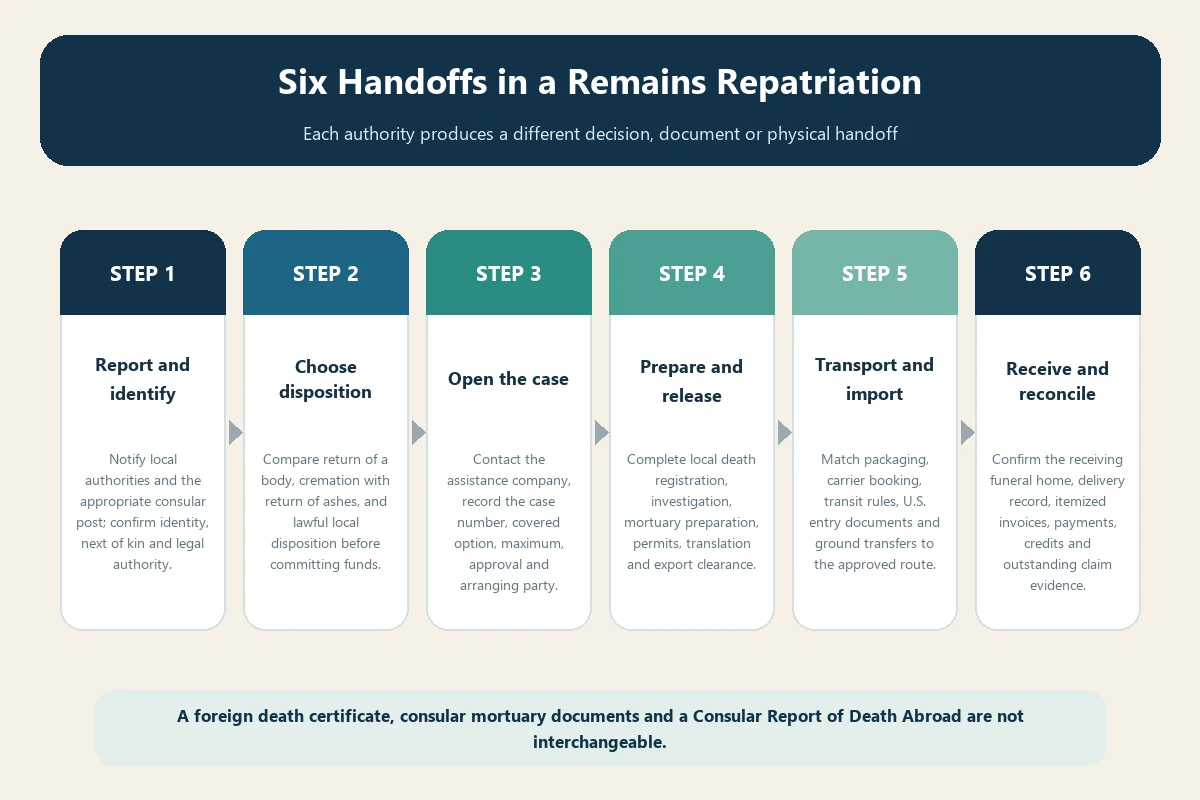
Stage 1: report the death and confirm authority
A hospital, police agency, or other local authority normally starts the local death-registration process. If the deceased was a U.S. citizen, contact the nearest U.S. embassy or consulate. The State Department’s death-abroad guidance says consular officers can help locate and notify next of kin, explain local arrangements, and provide lists of funeral homes or lawyers. It also states that the U.S. government does not pay to return remains or ashes.
Record the deceased person’s full legal name, date and place of birth, passport details, citizenship, policy number, local case number, place and time of death, attending facility, authority handling the case, and contact details. Confirm who may legally instruct the funeral home and insurer. A traveling companion can report facts, but may not have authority to select disposition or sign contracts.
Stage 2: determine whether release is pending
A natural death in a hospital, an accident, suspected crime, unknown cause, infectious disease, or death during transport can follow different local procedures. Ask whether identification is complete, whether an autopsy or investigation is required, which authority can issue a release, and whether any document needs translation, notarization, authentication, or legalization.
Do not promise a departure date while a legal hold exists. Storage, preparation, booked cargo, visa, and family-travel decisions can all depend on release. Keep every written update and identify whether a date is confirmed, estimated, or merely requested.
Stage 3: choose among three disposition routes
The lawful family representative may need to compare return of an embalmed or otherwise prepared body, cremation abroad with return or transport of ashes, and final burial or cremation near the place of death. Availability depends on local facilities, religion, family wishes, investigation status, local law, destination requirements, and the policy.
Ask the assistance company to quote each covered option before signing a funeral contract. Some certificates treat local burial or cremation as an alternative with a lower maximum, not an amount added to the return-of-remains maximum. The selected route should be recorded in writing with the destination, arranging party, limit, included services, excluded services, and required approvals.
Stage 4: open the insurance and assistance case
Call the 24-hour assistance number shown on the issued policy. Provide the facts without guessing at cause or coverage. Ask for a case number, named contact, secure document channel, benefit provision, maximum, deductible or coinsurance if any, approval requirements, authorized funeral provider, and permission boundaries for family-arranged services.
The pre-authorization guide provides a useful decision log even though a death-abroad benefit is not medical evacuation. Record whether the company is arranging and paying providers directly, approving a family proposal, or reviewing a reimbursement claim later. Those are different promises.
Read the specific return-of-remains clause
One 2026 IMG Global Medical Insurance sample contract lists a return-of-mortal-remains maximum, a smaller local burial or cremation maximum, return to the home country, and advance company approval. It is one current plan-specific example, not a market standard. Other certificates may use country of residence, place of burial, principal residence, home country, or another endpoint.
Copy the exact covered cause, eligibility period, endpoint, covered services, maximum, reasonable-and-customary rule, exclusions, coordination clause, notice deadline, proof-of-loss rule, and appeal procedure. The State Department insurance page reinforces the broader lesson: policies differ, so travelers must review what the issued contract covers.
Do not confuse living-patient repatriation with remains transport
The commercial medical repatriation guide concerns a living patient, airline medical clearance, seating or stretcher arrangements, escorts, oxygen, and receiving care. Remains normally travel under cargo, mortuary, public-health, customs, and destination rules. A large emergency medical evacuation maximum does not automatically fund return of remains, and the two benefits may have separate limits.
Stage 5: assemble the local document packet
The exact packet depends on the countries and circumstances. Common components can include a local death certificate, identification, release or burial-transit authorization, preparation or embalming certificate, cremation certificate when applicable, funeral director affidavit, export permit, translation, consular mortuary certificate, airline acceptance documents, and instructions from the receiving funeral home.
The CDC’s current human-remains import guidance tells a U.S. citizen’s next of kin or legal representative to work with consular officials on foreign export clearance, U.S. import documents, packaging, and transport. It distinguishes embalmed, cremated, non-embalmed, and potentially infectious remains. Treat its list as an entry framework, then confirm the case-specific requirements.
Understand what the Consular Report of Death Abroad does
After a local competent authority issues the foreign death certificate, a U.S. embassy or consulate may prepare a Consular Report of Death Abroad for a deceased U.S. citizen. The report is commonly used in the United States for insurance and estate matters. It is not necessarily the document that releases the remains or accompanies every cargo movement.
The State Department notes that the original consular-report process can take months in some countries. Its record-copy instructions describe a separate later process for obtaining official copies. Ask the insurer which interim evidence it accepts so the claim does not wait unnecessarily for a document used primarily for later administration.
Stage 6: prepare the remains and transport container
The local funeral professional must follow local law, carrier rules, transit-country rules, and U.S. entry requirements. Preparation can include embalming where allowed or required, a sealed inner container, an outer transfer case, labeling, documentation pouch, and coordination with an accepted cargo agent. Cremated remains follow a different packaging and documentation path.
The CDC says all non-cremated remains entering the United States must be fully contained in a leak-proof container, subject to its stated exceptions and permit framework. It also explains when a death certificate, English translation, consular documents, importer certification, or infectious-disease permit may be relevant. Do not rely on a generic coffin or baggage assumption.
Build the transport as connected handoffs
Map local removal, mortuary preparation, transfer to the airport, accepted shipper, international carrier, any transit point, U.S. entry, cargo release, destination ground transport, and receiving funeral home. For each segment record the provider, date, address, confirmation, document owner, payment method, delay responsibility, and after-hours contact.
A receiving funeral home should confirm acceptance before departure and identify any state or local requirements after entry. If the family changes the final city or funeral home, obtain written approval before rerouting. A destination preference is not the same as the endpoint covered in the certificate; the home-country definition guide shows why residence, citizenship, and requested destination can diverge.
Control invoices and payments before they multiply
Request itemized estimates for local removal, storage, preparation, container, government and consular fees, translation, cargo, ground transport, receiving services, cremation, burial, and optional memorial products. Mark each line as insurer-arranged, insurer-approved for reimbursement, family responsibility, or undecided.
Do not assume the travel policy pays the funeral ceremony, burial plot, permanent urn, obituary, flowers, family flights, or services that would have been purchased at home. Ask whether supplier refunds, life insurance, a funeral plan, employer benefit, credit card, or another policy must be disclosed. Preserve invoices, receipts, bank records, exchange-rate evidence, and credits for the eventual travel-insurance claim file.
Use one shared status sheet
- Identity, citizenship, policy, local case, and lawful representative
- Cause-of-death status, investigation, identification, and release authority
- Chosen disposition route and written family instruction
- Assistance case, benefit clause, maximum, approval, and arranging party
- Foreign death certificate, translations, local permits, and consular records
- Preparation method, container, funeral director, and carrier acceptance
- Route, air waybill, transit points, customs or entry contact, and final receiver
- Itemized estimates, invoices, payments, refunds, credits, and missing proof
Label every item requested, pending, received, submitted, accepted, or superseded. Store copies securely because these records contain sensitive personal, medical, identity, and financial information. Give the insurer documents through its approved secure channel rather than ordinary messaging when possible.
Escalate mismatches before shipment
Stop and reconcile a spelling mismatch, different date, untranslated cause of death, missing seal, inconsistent destination, unapproved provider, carrier rejection, expired permit, infectious-disease concern, or receiving-home change. Ask the issuing authority to correct its own record; do not edit official documents.
The family’s timeline, insurer’s authorization, funeral director’s packet, carrier booking, and receiving instructions should describe the same person, remains type, route, endpoint, and dates. The decision-authority guide offers a general lesson that applies here: advice, authorization, legal release, and operational acceptance come from different parties.
The practical conclusion
A sound repatriation of remains process starts with authority, not spending. Report the death, establish the lawful representative, determine release status, compare disposition routes, open the assistance case, and obtain written scope before contracting services. Then build one document packet and one physical handoff plan from the local funeral professional to the final receiver.
Travel insurance can fund and coordinate part of this path when the issued certificate applies. It cannot replace foreign law, a consular record, public-health requirements, carrier acceptance, or family authority. The best case file makes those systems agree before the remains move and preserves enough evidence to reconcile the claim afterward.
When a claim record is missing or authority is unclear, rebuild the evidence before escalating. Use who may document and submit a travel claim for a deceased insured to identify the required fact, obtain the strongest available record and document any remaining gap.