
Travel insurance storm surge flight cancellation coverage depends on the surge’s documented effect on the booked trip. A coastal warning can require evacuation while an inland airport remains open. Surge can also close an airport access road, inundate a terminal, make a beachfront hotel uninhabitable, stop a ferry, or cause the airline to cancel. Each fact supports a different part of the claim.
This U.S. guide connects the official coastal forecast, safety order, transportation and lodging status, carrier decision, policy wording, supplier remedies, and net expense. It is educational, not emergency, meteorological, flood-engineering, aviation, legal, medical, or insurance advice.
Storm surge coverage at a glance
- Follow evacuation and re-entry instructions before handling bookings.
- Save the surge forecast, affected zone, times, and later observations.
- Separate coastal hazard from airport, hotel, and carrier status.
- Document each supplier’s cancellation, alternative, refund, or credit.
- Test known-event timing and the exact issued policy trigger.
- Claim only eligible loss remaining after every recovery.
Reviewed August 17, 2026.
Storm surge is not ordinary high tide
The National Hurricane Center’s storm surge overview explains that surge is an abnormal rise of water generated by a storm, over and above predicted astronomical tides. Storm tide combines the surge and astronomical tide. Waves, rainfall, river flow, shoreline shape, and timing can make local conditions differ from a single forecast number.
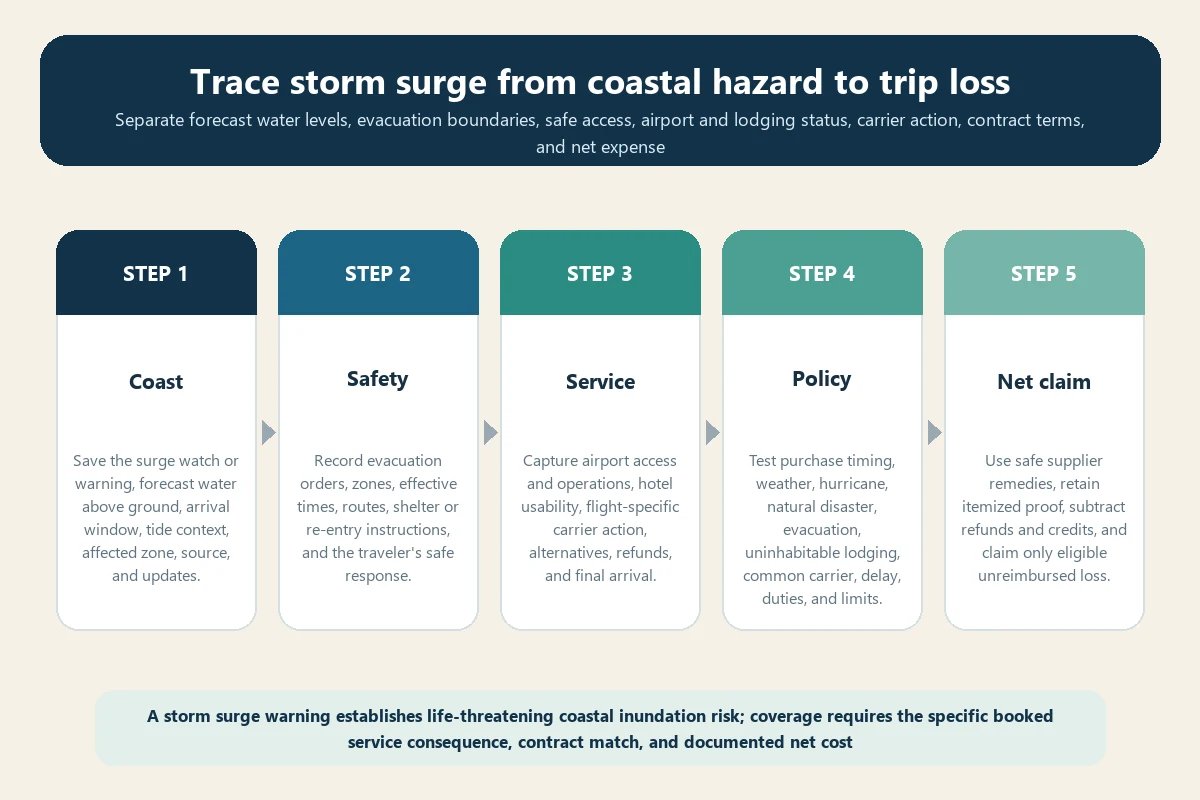
Record the forecast water height above ground, geographic zone, possible arrival window, tide context, update time, and source. Do not translate a basin-wide forecast into a precise depth at a hotel or runway unless the authoritative product does so.
A watch and warning answer a safety question
NHC’s hurricane hazard information identifies storm surge as a major coastal threat. A Storm Surge Watch means life-threatening inundation is possible, generally within 48 hours; a Storm Surge Warning means it is expected, generally within 36 hours. Current products and local instructions control.
The watch or warning establishes hazard, location, and timing. It does not prove that a booked flight was canceled, an airport closed, a hotel was unusable, or a traveler lost money. Those consequences need separate records.
Evacuate when authorities instruct
Ready.gov’s official hurricane preparedness guidance tells people in evacuation zones to follow local officials and use designated routes. Do not wait for an insurer to authorize a life-safety move. Do not enter a closed zone or cross floodwater to save a reservation.
After reaching safety, preserve the issuing authority, evacuation zone, mandatory or voluntary status, effective time, departure deadline, route, shelter guidance, cancellation or extension, and re-entry notice. Record where the traveler and booked lodging were located relative to the boundary.
An evacuation order is not a flight cancellation
A coastal hotel can be inside an evacuation zone while a regional airport outside the zone continues operating. A traveler may leave lodging early and still depart on the original flight. Alternatively, the airline may cancel before a local evacuation order is issued.
Build parallel timelines for safety, lodging, airport access, airport operations, and the booked flight. This prevents a valid evacuation fact from being used to claim a carrier action that did not occur.
Map every itinerary point to the surge zone
List the origin, connecting airport, destination airport, hotel, cruise port, rental location, attraction, and transfer route. Mark each against official surge and evacuation zones with dates and times. A warning at the destination may affect an inbound flight, while a warning near the origin can change departure and parking access.
Keep the official map legend, product time, forecast version, and URL. An uncropped map with its scale and zone labels is stronger than a social-media screenshot without context.
Prove airport access separately
Surge can close a causeway, bridge, tunnel, coastal highway, rail line, parking facility, or shuttle route before water reaches the airport. Save the transportation authority’s exact segment, direction, closure time, reason, alternatives, and reopening.
If no safe practical route remained, record why. If an alternative airport or route was offered, document its availability, travel time, cutoff, cost, and flood or evacuation restrictions. The flash flood flight guide provides a complementary access-versus-carrier timeline.
Prove airport operations without exaggeration
Possible consequences include ramp suspension, runway inspection, terminal closure, utility shutdown, equipment relocation, ground stop, diversion, reduced schedule, or complete airport closure. Preserve the responsible facility or FAA notice, scope, stated cause, start, extensions, and reopening.
A flooded roadway does not prove the runway closed. A ground stop does not necessarily mean the airport itself closed. Use our airport closure guide and air traffic control delay guide to label the operational state accurately.
Get the airline’s flight-specific disposition
Save the ticket, itinerary, flight number, scheduled times, boarding pass, app notifications, emails, texts, gate information, and call notes. Ask for the final reason: airport closure, surge, tropical cyclone, runway inspection, ATC restriction, inbound aircraft, crew displacement, or another cause.
Keep every rebooking, alternate-airport, waiver, voucher, meal, hotel, refund, and cancellation option. Record the offer time, acceptance or refusal, and final arrival. A regional hurricane headline is not a substitute for the booked carrier’s record.
Use airline remedies before insurance
The U.S. Department of Transportation’s airline refund guidance says passengers are entitled to a refund when the airline cancels and they decline alternative transportation or compensation. The cause being severe weather does not remove that right.
Subtract the refund from the claim. If safe rebooking is accepted, reasonable eligible delay expenses or unused prepaid land arrangements may remain. Keep the airline’s offer and final ticket status.
Hotel usability requires supplier evidence
A hotel inside a warning area may evacuate, close, lose utilities, suffer water damage, or reopen with limited services. Obtain its written cancellation, affected dates, evacuation response, physical condition, expected reopening, alternative lodging, and refund or credit decision.
Do not call the property uninhabitable merely because the wider coast was warned. Conversely, an operating airport does not make evacuated lodging usable. If the trip has already started, our trip interruption insurance guide helps separate unused arrangements from added transport and lodging.
Cruise and ferry segments create another chain
Storm surge may close a port, change a cruise embarkation point, suspend a ferry, or block ground access while flights continue. Preserve the operator’s cancellation or relocation, port notice, boarding cutoff, alternate transport, refund, future credit, and hotel consequences.
Do not assume a flight policy trigger automatically covers a missed cruise. Use the ferry travel insurance guide for operator and port evidence, and retain proof that the original connection was reasonable.
Choose the benefit by trip stage
Trip cancellation generally addresses an eligible pre-departure cancellation and forfeited prepaid arrangements. Trip delay may address reasonable added costs after a qualifying delay reaches its threshold. Trip interruption can address an eligible event after departure, unused arrangements, and additional transport under its wording.
Do not move an expense between benefits only to find a higher limit. The delay, interruption, and cancellation comparison explains how timing and loss type differ.
Test the exact policy language
Search the issued contract for weather, hurricane, named storm, natural disaster, common carrier, mandatory evacuation, airport closure, destination inaccessible, uninhabitable accommodation, trip delay, cancellation, interruption, and missed connection. Read every definition, duration threshold, notice duty, exclusion, per-day cap, and total limit.
A policy may require a common carrier to stop service for a specified period. Another trigger may depend on a mandatory evacuation or lodging becoming uninhabitable. A surge watch alone may not satisfy either. Use the issued policy and endorsements for the purchaser’s U.S. state.
Create a known-event chronology
Record the first trip payment, policy purchase, initial outlook, storm naming if relevant, surge watch, surge warning, evacuation order, supplier action, carrier decision, and each expense. Do not rely on a universal rule that coverage ends the moment a storm is named; known-event wording and insurer alerts vary.
A policy bought after the surge threat becomes public may not cover loss from that event. The when to buy travel insurance guide explains why dated purchase and forecast records matter.
Separate surge, rain flooding, wind, and damage
A tropical system can produce coastal surge, inland rainfall flooding, destructive wind, tornadoes, and utility failure. Record which hazard caused the actual booked-service failure. The answer may change as operators inspect facilities.
Use the tornado flight cancellation guide when a warning or damage path is the relevant cause. Avoid forcing every consequence under the storm-surge label.
Build one chronological claim file
- Policy, declarations, endorsements, purchase receipt, and itinerary.
- Surge products, evacuation orders, maps, times, and updates.
- Road, transit, airport, port, hotel, and carrier records.
- Every safe alternative, rebooking, refund, waiver, and credit.
- Original invoices, cancellation terms, itemized receipts, and payment proof.
- A timeline linking each expense to the qualifying consequence.
Use the travel insurance claim guide to index the submission. Explain gaps caused by evacuation, power loss, or unavailable communications rather than inventing precise times later.
Calculate net eligible loss
Start with each forfeited prepaid cost or reasonable additional expense. Subtract airline and hotel refunds, cruise or ferry payments, credits used, card recoveries, and other reimbursement. Then apply the relevant benefit limit, daily cap, deductible, and documentation rule.
If the airline refunds the airfare and the hotel refunds evacuated nights, those amounts are no longer insurance losses. A reasonable replacement hotel after a qualifying delay may remain, subject to the contract.
Common storm surge claim mistakes
- Treating a surge warning as proof every coastal service stopped.
- Confusing forecast surge above ground with ordinary tide level.
- Calling an evacuation order an airline cancellation.
- Entering a closed or flooded zone to preserve a booking.
- Using a hurricane headline instead of flight-specific evidence.
- Ignoring safe alternatives, refunds, credits, and policy duties.
- Claiming the gross trip price rather than net eligible loss.
Frequently asked questions
Does a Storm Surge Warning automatically cover cancellation?
No. It establishes expected life-threatening coastal inundation, but coverage still needs a qualifying booked-trip consequence, policy match, eligible expense, and net loss.
What if my hotel evacuates but the airport stays open?
Preserve the evacuation order, hotel decision, alternative lodging, refunds, and flight status. Mandatory-evacuation or uninhabitable-lodging wording may matter more than a carrier trigger.
What if the airport road closes but my flight departs?
Document the official closure, safe alternatives, cutoff, and airline response. Do not describe the flight as canceled. Test whether the policy contains an applicable access or road-closure trigger.
Are additional hotel nights covered?
They may qualify under delay or interruption wording after the required cause and threshold, subject to reasonableness, receipts, daily caps, total limits, and other recoveries.
Does a named hurricane guarantee coverage?
No. Naming can be relevant to purchase timing, but the issued contract, qualifying consequence, duties, exclusions, and remaining financial loss control the claim.
Bottom line: safety status, commercial status, and insurance status are different. Follow the evacuation first, then document exactly which access route, facility, carrier, lodging, or port service failed and what eligible cost remained after remedies.
Tsunami disruption needs separate source-event, alert-level, evacuation, facility, and carrier evidence. Use this tsunami flight cancellation travel insurance guide to preserve the safety timeline, supplier remedies, policy trigger, and eligible net loss.
Earthquake disruption needs separate source-event, local-shaking, inspection, facility, and carrier evidence. Use this earthquake flight cancellation travel insurance guide to preserve supplier remedies, test the issued policy, and calculate eligible net loss.
