
 David Sterling
A travel insurance recurring condition is evaluated through dates, medical facts, and policy language—not by the word “recurring” alone. A flare-up can relate to an earlier illness, follow a long symptom-free interval, or turn out to be a different condition. Each path produces a different certificate review.
This U.S.-focused guide builds that review without promising coverage. It is insurance education, not medical, legal, or coverage advice. Never delay evaluation, stop treatment, or change medication to create a longer quiet period.
Key takeaways
- Plot the earlier episode, quiet interval, look-back window, and later event.
- Separate a historic diagnosis from treatment or advice inside the look-back period.
- Do not treat symptom-free time as a universal policy safe harbor.
- Test whether the claimed event is related before applying the waiver and benefit.
- Preserve records for both the earlier episode and the new event.
Reviewed August 16, 2026. Definitions of pre-existing, chronic, subsequent, and recurring conditions vary by state and plan. The issued certificate controls.
Why the recurring label does not decide coverage
“Recurring” can describe repeated migraine episodes, intermittent back pain, diverticulitis flare-ups, asthma exacerbations, kidney stones, or another pattern. The clinical relationship between episodes matters, but the insurance question also depends on the exact pre-existing-condition definition and the benefit being claimed.
Start by separating four facts: what happened before, what occurred during the policy’s look-back period, what happened after purchase, and what loss affected the trip. The stability-period guide addresses plans that expressly use stability language. This guide focuses on recurrence when the form may instead list treatment, advice, symptoms, or related consequences.
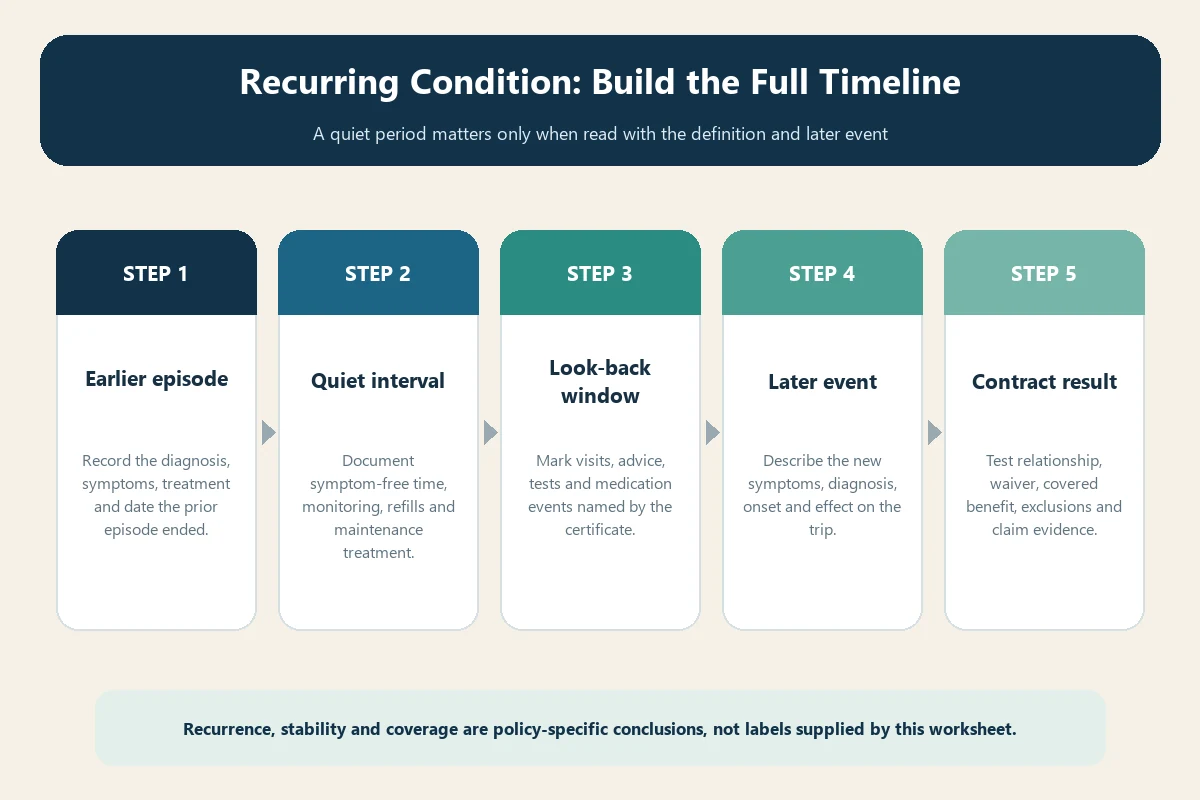
Build one timeline with five zones
Zone one covers the earlier episode: diagnosis, symptoms, tests, treatment, and when the episode resolved. Zone two covers the quiet interval. Zone three is the certificate’s look-back window. Zone four begins with policy purchase. Zone five is the later event and claimed loss.
Add the initial trip payment, plan purchase, effective dates, departure, and return. A simple calendar prevents a prior event from being placed in the wrong look-back window. Use the look-back guide to identify the correct anchor rather than assuming the period ends at departure.
Record what happened during the quiet interval
A symptom-free interval can be strong factual evidence, but document what “symptom-free” means. Was there no pain, no functional limitation, no rescue medication, or simply no physician visit? Did routine monitoring continue? Was maintenance medication refilled? Were tests scheduled or advice given?
Do not convert a personal description into a contract conclusion. A form that looks only for recommended or received medical advice or treatment may produce a different analysis from a form that also lists symptoms or prescribed-medication changes. The site’s look-back examples show how small wording differences change the event map.
Maintenance treatment and a flare-up are separate facts
Regular medication, physical therapy, monitoring, or a standing care plan can continue between episodes. Record those facts without deciding whether they satisfy the definition. Some forms distinguish controlled maintenance from a new or changed course; others do not include that exception.
If a prescription started, stopped, switched, or changed dose, preserve the reason and date. The medication-change guide separates routine refills and substitutions from clinical changes. A pharmacy record alone may not explain why an action occurred.
Compare two current wording patterns
A current Travel Guard Vermont sample policy defines a pre-existing condition through medical advice or treatment recommended or received during its stated 180-day period. It does not turn every historic diagnosis into a current match without applying those words.
Allianz’s current existing-condition explanation uses a plan example involving symptoms or treatment during a stated 120-day period. It also presents a recurring diverticulitis example when explaining later trip-cost updates. These examples show why a recurrence label is insufficient; the actual state-specific form may use different people, events, dates, and exceptions.
Test the relationship to the later event
Describe the later event precisely. Note onset, symptoms, diagnosis, tests, treatment, physician restrictions, and how it affected the trip. Then ask whether the certificate or claim process treats it as caused by, resulting from, related to, or a complication of an earlier condition.
A clinician’s records can establish medical history and relationship. Do not supply your own causal diagnosis. If the later event is truly unrelated, document that conclusion through appropriate medical evidence rather than a traveler-written statement.
Also distinguish recurrence from a complication or consequence. A later infection, injury, or medication side effect may be medically connected without repeating the earlier symptoms. Search the certificate for related to, resulting from, subsequent, complication, and consequence. Copy the whole sentence and every cross-reference. A claim reviewer may need records from both periods to apply that language, so preserve the earlier discharge summary and the later treating clinician’s assessment even when the traveler experienced a long quiet interval.
Do not collapse “same body part” into “same condition”
Pain in the same location can arise from a different cause. Conversely, a recurrence can present differently from the earlier episode. An insurer may request records to determine the connection. Keep the earlier and later diagnoses, imaging, laboratory results, and clinician assessments.
The controlled-condition guide explains why everyday labels such as controlled or resolved must be translated into facts. The same discipline applies to “recurring.”
Apply the waiver only after the definition
If the later loss is connected to facts that meet the pre-existing definition, check whether a waiver is available and whether every condition was satisfied. Requirements can include a time-sensitive purchase, medical ability to travel, insuring required trip costs, and adding later costs on time.
The waiver eligibility checklist converts each condition into a document. A valid waiver may remove the named exclusion, but it does not create a covered reason, erase unrelated exclusions, or pay routine maintenance care.
Travel Guard’s current pre-existing-condition page likewise describes time-sensitive purchase and other possible requirements. Treat the page as a prompt to read the selected form, not as a substitute for it.
Test the correct benefit
A flare-up before departure may lead to a trip-cancellation analysis. A flare-up during travel may involve emergency medical expense, interruption, or evacuation. Each benefit has its own trigger, limit, exclusions, and evidence.
For cancellation, check physician certification, travel restrictions, affected person, cancellation timing, and nonrefundable loss. For medical expense, check eligible services, medical necessity, provider rules, deductible, authorization, and exclusions. Use the benefits guide to keep the sections separate.
Distinguish maintenance care from an unforeseen event
Scheduled monitoring, routine therapy, prescription refills, and planned procedures are not the same as an unexpected acute episode. A waiver of a pre-existing exclusion does not automatically transform planned care into a covered emergency.
Read exclusions for routine care, preventive care, known treatment, travel for medical treatment, and travel against medical advice. Also check whether the benefit requires the sickness to begin during the trip or allows an eligible worsening of an existing condition under a waiver.
Use four limited examples
Historic episode with no recent care
A condition occurred years ago, resolved, and produced no symptoms, advice, treatment, or medication events inside the look-back period. Those facts may support the traveler, but only the form can determine whether another related-consequence clause applies.
Quiet symptoms with a recent follow-up
The traveler felt well but attended a monitoring visit during the look-back. Record what was evaluated and recommended. A routine visit is not automatically included or excluded; compare it with the exact event list.
Flare-up after purchase
The traveler was medically able to travel at purchase, then symptoms returned. Preserve the onset date and clinician assessment. Test effective dates, relationship wording, waiver conditions, covered benefit, and any known-loss or foreseeable-event terms.
New illness resembles the prior condition
New symptoms occur in the same body system, but the clinician identifies a different cause. Preserve the medical evidence and avoid declaring the events unrelated without support. The claim still must satisfy the benefit and exclusions.
Create a recurrence evidence matrix
Use rows for each episode and columns for onset, symptoms, diagnosis, treatment, resolution, medication, clinician advice, and source record. Add a relationship column that quotes only what the clinician or record says. Leave it blank when no medical conclusion exists.
Keep plan documents, trip-payment records, cancellation notices, supplier refunds, itemized bills, proof of payment, and assistance communications. The claim documentation guide provides a ledger for source, date, purpose, and submission status.
Ask questions tied to the issued form
Provide the state, plan name, form number, purchase and trip dates, and a limited factual scenario. Ask which facts enter the definition, whether subsequent or recurring consequences are included, how maintenance treatment is handled, which waiver requirements apply, and what records establish relationship and onset.
The National Association of Insurance Commissioners’ travel insurance overview advises consumers to compare covered events, exclusions, limits, and conditions. That is the correct frame: no single marketing phrase resolves all four layers.
Bottom line
For a recurring condition, document the earlier episode, the quiet interval, every look-back event, and the later loss. Then apply the exact definition, relationship language, waiver, benefit, exclusions, and evidence requirements. A clean timeline is useful; the issued certificate makes the contractual decision.