
Travel medical insurance for senior cruise passengers must follow the patient through several care locations. A shipboard visit, a transfer to shore, treatment at a foreign hospital, evacuation to a regional center, and return to the United States can involve different payers, authorizations, and policy benefits. “Cruise covered” is not enough.
This U.S.-focused guide builds a six-location claim map for older passengers. It does not rank insurers, cruise lines, or medical facilities and does not prescribe a universal coverage amount. Health advice belongs with a qualified clinician; the issued insurance certificate controls benefits.
Key takeaways
- Map care from symptom onset through shipboard treatment, shore transfer, hospital, evacuation, and return.
- Do not assume Medicare covers an international cruise or every service near a U.S. port.
- Confirm who must authorize evacuation and where the policy is allowed to send the patient.
- Audit pre-existing-condition rules, ship excursions, and missed-port consequences.
- Prepare payment and claim documents before boarding.
Reviewed August 16, 2026. “Emergency,” “medically necessary,” “nearest appropriate facility,” “preauthorization,” “trip interruption,” and “covered reason” are contract-defined terms.
Why cruise medical insurance needs a location map
The CDC’s Cruise Ship Travel chapter reports that roughly half of passengers seeking care at cruise medical centers are older than 65. It also says about 95% of acute illnesses or injuries are managed onboard, while the remainder require evacuation or shoreside consultation. Those figures describe medical operations, not insurance coverage, but they show why both routine shipboard payment and rare high-complexity transfer must be tested.
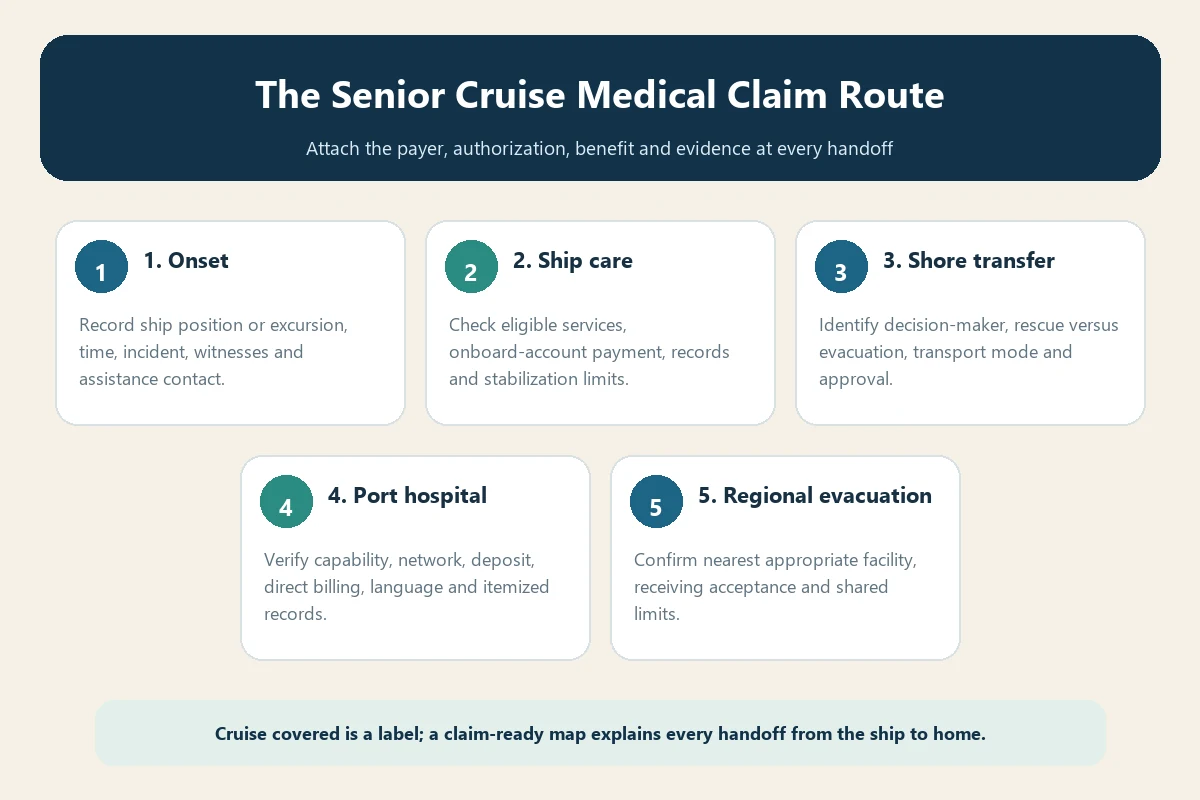
Create one row for each location where responsibility can change: the cabin or excursion, ship medical center, ship-to-shore transfer, port facility, regional hospital, and return journey. Attach the relevant policy clause and assistance phone number to each row.
Location 1: symptoms begin onboard or during an excursion
Record where and when symptoms or injury began, the ship’s position, the next port, and whether the passenger was on a cruise-line excursion, an independent excursion, or personal time. Seek appropriate care; do not delay treatment for insurance paperwork. As soon as practical, contact the assistance administrator using the policy’s emergency procedure.
From a claims perspective, location can affect territory, advisory exclusions, activity coverage, and Medicare. Save the daily program, excursion booking, incident report, photos when relevant, and names of witnesses or staff. Do not infer that an excursion sold by the cruise line is automatically insured.
Location 2: the ship medical center
The American College of Emergency Physicians publishes guidelines intended to support emergency care, stabilization, diagnostic capability, and timely evacuation aboard cruise ships. Actual resources vary with ship, itinerary, passenger mix, and circumstances. Ship medical centers are not a substitute for every shoreside specialty service.
Before sailing, ask the cruise line how medical charges are billed and whether payment is required to the onboard account. Ask the insurer whether shipboard physician, imaging, laboratory, medication, and observation charges are eligible and whether the plan can guarantee payment. A reimbursement policy can still require the passenger to fund care first.
Carry the policy number, assistance number, medication list, allergies, diagnoses, clinician contacts, and a concise medical history. CDC recommends that older travelers carry baseline medical information; for some cardiac histories it specifically suggests a hard or digital baseline electrocardiogram.
Does Medicare cover care on a cruise ship?
Medicare usually does not cover health care outside the United States. Its current fact sheet says it may cover medically necessary shipboard services when the doctor meets applicable requirements and the ship is in a U.S. port or no more than six hours away from a U.S. port when services are received. It says Medicare does not cover shipboard care when the vessel is more than six hours from a U.S. port.
This is a narrow rule, not blanket cruise coverage. The Medicare page also identifies U.S. territories considered part of the United States and rare foreign-hospital exceptions. A Medigap, Medicare Advantage, employer, or retiree plan can have separate terms. Confirm the exact existing plan, ship route, and service; save any required Medicare claim or denial documents.
Location 3: ship-to-shore transfer
A transfer might occur at the next scheduled port, by tender, ambulance, rescue craft, helicopter, or another arrangement. The treating clinician, captain, port authorities, assistance company, and receiving facility can all affect timing. Insurance does not control weather, vessel capability, or government response.
Find the transport clause and answer four questions: who declares the transfer medically necessary, who must preauthorize it, what transport modes are eligible, and what happens if communication is impossible. The cruise-ship evacuation guide separates rescue, ship-to-shore movement, ambulance, and later air transport.
Do not self-arrange an expensive transfer unless immediate safety requires it and the policy’s emergency exception applies. The evacuation preauthorization guide shows what to document when approval cannot be obtained in advance.
Location 4: the port clinic or hospital
The next port is not necessarily the place with definitive care. Record whether the facility can stabilize, diagnose, operate, provide intensive care, or arrange a higher-level transfer. Ask the assistance company whether it has a network, direct-billing relationship, language support, or a case manager in that location.
The U.S. Department of State recommends medical and emergency evacuation insurance for cruise travel and warns that Medicare and Medicaid do not cover medical costs abroad. It also advises a backup plan if the traveler must remain in a foreign country longer than expected. Save the destination page and embassy or consulate contact information for every foreign port.
Location 5: evacuation to a regional center
Emergency evacuation usually means transport to a facility the contract considers capable of appropriate treatment, not a passenger-selected hospital or an automatic flight home. Copy the definitions of medically necessary, nearest appropriate facility, attending physician, assistance company, and destination of transport.
The international hospital-transfer guide explains acceptance by the receiving facility, medical records, bed availability, and transport clearance. Verify whether one maximum covers the entire chain or whether local ambulance, air evacuation, escort, and later return use different benefits.
Location 6: continued treatment and return
After stabilization, the passenger may be unable to rejoin the ship. The insurance questions shift to continued treatment, hotel for a companion, trip interruption, change fees, medical escort, fit-to-fly certification, and unused trip cost. The cruise line’s assistance and the insurance contract are separate.
Check who approves a commercial flight, upgraded seat, stretcher, oxygen, escort, or air ambulance. Review the commercial-flight medical repatriation guide before assuming a standard ticket is appropriate or reimbursable.
Separate medical, evacuation, and trip-interruption benefits
| Benefit | Main question | Common confusion |
|---|---|---|
| Emergency medical | Which shipboard and shoreside expenses are eligible? | Assuming evacuation pays hospital bills |
| Medical evacuation | Who authorizes transport and to where? | Assuming the destination is home |
| Trip interruption | Which covered reason pays unused cost and return travel? | Assuming any missed sailing is covered |
| Travel delay | What delay cause and waiting period apply? | Assuming medical lodging is a delay claim |
| Companion benefits | Who qualifies and what expenses are limited? | Assuming every family member can stay |
The cruise insurance clause guide helps match operational events with the correct benefit. Keep each limit and deductible separate in the claim map.
Audit pre-existing conditions before final payment
Find the exact look-back period, waiver requirements, purchase deadline, medical-stability language, age eligibility, and treatment of related evacuation. Some waivers require purchase within a defined period after the initial trip deposit, insurance of required trip costs, and fitness to travel at purchase. The certificate controls.
Use the cruise pre-existing-condition waiver checklist. Record the first deposit, every later payment, policy purchase, medical changes, and final payment. A cruise line’s cancellation schedule does not change the insurer’s waiver deadline.
Include every port and excursion in the territory audit
Review destinations even if the passenger does not plan to disembark. Weather, illness, mechanical issues, or itinerary changes can produce an unexpected port or extended foreign stay. Search the policy for country, sanction, war, unrest, advisory, epidemic, alcohol, motorbike, diving, hiking, and other activity exclusions.
Ask how a substituted port affects coverage and what evidence is required for a missed prepaid excursion. “Missed port” is not automatically an insured event; payment depends on a listed benefit, covered reason, and documented loss.
Prepare the cruise claim packet
- Issued certificate, declarations, endorsements, and policy number
- Assistance and claims contacts available offline
- Cruise itinerary, booking invoice, payment history, and cancellation terms
- Passport copy, emergency contact, and existing health-plan cards
- Medication list, allergies, diagnoses, clinician letter, and relevant records
- Onboard statement, itemized bills, medical notes, test results, and receipts
- Ship location, port, transfer log, authorization numbers, and case-manager notes
- Proof of unused travel cost, refunds, credits, and new transportation
The medical evacuation claim-document guide provides a full evidence sequence. Photograph paper records before handing them over and request itemized, readable copies.
Questions to ask before boarding
- Are shipboard physician, laboratory, imaging, medication, and observation charges eligible?
- Must the passenger pay the ship first?
- How does the policy coordinate with Medicare, Medigap, or Medicare Advantage?
- Who authorizes ship-to-shore transfer and later evacuation?
- Is the covered destination the nearest appropriate facility?
- Are all ports and independent excursions inside the territory?
- What happens if the itinerary changes or a foreign stay is extended?
- How are pre-existing conditions and related evacuation handled?
- Which benefit pays a companion’s lodging or return travel?
- What documents are required if the passenger cannot rejoin the ship?
FAQ about senior cruise travel medical insurance
What is the best medical insurance for a senior cruise?
There is no universal best plan. Compare the exact itinerary, age, existing health coverage, shipboard payment, foreign hospital access, evacuation authority, pre-existing-condition rules, interruption benefits, and certificate.
Does Medicare cover a medical emergency at sea?
Only in limited circumstances. Medicare’s current fact sheet describes potential shipboard coverage in a U.S. port or within six hours of a U.S. port when other requirements are met, and no shipboard coverage beyond that distance.
Will cruise insurance pay for a helicopter evacuation?
Only if the transport is eligible under the contract and its authorization and medical-necessity rules. Rescue response and later insured medical evacuation can be different services.
Does cruise insurance cover a missed port?
Not automatically. A specified benefit must apply to a covered reason and documented financial loss. A schedule change alone does not prove a payable claim.
Bottom line
Travel medical insurance for senior cruise passengers is strongest when every handoff is documented before sailing. Map symptom onset, onboard care, shore transfer, port hospital, regional evacuation, and return. Then attach the payer, authorization rule, benefit, limit, and evidence to each location. That turns a vague promise of cruise coverage into a claim-ready care route.
Sources
- CDC Yellow Book — Cruise Ship Travel
- U.S. Department of State — Cruise Ships
- Medicare — Coverage Outside the United States Fact Sheet
- Medicare — Travel Outside the U.S.
- American College of Emergency Physicians — Cruise Ship Medical Facility Guidelines
- CDC Yellow Book — Travelers with Chronic Illnesses
