

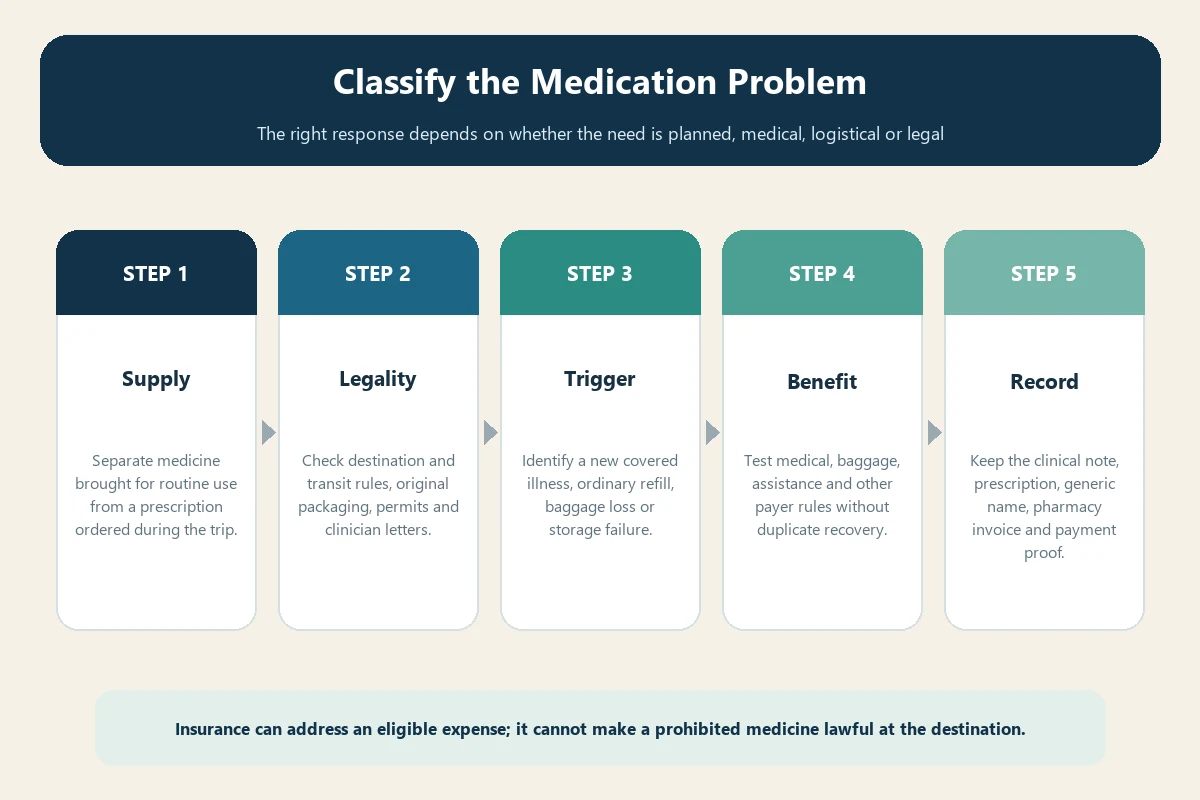
Travel medical insurance prescription medication coverage usually depends on why the medicine is needed. A drug prescribed after treatment for a new eligible illness is different from a routine refill, medicine lost with baggage, a temperature-damaged supply or a controlled substance restricted by the destination. Classify the problem before choosing a benefit or filing a claim.
Key takeaways
- Bring routine medicine from home; do not assume a travel policy will fund ordinary refills.
- A prescription for a new covered illness can be part of the medical expense claim.
- Lost medicine may involve baggage, assistance and medical benefits with different triggers.
- Destination law controls whether a medicine may enter or be dispensed; insurance does not override it.
- Keep the diagnosis, prescription, generic name, itemized pharmacy invoice and payment proof.
Planning information reviewed August 16, 2026. Medication law, availability and policy terms can change. Confirm current rules with the relevant embassy, clinician, pharmacist and issued certificate.
Separate four medication situations
Build four rows in the trip plan: regular medicine carried from home; a new prescription after an unexpected illness or injury; replacement after loss, theft, delay or damage; and a medicine whose legal status or availability differs abroad. Each row has a different solution.
The travel medical benefits guide explains why a prescription is not a standalone promise. It must connect to an eligible event, service, cost-sharing rule and evidence trail.
Routine medicine belongs in the pretrip plan
The CDC advises travelers to take enough prescription and over-the-counter medicine for the trip, plus extra for delays, and to keep it in carry-on baggage. Its current traveling abroad with medicine guidance also recommends original labeled containers and copies of prescriptions.
Arrange refills before departure. Ask the domestic insurer about vacation overrides and quantity limits. A short-term travel policy may be designed for unexpected medical events, not maintenance medicine the traveler knew would be needed.
A new prescription after eligible treatment
A clinician may prescribe antibiotics, pain relief or another medicine after assessing a new illness or injury during the trip. The pharmacy cost may fit the medical benefit when the event, provider, medicine and dates meet the certificate.
Keep the clinical note and diagnosis with the prescription. The medicine name alone does not prove why it was ordered. Ask whether the policy requires a licensed provider, a generic equivalent, prior contact or a specific pharmacy record.
Routine refills and stable conditions
A refill of medicine used before the trip can involve pre-existing-condition and routine-care wording even when it is purchased abroad. Do not describe it as a new medical expense merely because the pharmacy is overseas.
The pre-existing conditions guide explains look-back periods and waivers. A waiver can modify an exclusion but does not automatically create a maintenance-drug benefit.
Medicine lost or stolen during the trip
Loss can create three separate questions. Assistance may help locate a clinician or pharmacy. A baggage or personal-effects benefit may address the lost property if its terms are met. A medical benefit may address a medically necessary consultation or new prescription, but not necessarily the value of the missing supply.
Use the baggage delay and loss guide to check custody, carrier reports, police reports, item limits and proof of ownership. Do not recover the same expense twice.
Delayed checked baggage
Essential purchases after a covered baggage delay can have a waiting period, per-person cap and documentation rules. Medicine should normally travel in carry-on baggage, but a delay can still happen after forced gate-checking or mishandling.
Get the carrier’s irregularity report and delivery timeline. Ask assistance which local medical steps are safe and which benefit may apply. Keep every pharmacy and transport receipt.
Temperature damage and cold-chain medicine
Insulin, biologics and other temperature-sensitive products can become unusable after heat, freezing or refrigeration failure. Ask the prescribing clinician and manufacturer for storage ranges and replacement instructions before travel. Do not judge safety from appearance alone.
Document the incident, duration, temperature evidence when available and professional advice to replace the medicine. Property, baggage and medical wording can classify the expense differently. Verify rather than assume.
Destination and transit laws come first
The U.S. Department of State tells travelers to check the embassy of every destination and transit country for prescription restrictions and permit requirements. Medicine legal in the United States can be restricted elsewhere.
Pay special attention to controlled substances, stimulants, sleeping medicines, injectable products and medical cannabis. Insurance approval cannot authorize import, possession or dispensing. Obtain current written instructions from the responsible authority.
Carry the right medication documents
Keep medicine in original packaging labeled with the traveler and prescriber. Carry a prescription copy using both brand and generic names. For controlled or injectable medicine, ask the clinician for a letter describing the condition, dose and medical need.
Store secure digital copies separately, but carry any original document required by the destination. A pharmacy label may help identify the product yet fail to meet a permit requirement.
Availability and equivalent products abroad
A U.S. brand can have a different name, strength, formulation or legal status overseas. A local pharmacist may propose a generic or therapeutic alternative. Do not substitute without advice from a qualified clinician or pharmacist who understands the traveler’s condition.
The CDC warns about counterfeit and poorly regulated medicines in some destinations. Bring an adequate supply from a reliable source. If emergency purchase is unavoidable, use a legitimate pharmacy and retain the package and invoice.
Contact assistance before a stable replacement
The assistance team may locate a clinician, identify a pharmacy, arrange interpretation or explain the claim process. It may not prescribe medicine, guarantee availability or decide customs law. Record the case number and exact instruction.
The assistance versus claims guide distinguishes coordination from reimbursement. In an immediate medical emergency, seek care first and contact assistance as soon as practical.
Expect to pay the pharmacy first
Many pharmacies do not direct-bill a travel insurer. Ask for the price, currency, generic option and an itemized receipt before purchase. If the pharmacy retains the paper prescription, request a copy or dispensing record.
The CDC’s travel insurance page warns that overseas care may require out-of-pocket payment. Carry a practical payment method and know how to reach the claims administrator.
Apply deductibles, coinsurance and sublimits
An eligible prescription can still be reduced by a medical deductible, percentage share, per-prescription ceiling or trip-wide pharmacy limit. The policy may recognize only a generic equivalent or reasonable charge.
Use the travel medical deductible guide to determine the reset unit. Ask whether the clinician visit and medicine enter one incident calculation or separate benefit rows.
Do not mix medical and baggage calculations
A medical claim can address eligible treatment after a new illness. A baggage claim can address covered loss or delay. One expense can be relevant to both fact patterns without being payable twice. List each invoice once and record every reimbursement.
Ask the insurer which section should receive the claim and whether one department must decide before another. Preserve both decisions if the expense is transferred internally.
Run a lost-medicine scenario before travel
Assume a traveler loses a stable daily medicine on day two of a ten-day trip. Test the plan without assuming coverage.
- Is the medicine lawful and available at the destination?
- Can a U.S. prescription be used, or is a local consultation required?
- What will assistance coordinate?
- Does baggage coverage recognize the cause of loss?
- Does medical coverage recognize the consultation or replacement prescription?
- What deductible, waiting period or sublimit applies?
- Which reports and receipts are required?
This scenario exposes the difference between replacing property and treating a medical need.
Build the claim evidence chain
For a new prescription, keep the symptom timeline, clinical note, diagnosis, prescription, generic name, dosage, pharmacy itemization and payment proof. For loss or delay, add carrier or police reports, proof of prior possession and the replacement timeline.
The claim documentation guide provides a ledger for currencies, provider payments, refunds and other insurers. Submit the final unreimbursed eligible amount.
Read the certificate for medication-specific words
Search for prescription, pharmacy, medicine, drug, refill, replacement, loss, baggage, pre-existing, preventive, generic, quantity and medically necessary. Follow cross-references to definitions and exclusions. A schedule row can omit a condition stated elsewhere.
Use the policy reading guide and ask the insurer to apply the wording to one routine-supply scenario and one new-illness scenario. Keep the response with the issued documents.
Check the domestic coverage layer
A U.S. pharmacy benefit may allow an early refill, mail-order quantity or vacation override. A U.S. medical plan may also have rules for emergency prescriptions abroad. Document those benefits before assuming the travel plan pays first.
The health insurance abroad guide provides a written question list. If another payer contributes, include its explanation of benefits in the travel claim.
Use a medication-first travel checklist
- Bring enough medicine plus a reasonable delay buffer.
- Keep it in carry-on baggage and original labeled packaging.
- Carry prescription copies and a clinician letter when appropriate.
- Check every destination and transit-country rule.
- Plan refrigeration, security and dosing across time zones.
- Save assistance and claim contacts offline.
- Know which payment method a local pharmacy may accept.
NAIC’s current consumer guidance emphasizes that every travel policy sets its own limits and exclusions. Apply that principle to medicine instead of relying on a generic “prescriptions covered” label.
Make the final decision
Plan ordinary supply and legal compliance before departure. Use travel medical coverage for a prescription only when it is connected to an eligible event and meets the certificate. Use baggage coverage only when the cause of loss or delay and item rules fit.
The safest medication strategy does not depend on a claim. It combines enough lawful medicine, proper documents, safe storage, destination research, an assistance pathway and a verified insurance fallback. If an unexpected need occurs, that preparation also creates the strongest evidence for timely treatment and an accurate claim.
Daily medicine creates four different insurance questions. Use the travel medical insurance for chronic medication guide to separate routine supply, new treatment, loss and a flare-up.
Asthma claims depend on both the attack and the pre-trip timeline. Use the travel medical insurance for asthma guide to test stability, medicine changes and emergency care.
Diabetes adds equipment, temperature and emergency-treatment questions. Use the travel medical insurance for diabetes guide to test insulin supply, device failure and complications separately.
Autoimmune disease creates both flare and infection pathways. Use the travel medical insurance for autoimmune disease guide to test medicine, planned treatment and emergencies separately.
A recent prescription event needs its own timeline. Use the travel insurance medication change and pre existing condition guide to classify starts, stops, dose adjustments, substitutions and routine refills.
Medicare Part D generally does not pay for prescriptions purchased outside the United States. Use this Medicare Part D travel medication plan to arrange supply, vacation overrides, lawful transport, storage, loss, and emergency backup before departure.
An insulin pump or CGM trip plan must protect therapy, insulin, sensors, power, connectivity, and a clinician-approved backup. Use this senior insulin pump and CGM travel insurance guide to verify screening, storage, device loss, delays, pre-existing conditions, and claims.
Severe-allergy travel requires avoidance, epinephrine continuity, clear communication, emergency response, and insurance. Use this senior severe-allergy travel insurance guide to test pre-existing conditions, airline limits, hospital care, evacuation, and claims.
