

A travel insurance controlled condition can still fall within a policy’s pre-existing-condition definition. “Controlled” is an everyday or clinical description; coverage turns on the issued certificate, its look-back facts, the relevant benefit, and any waiver requirements.
This U.S.-focused guide shows how to replace a vague label with a dated policy review. It is educational information, not medical, legal, or coverage advice. Never change necessary care to influence an insurance result.
Key takeaways
- Do not treat “controlled” as a universal insurance safe harbor.
- List symptoms, visits, tests, treatment advice, and medication events separately.
- Copy the look-back anchor date and number of days from the issued form.
- Test a waiver only after identifying the exclusion and affected benefit.
- Keep medical fitness to travel separate from contractual coverage.
Reviewed August 16, 2026. Definitions, endorsements, and state forms vary. The certificate issued to the traveler controls.
Start by translating “controlled” into facts
A traveler might say asthma is controlled because an inhaler works, diabetes is controlled because readings are consistent, or blood pressure is controlled because the same prescription has been used for years. Those descriptions help a clinician understand health. They do not, by themselves, answer an insurance definition.
Make a fact list instead. Include when symptoms last occurred, whether a clinician evaluated them, whether testing was performed or recommended, whether treatment was given or advised, and whether a prescription started, stopped, switched, or changed dose. Record an unchanged refill too, but do not assume that it erases other events from the same visit.
The pre-existing condition stability guide explains why the word “stable” can describe a separate plan mechanism. This article focuses on the broader mistake of substituting a personal label for the certificate’s actual test.
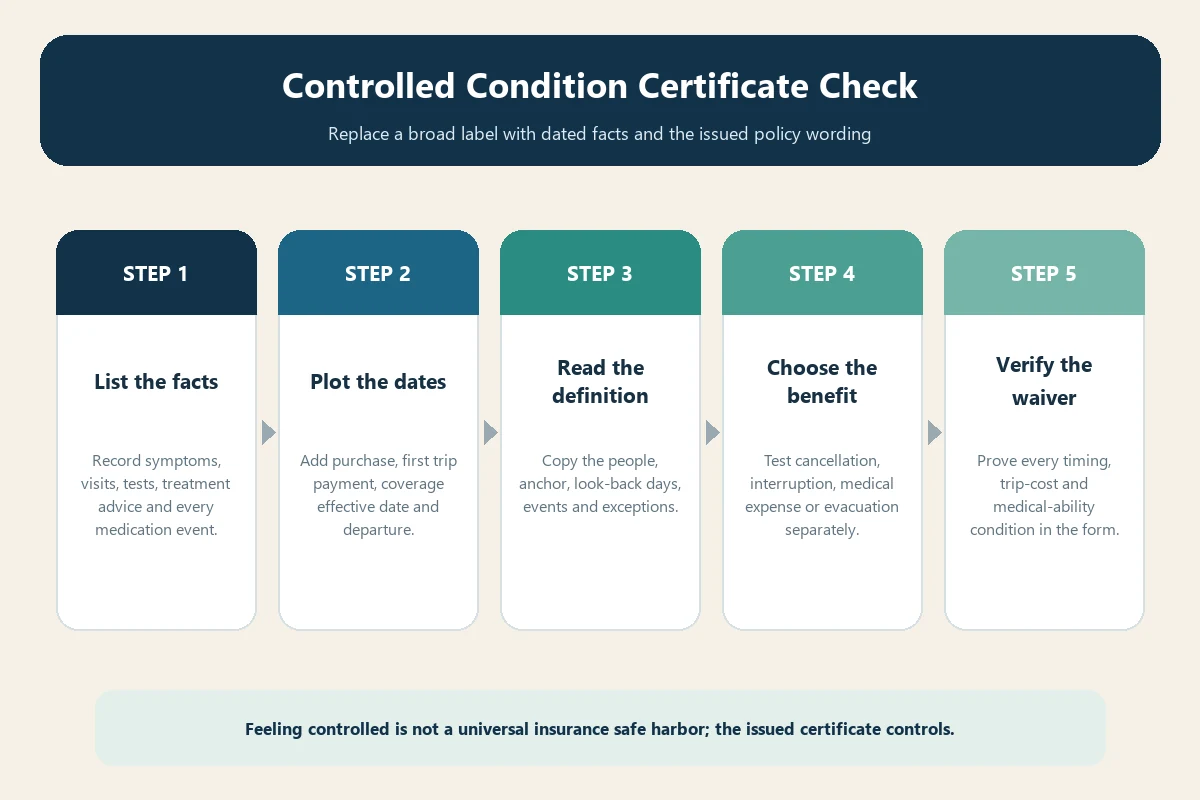
Use a three-stage controlled-condition review
Stage one is the medical timeline. Stage two is the contract definition. Stage three is the benefit and waiver analysis. Do not jump directly from “I feel fine” to “the claim is covered.”
Stage one: build the medical timeline
Use exact dates for symptoms, appointments, lab or imaging orders, diagnoses, treatment, and prescriptions. Add the date of the first trip payment, plan purchase, coverage effective date, and departure. A clean timeline helps prevent the wrong event or anchor date from controlling the analysis.
Stage two: apply the issued definition
Search the certificate and every endorsement for “pre-existing medical condition.” Copy the entire definition, including the person to whom it applies, the look-back period, the anchor date, listed medical events, and exceptions. Then mark each timeline fact that matches the language.
Stage three: identify the benefit and waiver
Ask which loss is being tested: trip cancellation, trip interruption, emergency medical expense, evacuation, or another benefit. The same certificate can apply an exclusion differently across benefits. If a waiver exists, confirm every condition rather than assuming it follows from early purchase alone.
A sample definition shows why facts matter
A current Travel Guard Pennsylvania sample policy defines a pre-existing medical condition through events during a stated period before purchase. The sample includes manifestation or worsening, symptoms that would prompt reasonable care, care or testing that was given or recommended, and a change in prescribed medication.
That is one state-specific example, not a market-wide rule. It demonstrates the review method: a traveler who feels controlled can still have testing, advice, symptoms, or a prescription event named by the definition. Another form may use different days, dates, people, exceptions, or wording.
Use the look-back period guide to copy the correct anchor and count backward. Do not borrow a 60-, 90-, or 180-day period from a blog or a friend’s policy.
Unchanged medication does not answer every question
An unchanged dose can be useful evidence, but it is only one fact. A traveler may have visited a clinician because symptoms returned, received new tests, or been advised to schedule a procedure while the prescription stayed the same. A definition that lists those events can still be relevant.
The reverse is also possible. A pharmacy may substitute a generic equivalent without a clinical change, or a clinician may make an administrative adjustment. Whether that event counts depends on the certificate and its exceptions. The medication-change guide provides a separate classifier for starts, stops, dose changes, substitutions, and refills.
“Controlled” and “medically able to travel” are not synonyms
Some waiver language requires the insured to be medically able to travel at purchase. A condition can be managed in daily life while the proposed itinerary creates a different medical concern. Conversely, a clinician may consider a traveler fit for the trip even though a look-back definition is triggered.
Ask the treating professional for medical advice based on the destination, trip demands, and access to care. Ask the insurer about certificate language. A medical letter records health facts and advice; it does not amend the policy or guarantee payment.
The CDC’s Yellow Book insurance chapter advises travelers to understand whether existing health coverage works abroad and to compare travel health and evacuation protection. That preparation is separate from the pre-existing-condition contract test.
Test a waiver as a checklist, not a slogan
A pre-existing-condition exclusion waiver may remove the named exclusion from specified benefits. Requirements can include purchase during a time-sensitive period, medical ability to travel, insuring required nonrefundable trip costs, and updating coverage after later payments.
The waiver eligibility checklist turns those requirements into evidence. If one condition is not met, the result can change. Even a valid waiver does not create a covered reason, remove an unrelated exclusion, or pay for planned maintenance care.
Allianz’s pre-existing-condition explanation also describes plan-specific, time-sensitive requirements. Treat it as an example of why the selected plan must be checked, not as the reader’s contract.
Run a benefit-specific test
Imagine a controlled cardiac condition becomes acute before departure. For trip cancellation, the file needs a listed cancellation reason, the required physician certification, a covered person, and nonrefundable loss. For emergency medical expense during the trip, the file needs eligible treatment, dates, diagnoses, bills, and compliance with assistance or authorization rules.
The travel medical benefits guide separates emergency treatment, evacuation, dental, and other sections. Read the benefit first, then its exclusions, definitions, limitations, and endorsements.
A controlled condition can also be irrelevant to a new accident. Yet an unrelated broken ankle still must satisfy the applicable benefit and exclusions. “Unrelated” is not shorthand for automatic coverage.
Watch for general exclusions and known plans
A waiver of one exclusion does not normally erase every policy limitation. Travel against medical advice, travel for the purpose of securing treatment, foreseeable or known losses, routine care, or other general exclusions may still matter if the issued form contains them.
Use the five-layer exclusions guide to check general exclusions, benefit exclusions, defined terms, benefit conditions, and endorsements. Read every cross-reference. Marketing summaries rarely show all five layers.
The National Association of Insurance Commissioners’ travel insurance overview recommends comparing covered events, exclusions, and limits. It is a useful consumer baseline, while the issued policy remains decisive.
Build a controlled-condition evidence packet
Keep the issued certificate, schedule, endorsements, purchase confirmation, first trip-payment record, later trip-cost payments, and written insurer answers. Add relevant visit notes, a medication list, test orders and results, treatment recommendations, and a short clinician statement describing dates and medical facts.
For a claim, add the cancellation or interruption notice, supplier refund records, itemized medical bills, proof of payment, diagnoses, physician restrictions, and assistance-center communications. Preserve original files and create a simple index.
The claim documentation guide explains how to organize a submission ledger. Never ask a clinician to hide symptoms, alter a date, or characterize a condition for insurance purposes.
Work through three limited examples
Same prescription, recent testing
A traveler says hypertension is controlled and the dose has not changed. Two weeks before plan purchase, a clinician orders cardiac testing after new symptoms. The prescription fact is favorable but incomplete. Testing, symptoms, and advice must be tested against the definition.
Administrative substitution
A pharmacy supplies a generic equivalent at the same strength. The traveler has no new symptoms, visit, or treatment change. The certificate may contain an exception—or may not. Save the dispensing record and ask for written confirmation instead of relying on a general article.
Valid waiver, different exclusion
A traveler meets every stated waiver condition but schedules treatment during the trip. The waiver can remove the named pre-existing-condition exclusion where applicable. It does not necessarily turn planned treatment or travel for treatment into an eligible emergency expense.
Ask the insurer precise written questions
Identify the exact plan, state, purchase date, trip-payment date, and departure date. Ask which definition and look-back period apply; whether the named medical facts fall within it; which people and benefits the exclusion covers; whether a waiver is available; and which documents prove every waiver condition.
Then ask how the plan treats unrelated losses, routine care, and travel against medical advice. Request the certificate and answer in writing before any time-sensitive window expires. For help comparing plans, the pre-existing conditions buying guide provides a structured selection process.
Bottom line
A controlled condition is not automatically covered, excluded, or outside the pre-existing definition. Replace the label with dated symptoms, care, tests, advice, and medication events. Apply the issued definition, identify the affected benefit, and then test every waiver condition.
That certificate-first method produces a defensible purchase file and a clearer claim record without turning health decisions into insurance tactics.
A symptom-free interval does not answer a recurrence claim by itself. Use the travel insurance recurring condition guide to map earlier episodes, recent treatment, the later flare-up and the issued policy wording.
