

Medical evacuation insurance travel companion coverage depends on who the other person is and why that person must travel. A medically trained escort, a spouse already on the trip, a relative flown to the bedside, and an attendant returning children can fall under four different clauses. Approval of the patient’s transport does not automatically pay for any of them.
Call local emergency services and obtain appropriate care first. This guide is educational, not medical, insurance, aviation, or legal advice. Aircraft operators, clinicians, border authorities, assistance teams, and policy administrators make separate decisions. A seat for a companion is never guaranteed.
Key takeaways
- Identify the person’s role before looking for a benefit.
- A medical escort is not a personal travel companion.
- The patient’s aircraft may not have a companion seat.
- Staying-nearby expenses and flying-in expenses can have different triggers.
- Obtain separate authorization for airfare, lodging, meals, and ground transport.
Reviewed August 16, 2026. “Traveling companion,” “family member,” “medical escort,” “bedside visitor,” “child,” and “attendant” are policy terms. Read their definitions, schedules, conditions, and exclusions in the issued certificate.
Build a role map before booking anything
Start with the event, then assign every person a role. The patient needs medical transport. A clinician may be needed for care in transit. A personal companion may remain at the foreign hospital or travel on a separate itinerary. Someone at home may be eligible to visit. Children may need a custodian and attendant.
The international hospital-transfer guide maps the clinical handoffs. This article maps the people traveling around that transfer.
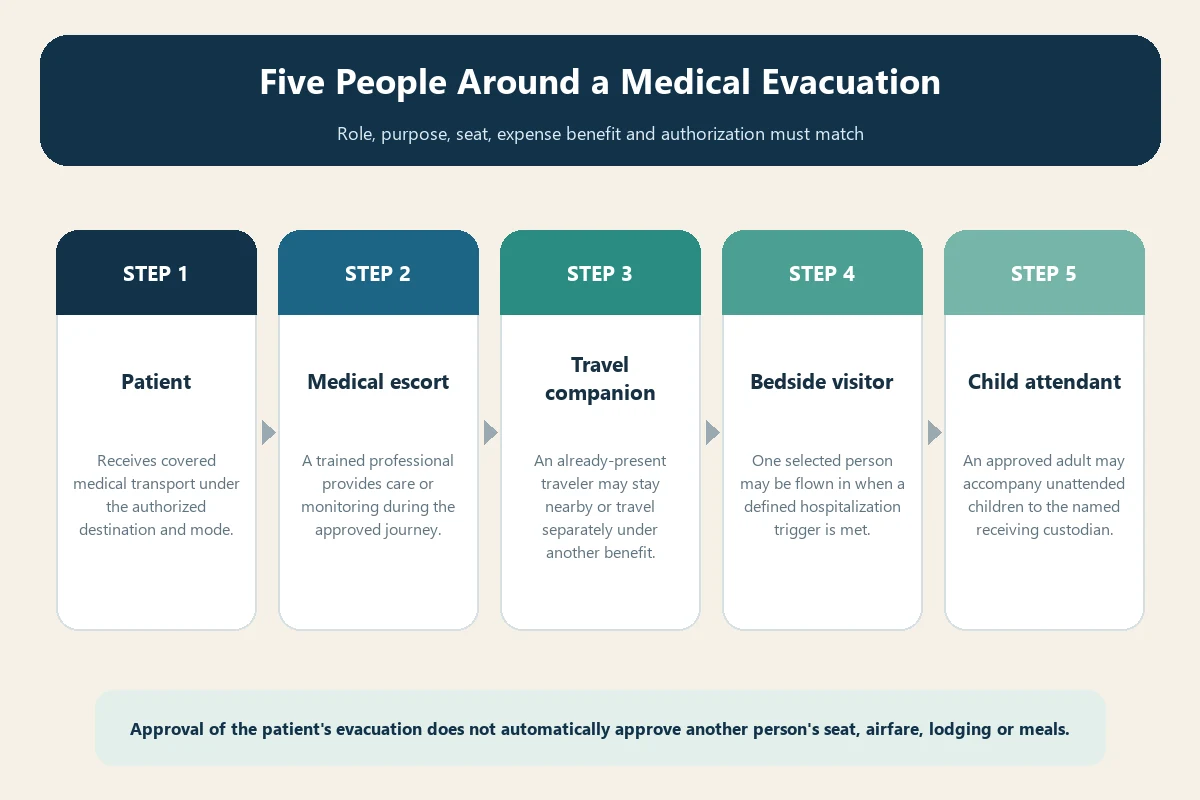
Five roles can surround one evacuation
| Person | Main purpose | Possible contract section |
|---|---|---|
| Patient | Receive necessary medical transport | Emergency evacuation or repatriation |
| Medical escort | Provide clinical care in transit | Evacuation transportation |
| Travel companion | Remain nearby or change itinerary | Companion daily or interruption |
| Bedside visitor | Travel from home to visit patient | Family or bedside visit |
| Child attendant | Accompany unattended dependents | Return of children |
A policy may omit a role, combine two roles under one maximum, or use different labels. The travel medical benefits guide helps trace each promise from schedule to definition, coverage grant, condition, and exclusion.
The medical escort works for the patient’s clinical need
A medical escort is a trained professional assigned to monitor or treat the patient during movement. The escort might accompany a traveler in a commercial cabin, stretcher arrangement, ground ambulance, or dedicated aircraft. The escort’s profession and equipment should match the patient’s risk.
An Illinois-specific IMG sample contract defines a medical escort as a trained professional contracted to provide care during transport. Its example requires written recommendation by an onsite attending physician. Other forms can differ.
The personal companion may have no seat on the medical mission
An air ambulance has weight, space, equipment, crew-duty, safety, passport, and landing constraints. Even a commercial stretcher can occupy several seats. The operator, medical director, carrier, and assistance team decide whether a nonclinical companion can be accepted.
If the companion cannot join the patient, create a separate plan: commercial flight, airport transfer, hotel, baggage, original-ticket change, receiving-hospital access, and a reliable case contact. The route-cost guide helps keep personal travel costs out of the medical aircraft invoice.
Clinical need and emotional preference are not the same test
A familiar person can provide history, interpretation, consent support, communication, mobility help, or behavioral reassurance. Those needs matter, but they do not automatically establish that the person is medically required in transit.
Ask the treating clinician to document any function that cannot safely be supplied by the transport team. Ask the administrator whether that proof changes the companion benefit, escort arrangement, or only the operator’s seating decision.
Staying near a hospitalized companion can be its own benefit
Some policies reimburse an insured companion’s extra lodging, meals, or local transportation while remaining near the patient. A trigger may require a defined inpatient period. It can be supplemental to trip interruption and subject to a shared total.
The cited IMG sample illustrates a three-day trigger for a traveling companion’s nearby expenses and immediate availability when the patient is an insured child. It requires receipts and prevents duplicate payment. Those details are examples, not market standards.
A bedside visitor starts somewhere else
A bedside-visit benefit commonly addresses one selected person who was not already on the trip. The person travels to the hospitalized insured rather than accompanying the evacuation from its origin.
The same sample contract illustrates a different trigger: more than three consecutive hospital days, a traveler who is alone, one round-trip economy ticket, and no imminent evacuation or medical repatriation. Another certificate may use different days, relationships, fare class, maximum, or conditions.
Return of children is not companion airfare
If a hospitalized or evacuated parent can no longer care for accompanying children, a dependent-return clause may fund one-way transport and an attendant. It requires a safe receiving arrangement and travel documents, not merely a receipt for replacement tickets.
Keep that workflow separate from an adult companion’s interruption claim. The child’s residence, custody, passport, consent, carrier acceptance, receiving adult, and unused-ticket value can all affect the plan.
Companion travel can sit outside the evacuation maximum
Schedules sometimes list evacuation, companion daily expenses, bedside transportation, child return, and trip interruption as separate rows. Other contracts place some costs inside one combined maximum. Copy each row, page, maximum, deductible, daily cap, and no-duplication rule.
The IMG Travel Series page shows how one plan family lists evacuation, return transportation, child transportation, and bedside-visit transportation as distinct items. The issued state-specific policy still controls.
The companion’s own insured status matters
A person listed on the same trip policy can have personal interruption, delay, medical, or baggage benefits in addition to any companion provision tied to the patient. A person not insured may have only the narrow expenses expressly granted because of the patient’s event.
Record who purchased the policy, every named insured, insured trip cost, original itinerary, and each person’s other insurance. Do not assume a shared booking means shared coverage, and do not submit one hotel or replacement ticket under two people’s benefits.
Caregiving needs continue after the aircraft lands
A companion may need accessible lodging, hospital access, a rental wheelchair, medication storage, interpretation, ground transport, or time away from work. Those are real planning needs, but the evacuation section may not pay them.
Build a receiving-city budget and identify the policy, employer, health plan, airline, hospital social work, or personal funds responsible for each item. That keeps a safe companion plan from depending on an unsupported assumption.
Ask five aircraft questions
- Does the operator permit a nonmedical passenger on this mission?
- Is the companion medically or operationally required?
- Who pays if a seat is available but not covered?
- What baggage and document limits apply?
- What is the separate plan if the companion is not accepted?
The CDC air-travel chapter provides medical-clearance and in-flight context. It does not establish policy coverage or operator acceptance.
Map companion expenses by payer
| Expense | Possible section | Evidence |
|---|---|---|
| Medical-flight seat | Evacuation or optional companion | Manifest, authorization, invoice |
| Separate airfare | Interruption or companion transport | Original ticket, new fare, credit |
| Hotel and meals | Companion daily or interruption | Inpatient dates, itemized receipts |
| Inbound visitor fare | Bedside or family visit | Trigger proof, relationship, ticket |
| Child attendant | Return of dependents | Consent, itinerary, attendant record |
Do not place every expense under “medical evacuation.” Ask the case manager to name the applicable benefit and maximum before purchase.
Authorization has two separate subjects
The patient’s authorization should identify medical necessity, destination, mode, vendor, and clinical crew. The companion authorization should identify the person, role, route, fare class, allowed expenses, daily cap, maximum, booking method, and required receipts.
Use the pre-authorization guide to record the difference between a clinician’s recommendation, assistance arrangement, benefit approval, advance payment, and final claim decision.
Build a companion communication file
- Patient consent and privacy authorization
- Policy, schedule, definitions, and case number
- Companion identity, relationship, passport, and contact
- Clinician statement for any required support role
- Hospital admission and expected inpatient dates
- Patient mission and companion itinerary
- Written approval for each person and expense category
- Original tickets, fare credits, refunds, and new tickets
- Hotel, meal, local-transport, and baggage receipts
- Receiving hospital, family contact, and contingency plan
The CDC insurance chapter notes that assistance can help keep relatives informed during a severe emergency. The U.S. Department of State’s insurance guidance explains that government assistance does not become payment for medical or companion costs.
Protect privacy without blocking coordination
A hospital may need the patient’s permission before discussing details with a companion or case manager. Carry an emergency contact, healthcare proxy or other appropriate authority, medication list, clinician contacts, and a way to share records securely. Legal forms and privacy rules vary by jurisdiction.
If the companion expense is declined
Ask whether the problem is the person’s definition, hospitalization trigger, missing authorization, fare class, expense type, daily cap, shared maximum, duplication with interruption, or absence of receipts. Request the relied-on clause and appeal process in writing.
Keep the patient’s necessary care and transport separate from the companion dispute. A denied companion ticket does not by itself decide the patient’s evacuation claim.
Compare plans with a role-by-role worksheet
- Who qualifies as a traveling companion or family member?
- When is a medical escort covered, and who recommends one?
- Can a personal companion ride with the patient?
- What pays for separate companion airfare?
- What inpatient-day trigger applies to nearby expenses?
- Who may be flown in for a bedside visit?
- How are unattended children and attendants handled?
- Which costs share an interruption or evacuation maximum?
- Who must arrange travel and approve it in advance?
- Which documents and receipts are mandatory?
The follow-up care guide helps plan the companion’s role after arrival without assuming domestic treatment or caregiving costs fall under evacuation.
Bottom line
Medical evacuation insurance travel companion coverage begins with role clarity. The medical escort, personal companion, nearby companion, incoming bedside visitor, and child attendant have different purposes, seats, triggers, expenses, and evidence. Get separate written decisions for the patient’s medical mission and every companion arrangement before treating the combined journey as covered.
A senior and caregiver can have different insured status, trip costs, medical risks and authority even when they travel together. Use the senior caregiver travel insurance two-person ledger to test cancellation in both directions, interruption, replacement care, consent, shared limits and claim evidence.
Travel with dementia requires a caregiver, consent, medication, identification, safety, and emergency plan before an insurance plan can respond. Use this senior dementia travel insurance guide to test pre-existing conditions, cancellation, caregiver costs, medical care, and evacuation.
A service dog trip must satisfy airline, destination, transit, accommodation, veterinary, and U.S. return rules; ordinary travel insurance may cover only the human traveler. Use this senior service dog international travel insurance guide to map every rule and uncovered cost.
A caregiver cancellation is covered only when the person and event match the policy’s definitions; “essential to the trip” is not enough. Use this senior caregiver cancellation decision tree to test insured traveler, companion, family, illness, unavailability, replacement, and claim evidence.