

Medical evacuation insurance cost can mean two very different numbers: the price of buying coverage and the cost of an actual transport. The first is a premium quote. The second is a route, aircraft, crew, equipment, ground-transfer, and patient-care invoice that can change dramatically with location and condition.
This U.S.-focused guide explains the event-cost side without promising a price or insurance payment. It is educational, not medical, insurance, aviation, financial, or legal advice. Policy forms and missions vary; the issued contract and authorized case plan control.
Key takeaways
- Separate the insurance premium from the cost of the evacuation mission.
- Price every route leg, not only the aircraft carrying the patient.
- Patient acuity changes crew, equipment, permits, and flight options.
- Rescue, evacuation, repatriation, and return airfare can use different benefit buckets.
- A broad government range is planning context, not a vendor quote.
Reviewed August 16, 2026. Dollar figures cited below are broad official planning ranges current to the cited pages; obtain route-specific estimates from authorized providers.
First answer: premium or transport invoice?
A comprehensive travel plan can bundle cancellation, medical expense, evacuation, baggage, and other benefits. Its premium can depend on trip cost, traveler age, plan level, duration, residence, and options. A standalone evacuation product or membership can use a different price model.
Do not divide the plan premium by the evacuation limit and call the result value. The membership-versus-insurance guide explains why a service promise and an indemnity limit are different products.
What official ranges can and cannot tell you
The CDC Yellow Book places total medevac cost in a broad range from about $25,000 within North America to more than $250,000 for distant or remote locations. It says critical illness and complex infection-control needs increase cost.
The U.S. Department of State’s medicine-and-health guidance gives another broad air-ambulance-to-the-United-States range of $20,000 to $200,000, depending on location and health condition. Neither page quotes a specific case. The overlap shows scale, not a guaranteed minimum or maximum.
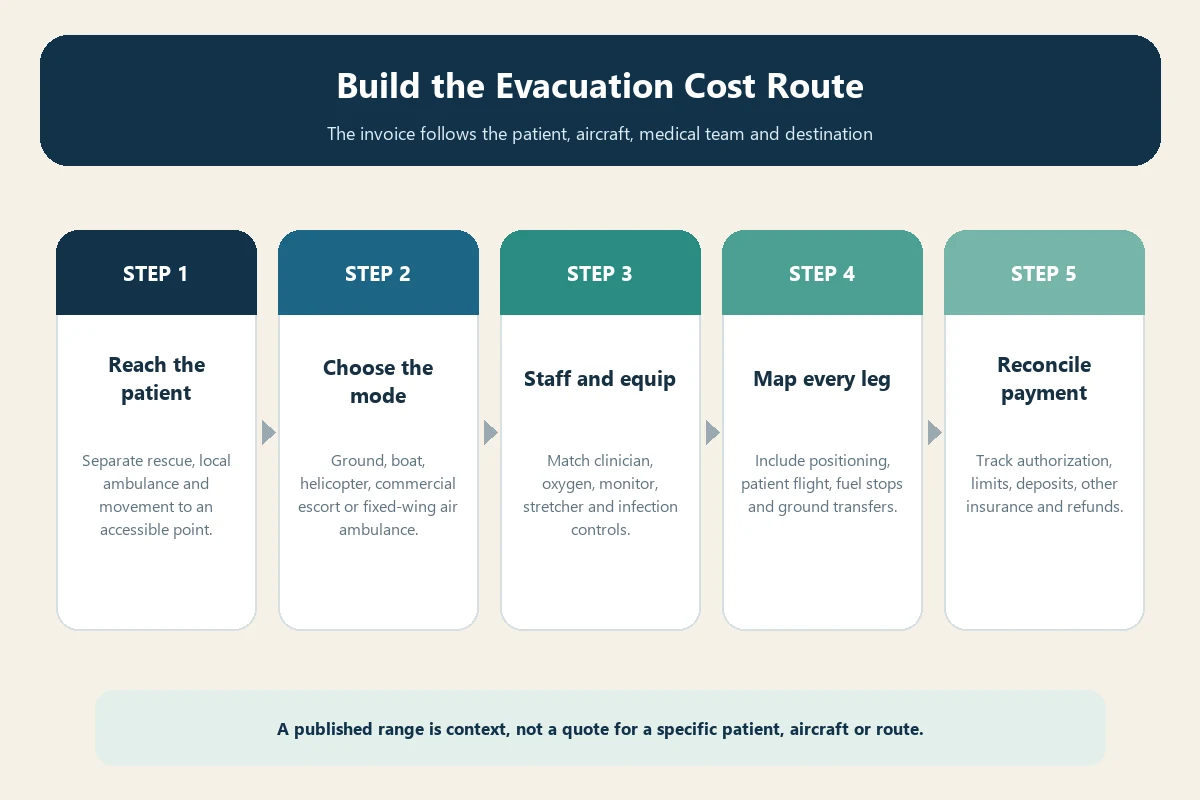
Cost component 1: Reaching the patient
A traveler may first need trail extraction, ski-patrol movement, boat transfer, local ambulance, or helicopter rescue. That stage can be operated and billed separately from an interfacility air ambulance.
Ask where search and rescue ends and medical evacuation begins. The remote-trip evacuation guide helps map accessibility, communications, and initial response. A policy can give rescue a smaller separate sublimit.
Cost component 2: Ground transfers at both ends
The patient may require ambulance transport from a clinic to an airport and again from the destination airport to the receiving hospital. A critical-care ground ambulance costs more than a basic transfer and may need a nurse, ventilator, monitor, or medication pump.
Record pickup address, airport, receiving airport, hospital, distance, level of care, waiting time, tolls, and after-hours charges. Confirm whether these transfers are inside the evacuation maximum or processed as medical expense.
Cost component 3: Transport mode
Possible modes include ground ambulance, boat, helicopter, commercial flight with a medical escort, commercial stretcher, business-class or lie-flat seat, and dedicated fixed-wing air ambulance. The least expensive safe mode may not be available on the required date or route.
Travel Guard’s ancillary evacuation guidance lists examples such as helicopter transfer, private charter, full-recline seating, business class, and medical escort. It is a carrier example; the actual form determines eligibility.
Cost component 4: Aircraft positioning and distance
A dedicated aircraft often must fly empty to the patient, carry the patient to the destination, and then reposition. Fuel stops, crew duty limits, airport operating hours, landing fees, handling, and permits can add cost.
Measure the mission rather than the straight-line distance between traveler and home. The destination guide explains why the covered endpoint may be the nearest adequate facility rather than a preferred U.S. hospital.
Cost component 5: Patient acuity
A stable ambulatory traveler can require a very different configuration from an intubated patient. Oxygen flow, ventilator, isolation, blood products, monitoring, medication infusions, bariatric equipment, neonatal care, and pressure or altitude restrictions affect the mission.
Ask the treating and transport clinicians to document the required level of care. Do not choose a cheaper mode against medical advice. The approval-chain guide identifies who supplies medical facts and who authorizes coverage.
Cost component 6: Medical team and escort
The crew can include a flight nurse, paramedic, respiratory therapist, physician, or another specialist. A separate nonmedical attendant or family escort may be covered only when recommended and may share the evacuation maximum.
A current state-specific Travel Guard policy example includes an escort or contracted attendant inside the emergency-evacuation maximum when an attending physician recommends one. Other contracts can separate or exclude the expense.
Cost component 7: Receiving-facility coordination
The receiving hospital may require a physician acceptance, bed, deposit, guarantee of payment, record transfer, interpreter, or advance clinical review. Delay can increase aircraft and crew cost.
Record who secured the hospital, what it can treat, acceptance time, and financial conditions. The hospital bill itself is usually a medical-expense question, not automatically part of the transport invoice.
Cost component 8: International operations
Cross-border missions can require overflight and landing permissions, visas, customs, medical clearance, ground handling, and coordination across time zones. Sanctions or airspace closures can change the route.
Weather, airport capability, runway length, darkness, and security can make a direct mission impossible. A quote can expire as operational facts change.
A route ledger for comparing estimates
| Line | Facts to record | Coverage question |
|---|---|---|
| Patient access | Rescue, boat, trail or local ambulance | Rescue or evacuation benefit? |
| Origin transfer | Facility, airport, care level | Inside the evacuation maximum? |
| Aircraft | Mode, positioning, patient legs, fuel stops | Authorized provider and route? |
| Medical configuration | Crew, oxygen, equipment, isolation | Medically necessary and documented? |
| Destination transfer | Airport, accepting hospital, ambulance | Covered endpoint? |
| Other payment | Health plan, membership, refunds, deposits | Primary, excess, or service arrangement? |
Why the insurance limit is not the estimate
A $250,000 limit does not mean the mission will cost $250,000. It is a ceiling subject to definitions, authorization, exclusions, and shared expenses. A lower actual charge does not prove the limit was suitable for every route.
The evacuation-limit pillar explains coverage gates and broad selection. Use the route ledger to test the components behind the number.
What to ask before paying privately
- Has the assistance administrator opened a case?
- Is the mode and destination authorized in writing?
- Does the vendor quote include all positioning and ground legs?
- Which crew, equipment, permits, taxes, and waiting charges are included?
- Is advance payment a guarantee, loan, deposit, or reimbursement?
- What amount might remain the traveler’s responsibility?
The assistance-line guide explains why arranging a service is not identical to final claim approval. Preserve every quote, authorization, invoice, receipt, and case message.
Three route patterns to model
Urban regional transfer: A traveler is stabilized at a local hospital but needs a specialist in another city. The route may use two critical-care ground ambulances and a short fixed-wing flight. The aircraft distance is modest, but airport transfers, waiting time, and clinical equipment remain part of the mission.
Island transfer: A traveler starts at a clinic on a small island. A boat or local aircraft reaches a larger island, then an international flight reaches a regional hospital. Weather and limited operating hours can add an overnight delay and a second medical crew.
Remote intercontinental case: Field extraction reaches a local facility, a regional air ambulance reaches a hub hospital, and a later medically escorted commercial flight continues toward home. This is not one uninterrupted “flight home.” Each handoff can use different authorization and benefit language.
Compare quotes on the same scope
Two vendor estimates are comparable only if they use the same patient condition, pickup point, destination, aircraft type, crew, equipment, ground transfers, permits, taxes, and validity period. A lower quote may omit a positioning leg or destination ambulance.
Ask each vendor to mark included, excluded, provisional, and pass-through charges. Confirm cancellation charges if the patient becomes unfit to travel or the receiving bed disappears.
Do not confuse billed cost with covered cost
The vendor invoice describes services. The covered amount applies policy definitions, reasonable-and-customary language, authorization, maximums, exclusions, and other insurance. The two totals can differ.
Request both an itemized invoice and a coverage explanation. If the administrator negotiated the mission, ask for the amount it agreed to pay and any traveler responsibility before dispatch when possible.
Keep currency and timing visible as well. A quote issued in local currency can change after exchange conversion, while overtime, holiday, and extended-ground-wait charges may arise after the estimate expires. Record the quote currency, conversion date, validity window, and who bears an authorized change.
Reconfirm it before dispatch.
Ask whether a payment guarantee covers the entire authorized mission or only one vendor. Ground operators, airports, hospitals, and aircraft providers may request separate commitments. Record who issued each guarantee, its currency and ceiling, the supplier that accepted it, and any deposit still charged to the traveler. Reconcile those commitments against the final itemized invoices.
Bottom line
To understand medical evacuation insurance cost, separate premium from mission. Build the event invoice from patient access, ground transfers, aircraft type, positioning legs, route distance, medical crew, equipment, permits, destination, and payment coordination. Official ranges show that exposure can be large, but only a case-specific, authorized route can produce a useful estimate.
Commercial medical repatriation is a coordinated transport chain, not an ordinary ticket with a nurse added. Use the medical repatriation commercial flight guide to plan clearance, cabin configuration, escort, oxygen, equipment, ambulances, connections, receiving care, authorization, and contingency costs.
