

Travel insurance for seniors on a long trip is controlled by several clocks, not one policy end date. A certificate can run for a year while limiting each journey to 30 or 45 days. A single-trip medical plan can cover months but end when the traveler returns home. An extension can require approval before expiry, and a continuation-of-treatment clause may protect only one existing illness after coverage otherwise ends.
This guide builds a duration calendar and continuity plan for a U.S. senior taking one extended international trip. It is educational, not insurance, medical, legal, financial, pharmacy, immigration, or Medicare advice. Use the issued certificate, destination rules, and guidance from the traveler’s clinicians and insurers.
Key takeaways
- Separate policy year, per-trip days, continuous stay, extension, treatment continuation, and renewal.
- Do not treat annual multi-trip insurance as automatic long-stay cover.
- Confirm how a return home, side trip, birthday, or delayed return changes the clocks.
- Plan prescriptions, routine monitoring, mobility, and communication outside emergency benefits.
- Recheck medical advice and coverage before extending or materially changing the itinerary.
Reviewed August 16, 2026. “Trip,” “period of coverage,” “coverage duration,” “extension,” “continuation of treatment,” “country of residence,” and “medically able to travel” are contract-specific terms.
Begin with six separate clocks
| Clock | Question | Proof |
|---|---|---|
| Policy period | When does the contract begin and end? | Declaration and time-zone rule |
| Per-trip limit | How many days may one journey last? | Annual-plan benefit schedule |
| Continuous stay | Does one absence remain one trip? | Trip and return-home definitions |
| Extension | Can coverage be lengthened before expiry? | Extension clause and confirmation |
| Treatment continuation | Can eligible care continue after expiry? | Benefit-specific continuation clause |
| Renewal | Can another policy period begin? | Eligibility, age, and renewal terms |
The general long-stay insurance guide explains trip-length mechanics for all travelers. For seniors, add age eligibility, Medicare coordination, medical-history terms, prescriptions, monitoring, accessibility, and the possibility that health changes before an extension or renewal.
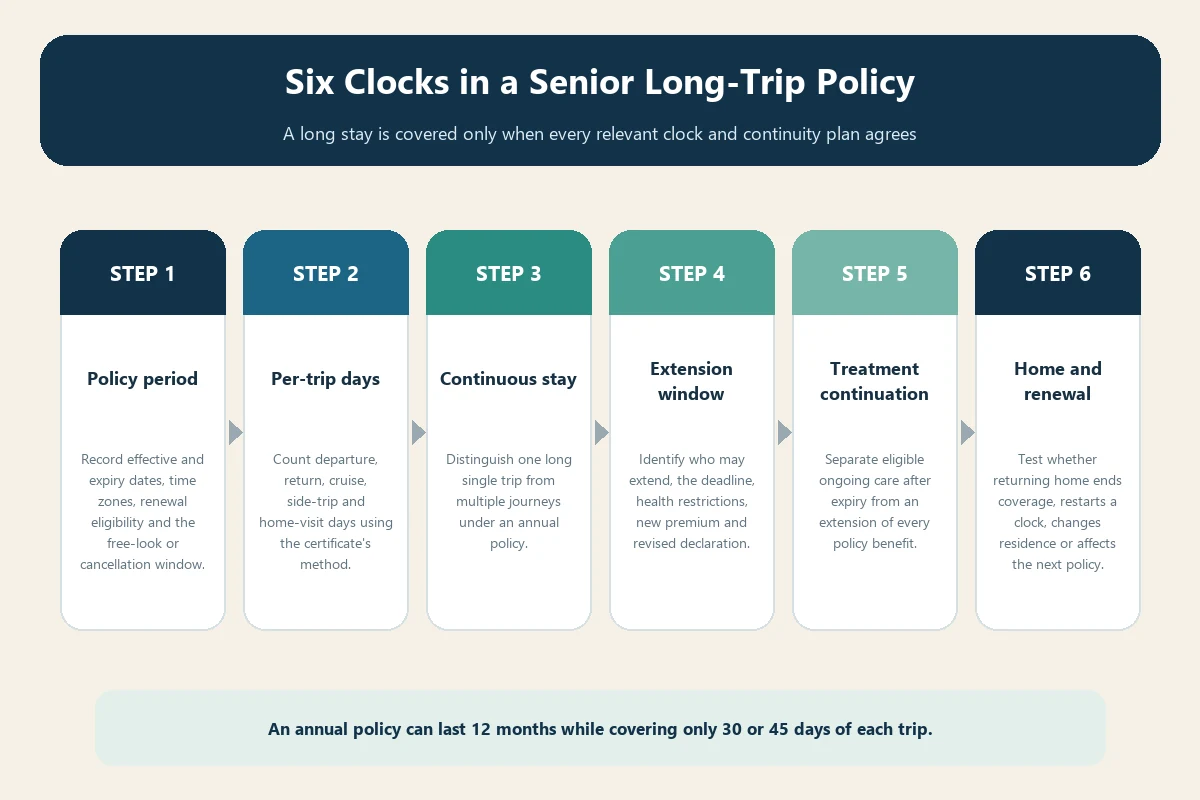
Clock 1: copy the policy period exactly
Record the effective date and time, expiry date and time, issuing time zone, state form, plan, maximum period, and any waiting period. Include the original quote, application, declaration, endorsements, and premium receipt. A calendar reminder should fire well before expiry, not on the final day.
Ask whether coverage begins on the requested date, actual departure, or another event. Ask whether early return ends the contract and whether a postponed departure consumes covered days. If the traveler crosses the International Date Line, use the certificate’s method rather than counting nights.
Clock 2: distinguish a policy year from days per trip
An annual plan can insure multiple departures during twelve months while capping each trip. IMG’s current GlobeHopper Senior brochure, for example, describes a single-trip option lasting up to 12 months and a multi-trip option with 30- or 45-day trip choices. This is a product-specific illustration, not a market rule.
A 120-day stay does not fit a 30-day annual trip merely because the annual contract remains active. Do not invent returns home or split a continuous absence on paper. Match the actual movement to the trip definition.
Clock 3: decide whether this is one long trip
Map departure from the country of residence, every destination, cruise, side trip, return home, and final return. Check whether a temporary home visit terminates coverage, creates a new trip, or falls within a home-country benefit. Some products permit incidental home-country coverage; others exclude it or end the insured journey.
The age-limit certificate audit adds a related question: does the traveler’s age at the new start date, extension, or renewal change eligibility or available benefits? Record the birthday and every possible measurement date.
Single-trip and annual products solve different problems
A long single-trip plan can follow one continuous absence and may offer extensions. An annual plan can suit frequent shorter journeys but fail a long stay. Comprehensive trip protection may insure prepaid cancellation and interruption but have a shorter maximum trip. Medical-only coverage may allow a longer stay without protecting the trip investment.
Compare product class, not company name. Use the same traveler, residence, destination, dates, trip cost, and medical needs. A cheaper annual quote that ends on day 45 cannot be compared as though it covers day 46 through day 120.
Clock 4: find the extension decision date
Copy whether an extension is guaranteed, discretionary, or unavailable; who may request it; how early; maximum additional days; new premium; health or claim restrictions; and whether a new declaration is issued. Set reminders at least several weeks before the decision deadline.
Ask whether an illness, claim, change in medical advice, change of destination, return home, or lapse prevents extension. Never assume paying another premium after expiry retroactively repairs a gap.
An extension is not always identical coverage
Compare the original and extended declarations line by line. Deductibles, maximums, age tiers, state forms, exclusions, destinations, or assistance contacts can change. Confirm whether a condition that arose during the first period becomes pre-existing for a new contract or remains within one continuous period.
The medically-able-to-travel waiver guide explains why purchase-time health requirements and later changes must be kept separate. A clinician saying the traveler can continue does not bind an insurer to renew or extend.
Clock 5: read continuation of treatment narrowly
A continuation clause can allow eligible treatment for an illness or injury that began during coverage to continue after the policy ends. It may stop on return to the country of residence, after a fixed number of days, at a benefit maximum, or when the condition stabilizes. It rarely extends every unrelated benefit.
Ask whether new illnesses, baggage, delay, cancellation, routine care, prescriptions, or another evacuation remain covered after expiry. Record the covered condition, service dates, location, maximum, and claim deadline.
Clock 6: test renewal before booking future travel
For a renewable product, record maximum renewal age, continuous-month limit, residence requirement, claims effect, premium change, and benefit tier. Do not book nonrefundable travel beyond the current period on the assumption that renewal will remain available.
The senior age-band guide explains how benefit choices can narrow after a birthday. Obtain the future quote using the age and trip dates that will apply, then verify it again when renewal opens.
Plan medication for the whole absence
The State Department’s age 65+ guidance recommends enough medication, original labeled containers, generic names, and a provider letter describing conditions, allergies, and medicines. Confirm whether each medication is legal at every destination and whether import quantities are limited.
Ask the prescriber, pharmacy, drug plan, and destination authority about advance fills, refills, controlled substances, refrigeration, needles or devices, time-zone dosing, lost supply, and substitutions. The chronic-medication guide explains why routine replacement is often different from treatment of a new covered emergency.
Create a monthly clinical continuity plan
List every expected laboratory test, infusion, injection, device supply, specialist review, physical therapy session, dental need, and routine prescription. Mark which care can safely wait, which must occur abroad, who orders it, where results go, and who pays. Travel insurance is commonly designed for unexpected illness or injury rather than predictable maintenance.
CDC’s Yellow Book chapter for travelers with chronic illnesses recommends pretravel consultation, adequate medications and supplies, medical summaries, and planning for exacerbations. Use individualized clinical advice rather than a generic age rule.
Recheck medical history at every decision point
A long interval between booking and departure can include medication changes, new symptoms, tests, hospitalization, surgery, or a clinician’s travel restriction. Keep a timeline and review the certificate’s look-back, stability, waiver, and medically-able-to-travel provisions.
The senior pre-existing-condition checklist separates eligibility, waiver timing, definitions, medical maximums, and evacuation. Do not cancel or extend based on a self-diagnosis; obtain appropriate medical advice and ask the insurer how the contract applies.
Verify Medicare and domestic coverage for months abroad
Medicare’s official foreign-travel page says Medicare usually does not cover care outside the United States, subject to limited exceptions, and notes that some Medigap policies may cover foreign emergency care. Confirm Medicare Advantage, Medigap, employer, retiree, military, and pharmacy coverage individually.
A long absence can also affect network use, prior authorization, mailed notices, premiums, and access to routine U.S. care. Record which plan is primary or secondary, which EOBs a travel claim requires, and who can receive correspondence securely.
Build the emergency assistance handoff
Carry the policy number, 24-hour assistance line, secure portal, plan summary, passport copy, itinerary, medical summary, generic medication list, allergies, emergency contacts, and consent preferences. Store copies offline and with a trusted person chosen by the traveler.
Identify hospitals at long-stay locations, accessible transport, translation, payment methods, and routes to higher care. The fit-to-fly guide explains why a delayed return after illness can require new clinical and airline clearance even when the original itinerary was simple.
Plan accessibility without assuming dependence
Ask the traveler what support they want. Confirm mobility-device dimensions and batteries, accessible lodging, shower and elevator access, hearing or vision communication, oxygen or refrigeration, rest days, ground transfers, and backup charging. Airline, cruise, hotel, tour, and insurance responsibilities are separate.
If a companion may help, document permissions for medical information, assistance calls, funds, and claims. A companion does not automatically hold legal authority. Obtain jurisdiction-specific advice for health-care proxies or powers where needed.
Keep a long-trip evidence calendar
- Policy, per-trip, extension, continuation, renewal, and birthday dates
- Every departure, border crossing, cruise, side trip, home visit, and return
- Trip payments, insured-cost updates, supplier changes, refunds, and credits
- Medication fills, laboratory work, appointments, device supplies, and provider letters
- Symptoms, treatment, assistance calls, authorizations, and claim submissions
- Passport, visa, residence, destination, and entry-rule deadlines
- Premiums, card expiry, emergency funds, bank access, and trusted-contact reviews
- Monthly check of itinerary, health advice, coverage, communications, and exit plan
Use a monthly continuity review
Thirty days before departure, confirm all six clocks and the medical plan. Each month abroad, review remaining covered days, extension deadline, medications, appointments, destination risks, emergency funds, communication, and return route. After any hospitalization or major itinerary change, contact the insurer and treating clinicians promptly.
The State Department’s medicine and health guidance recommends checking overseas coverage, carrying claim forms, and considering evacuation insurance. On a long trip, repeat that check rather than treating it as a one-time departure task.
The practical conclusion
Travel insurance for seniors on a long trip must survive six clocks and a continuity test. Verify policy dates, per-trip days, continuous-trip definition, extension, treatment continuation, return-home effect, and renewal. Then map medication, routine care, medical-history changes, accessibility, payment, and emergency communication for the whole absence.
A long trip is not simply a short policy with more days. It is an evolving plan that needs scheduled rechecks before a deadline, health change, or return delay creates an uninsured gap.
