
Travel insurance for seniors taking blood thinners must be reviewed against the underlying condition, recent clot or bleeding history, surgery, hospital care, medication changes, monitoring, and pre-existing-condition definition. Arrange the lawful medication supply and clinician-directed time-zone plan before departure. Then compare emergency medical, cancellation, interruption, delay, and evacuation provisions for both bleeding and clot-related events.
This article is educational, not medical, pharmacy, legal, aviation, or insurance advice. “Blood thinner” can refer to different anticoagulant or antiplatelet medicines used for different conditions. The prescriber or anticoagulation clinic must guide dosing, monitoring, missed doses, interactions, flight precautions, injury, and emergency care. Never change medicine based on general travel content.
Key takeaways
- The insurer may evaluate the medicine, the reason it is prescribed, and recent changes or events.
- Carry enough U.S.-dispensed medication, original labels, a generic-name list, and the prescriber’s emergency instructions.
- Bleeding and thrombosis are distinct medical scenarios; rehearse both without self-treating.
- Medicare Part D generally does not cover retail prescriptions bought outside the United States.
- Medical evacuation is not automatic after a hospital visit and may end at the nearest appropriate facility.
Reviewed: August 16, 2026.
“Blood thinner” is not a diagnosis
Anticoagulants and antiplatelet medicines can be prescribed for atrial fibrillation, prior deep vein thrombosis or pulmonary embolism, mechanical heart valves, coronary disease, stroke prevention, recent procedures, and other reasons. The insurance application may ask about the condition, treatment, hospitalization, symptoms, and medication.
Answer the questions accurately. Do not disclose only the drug name when the application requests the diagnosis or event. Do not volunteer sensitive information beyond what is required to an unverified seller.
Build the medical timeline
Record the diagnosis, last clot or bleeding event, surgery or procedure, hospitalization, medication start, stop, dose change, laboratory monitoring, symptoms, and clinician clearance. The dates help compare the traveler’s record with the policy’s look-back period.
A stable long-term prescription can present different insurance facts from a medicine started after a recent pulmonary embolism. The certificate—not a general label—decides whether a loss is connected to a pre-existing condition.
Pre-existing-condition exclusions and waivers
A travel policy may exclude losses related to a pre-existing condition unless a waiver applies. A waiver often depends on purchase timing after the initial trip payment and other eligibility conditions. It removes the exclusion only for otherwise covered losses.
A waiver does not guarantee fitness to travel, pay for routine medication, or cover a planned procedure. Use our senior pre-existing-condition questions to review the look-back, symptoms, treatment, prescriptions, and medical-ability requirement.
Clinical clearance for the actual itinerary
Ask the prescriber whether the traveler is stable for the flight duration, altitude, cruise, heat, remote route, fall risk, planned activities, and time-zone change. The clinician should advise on movement, hydration, compression, meals, alcohol, interactions, and when to seek care.
Do not generalize from another traveler taking the same drug. Age, kidney or liver function, weight, diagnosis, surgery, other medicines, and bleeding history can change the plan.
Medication supply
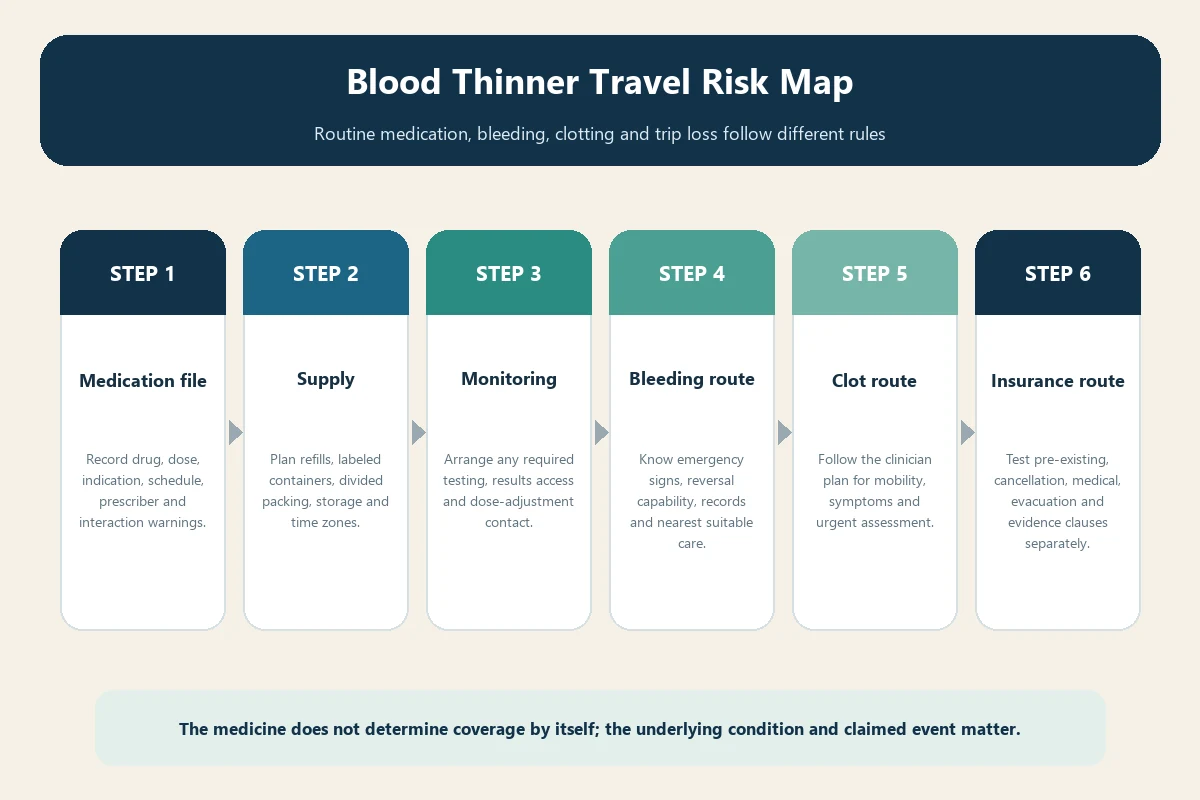
Arrange enough medication for the door-to-door trip plus a permitted disruption buffer. Keep it in original pharmacy-labeled containers and carry a list with generic name, strength, schedule, indication, prescriber, pharmacy, and allergies. Split supplies only when labeling and safety remain intact.
Request a vacation override or extended fill early. Our prescription medication travel guide explains Part D, foreign refills, labels, storage, and loss.
Part D and foreign purchases
Medicare states that drug plans generally do not cover prescription drugs bought outside the United States. A foreign refill or replacement should be treated as a likely personal expense unless the exact plan gives written guidance otherwise.
Foreign brand names, strengths, formulations, and prescription laws can differ. Use a licensed clinician and pharmacy. Do not purchase from informal markets or change to an “equivalent” without qualified guidance.
Time zones and missed doses
The safe schedule depends on the exact medicine, dosing frequency, indication, and journey. Ask the prescriber or pharmacist for a written plan showing home and destination times and what to do after a missed or delayed dose.
Do not double, skip, or shift a blood thinner by intuition. Phone clocks can update automatically while airline schedules, cruise time, and medicine reminders remain on another zone.
Monitoring abroad
Some travelers require laboratory monitoring, while others use medicines that do not use the same routine test. Ask the clinician whether the trip requires testing, which result is needed, how it will be communicated, and what destination facilities are acceptable.
Confirm whether planned monitoring is a personal expense. Travel medical insurance generally focuses on unexpected illness or injury and may not pay routine tests. Keep recent results and the anticoagulation clinic contact.
Drug and food interactions
New medicines, supplements, over-the-counter pain relievers, antibiotics, alcohol, and food changes can interact differently depending on the prescribed drug. A foreign pharmacist may not see the U.S. record.
Carry the complete medication list and ask the prescriber or pharmacist which products to avoid. Do not use generic travel advice to change diet or medicine. Our chronic medication travel guide helps organize the records.
Airport screening and sharps
Tablets and liquid medicines follow TSA and destination screening rules. A traveler using injectable anticoagulants may carry needles and sharps subject to medical and security procedures. Declare supplies as requested and keep prescriptions and original labels.
Check current rules for every airport and transit country. Plan safe sharps storage and disposal with the clinical team and lodging or cruise provider.
Long travel and blood-clot risk
CDC says long-distance travel can increase blood-clot risk, while the overall risk is generally small and varies with individual factors. Taking an anticoagulant does not permit the traveler to ignore symptoms or invent a dosing strategy. The clinician should assess the person’s risk and prevention plan.
Know the emergency symptoms identified by the care team and where to seek help. Do not delay evaluation because insurance has not authorized the visit.
Bleeding emergency plan
Ask the prescriber what injuries, bleeding, falls, headaches, symptoms, or device alerts require urgent care and what information emergency clinicians need. Carry the drug name, last-dose timing process, diagnosis, allergies, relevant laboratory results, and emergency contact.
A medical identification card or bracelet can help, but it does not replace records. A companion should know where the information is stored without being asked to make clinical decisions.
Travel medical coverage
Emergency medical insurance can cover eligible evaluation and treatment abroad, subject to the pre-existing-condition terms, deductible, coinsurance, maximum, exclusions, and coordination. A covered event could include unexpected bleeding or thrombosis, but no outcome should be assumed from the diagnosis alone.
Ask the insurer to explain two hypotheticals: an injury with bleeding and a new clot-related hospitalization. Request the policy provisions, not a product ranking.
Direct billing and payment
A foreign hospital may require a deposit. Assistance can locate a facility, arrange a payment guarantee for an eligible event, or merely provide a referral. A high medical limit does not ensure bedside payment.
Use the direct-billing guide to compare assistance and reimbursement. Keep an itemized bill, proof of payment, diagnosis, imaging, laboratory results, medication administration record, and discharge plan.
Trip cancellation
Cancellation may apply when a covered medical event makes the traveler unable to depart and the clinician and policy documentation support it. The pre-existing-condition clause can determine whether a recent clot, bleeding event, medicine change, or related condition is eligible.
Preserve the initial trip deposit date, insurance purchase date, clinical timeline, supplier refunds, and nonrefundable balance. A doctor’s advice not to travel is important, but it does not override an exclusion.
Trip interruption
After departure, interruption coverage may reimburse eligible unused arrangements and additional transport after a covered event. Separate the hospital bill from the new ticket, companion lodging, change fee, and unused tour. Each may have a different benefit.
Ask whether the insurer must arrange the return. A stable traveler may still require fit-to-fly clearance, medication planning, or an escort, but preference alone does not guarantee coverage.
Medical evacuation
Evacuation generally requires that local care be inadequate and that the assistance company authorize transport. The endpoint is often the nearest appropriate facility, not home. A blood-thinner-related emergency can affect monitoring and transport, but the treating and assistance physicians decide the route.
The evacuation approval guide explains decision authority. For documentation, use the evacuation claim checklist.
Activities and injury risk
Adventure sports, cycling, skiing, hiking, and other activities can raise injury exposure and may be excluded under the travel policy. Anticoagulant use does not change the certificate’s activity definition. Ask the clinician whether the activity is appropriate and the insurer whether it is covered.
Protective equipment and an activity rider do not make an unsafe plan medically suitable. Clinical and insurance approval are separate.
Five-scenario rehearsal
- Flight delayed overnight: access the carry-on supply and preserve the schedule from the clinician.
- Medicine lost: contact the prescriber, plan, assistance vendor, and licensed local pharmacy.
- Fall with head injury: follow the emergency instructions immediately.
- Symptoms of clot: seek urgent care according to the clinical plan.
- Hospital recommends transfer: coordinate the insurer before a non-emergency move when reasonably possible.
Document packet
- Medicine name, strength, schedule, and indication
- Prescription, pharmacy, and prescriber contacts
- Diagnosis and recent event timeline
- Relevant monitoring plan and recent results
- Allergy and interaction list
- Clinical emergency and missed-dose instructions
- Travel policy and Medicare-related cards
- Destination hospitals and assistance numbers
- Trip payments, refunds, and receipts
- Secure companion communication authorization
Questions for the insurer
- How are the medicine, underlying condition, and recent care treated under the pre-existing-condition definition?
- Is a waiver available and valid for the purchase timeline?
- Would an unexpected bleeding event or thrombosis be eligible?
- Is routine monitoring excluded?
- Can assistance arrange direct payment?
- What evacuation trigger and endpoint apply?
- How are cancellation and interruption documented?
- Are high-risk activities excluded?
- Which payer is primary?
- What medical records and deadlines apply?
FAQ
Can a senior get travel insurance while taking blood thinners?
Often, yes, but availability, price, exclusions, and waiver eligibility depend on the medicine, underlying condition, recent events, age, and policy.
Must blood thinners be declared?
Answer every application question accurately. The insurer may ask about medication, diagnosis, recent treatment, or hospitalization.
Will Part D pay for a replacement abroad?
Medicare drug plans generally do not cover prescriptions bought outside the United States. Arrange supply and a licensed backup path before travel.
Does taking a blood thinner prevent travel-related clots?
Only the treating clinician can assess individual risk and prevention. Do not alter medicine or ignore symptoms based on general assumptions.
Bottom line
Travel insurance for seniors taking blood thinners is a timeline and scenario review. Confirm clinical readiness, protect medication continuity, document the underlying condition and recent changes, and test both bleeding and clot events under medical, cancellation, interruption, and evacuation provisions.
