

Europe travel insurance for self-guided tours should protect the prepaid route stages and the traveler’s independent journey between them. A self-guided package may arrange inns, luggage transfers and route notes without providing a guide who solves disruptions in person. The policy therefore needs to fit the actual activities, separate transport contracts, interruption route and evidence available at each stage.
Key takeaways
- A self-guided tour is not the same contract as an escorted group tour or a fully independent vacation.
- Map every prepaid stage, transfer and overnight stay before calculating trip cost.
- Choosing to abandon a route is not automatically a covered trip interruption.
- A luggage-transfer driver may not meet the policy definition of a common carrier.
- Medical evacuation, search and rescue, and ordinary transport are different expenses.
Define what the tour operator actually provides
A self-guided itinerary typically gives travelers a planned route while they move at their own pace. The organizer may reserve lodging, transfer the main suitcase, supply maps or an app, book rail segments and provide telephone support. It may not provide a daily guide, vehicle or guaranteed rescue service.
Read the booking terms and divide the trip into three responsibility layers:
- Operator layer: accommodation, luggage transfers, route materials and any included transport.
- Traveler layer: navigation, pace, daily departure time, optional detours and independently booked services.
- Public-transport layer: airlines, trains, ferries or buses governed by their own tickets and passenger rights.
This is the main distinction from an escorted Europe tour, where a leader and fixed group departure can change the missed-departure analysis. It is also different from a do-it-yourself vacation because the self-guided operator may still control a chain of prepaid services.
Turn the itinerary into insured stages
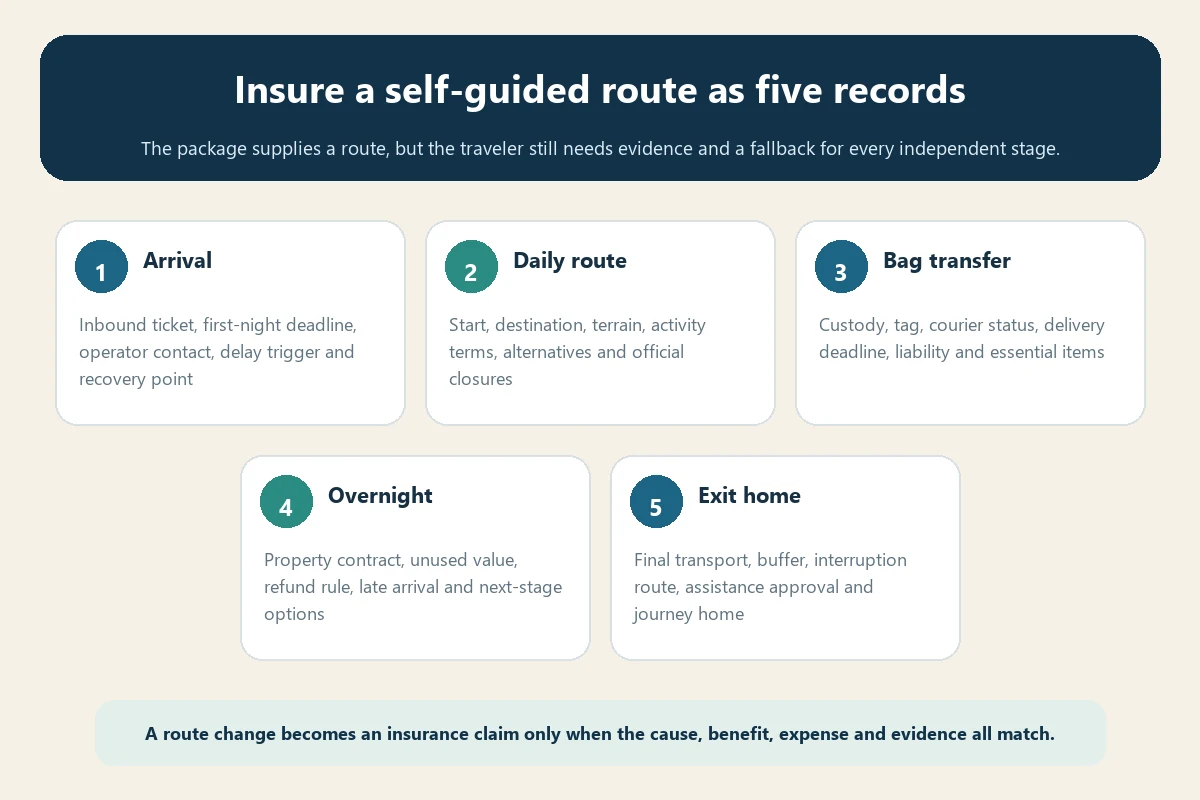
Do not treat the brochure as a single undivided product. Create one record for every day or contracted stage:
| Stage record | Details to save | Insurance question |
|---|---|---|
| Arrival and first night | Flight or train, transfer and check-in cutoff | Can a delay cause loss of the first prepaid stage? |
| Daily route | Start, destination, distance, terrain and alternatives | Is the activity covered at the planned difficulty? |
| Main-bag transfer | Collector, handoff time, receipt and destination | Who is responsible for delay or loss? |
| Overnight stay | Property, booking holder and cancellation rule | Is the unused night a recoverable trip cost? |
| Exit and journey home | Station, airport, buffers and ticket relationship | How would interruption transport be calculated? |
For a multi-country route, verify that every country is inside the policy territory. Our multi-country Europe insurance guide explains how to record border crossings and the full travel window.
Calculate trip cost from the cancellation schedule
The package price is not automatically the insured cancellation amount. Save the operator’s dated penalty schedule, then add independently booked flights, arrival hotels and onward transport. Subtract amounts the supplier would refund or credit.
The Federal Trade Commission advises travelers to research travel companies and obtain cancellation and refund policies before paying. Keep the version accepted at checkout because web terms can change after the deposit.
Update the cost ledger when a balance becomes nonrefundable, an extra stage is added or the operator returns money. Follow the Europe trip insurance checklist so the declared cost, dates and travelers match the issued schedule.
Route abandonment is not automatically interruption
A traveler may stop a self-guided route because of injury, illness, dangerous conditions, fatigue, poor navigation or a simple change of preference. The financial result can be the same—unused inns and new transportation—but the insurance result depends on the cause.
Trip interruption generally requires a covered event and supporting evidence. Feeling unable to continue, deciding the route is too hard or choosing a different city may not qualify. A physician-documented injury might qualify if it meets the wording and is not excluded by the activity rules.
Before buying, compare:
- covered interruption reasons;
- the maximum unused trip-cost benefit;
- additional transportation to the next stage or home;
- the definition of the return destination;
- refunds or credits from the operator; and
- requirements to contact the assistance service.
The trip interruption guide shows how covered cause, unused arrangements and new return transport fit together.
Plan a catch-up route before the first day
Unlike a group tour, a self-guided traveler may not need to catch a moving coach. They may need to skip one stage and reach the next reserved inn. Ask the operator for the practical recovery points and after-hours number.
For each critical stage, save the nearest rail or bus alternative, latest hotel check-in, taxi availability and cost estimate. Check whether the policy’s missed-connection or trip-delay benefit can apply to the inbound carrier and cause. A late personal start or navigation error is different from a documented common-carrier delay.
When rail is part of the package, the European Commission’s rail passenger-rights page explains assistance, rerouting and reimbursement rights under applicable EU rules. Claim from the carrier or operator first, then document the unrecovered balance for insurance. Our Europe train insurance guide covers through-tickets, separate tickets and replacement transport.
Audit walking, cycling and other included activities
“Self-guided” describes the service model, not the physical risk. One tour may be an urban food route; another may cross mountain paths. Match every planned activity to the definitions and exclusions in the certificate.
Record distance, elevation, maximum altitude, trail type, bicycle type, any climbing equipment, water activity and whether the route enters remote terrain. Look for exclusions involving mountaineering, racing, professional activity, off-road riding or travel against an official warning.
Do not rely on the operator calling a route easy or moderate. Insurance wording controls. The adventure-activity exclusion guide helps translate a marketing itinerary into policy questions.
Separate medical evacuation from search and rescue
A medical evacuation benefit may arrange transport to an appropriate medical facility when medically necessary and approved. It may not pay every mountain-rescue, trail-recovery or helicopter-search charge. Ask whether search and rescue has a separate limit and who must authorize service.
The U.S. Department of State recommends considering travel health and medical evacuation insurance, especially where care may be limited. Compare the policy’s medical and evacuation provisions against the remote sections of the route, not only the European destination label.
Save the assistance number offline, share the itinerary with an emergency contact and understand when local emergency services must be called first. The medical evacuation limits guide explains authorization, appropriate facility and transport destination.
Treat luggage transfer as a separate contract
Many self-guided packages move the main suitcase to the next inn while the traveler carries a daypack. Identify who accepts the bag, where custody changes and what the operator promises if delivery fails.
Insurance baggage-delay benefits often require a carrier delay and receipts for necessary replacement items. A local transfer driver may or may not satisfy the certificate’s carrier definition. Ask the insurer before relying on the benefit.
Photograph the bag at handoff, keep any tag or receipt and carry medications, identification, keys and one change of essential clothing in the daypack. The baggage delay and loss guide separates carrier liability, insurance limits and documented purchases.
Weather and closures need a named trigger
Rain, heat or an unpleasant forecast does not by itself create coverage. A route may become unusable because a carrier stops operating, an authority closes an area, lodging becomes uninhabitable or a traveler suffers a covered medical event. Each produces different evidence.
Save official closure notices, operator messages, carrier alerts and contemporaneous weather reports. Follow reasonable safety instructions and contact the operator before purchasing an alternative stage. The weather-delay insurance guide explains why the documented effect matters more than the weather label.
Create a self-guided tour claim file
- booking confirmation and accepted terms;
- daily route, difficulty and included services;
- payment ledger and cancellation schedule;
- rail, ferry, bus and flight tickets;
- luggage-transfer receipts and photographs;
- operator support messages and incident timeline;
- medical reports, prescriptions and assistance approvals;
- supplier refunds, credits and denial letters; and
- receipts for replacement transport, lodging and essentials.
If bus or coach transport is part of the recovery route, review the European Commission’s bus and coach passenger-rights guidance. Applicable carrier remedies reduce the loss submitted to the insurer.
Frequently asked questions
Is a self-guided tour covered like a package tour?
It can contain packaged services, but coverage depends on the actual contracts and issued policy. Record the operator’s services and every independently booked component separately.
Will insurance pay if I skip a difficult stage?
Not merely because the stage is difficult. A claim needs a covered event, eligible loss and required evidence. Voluntarily changing the route is usually a different situation.
Does baggage delay cover an inn-to-inn suitcase transfer?
Only if the facts and transfer provider meet the benefit wording. Confirm whether the operator or courier qualifies and what delay period, receipts and reporting steps apply.
Should the policy end on the final walking day?
Usually the insured travel window should include the full journey home, but the policy’s trip-date definitions control. Include pre-tour and post-tour transport when setting dates.
Planning the Camino or another multi-day pilgrimage? The Europe pilgrimage-route insurance guide maps walking activity, route stages, baggage transfers, medical interruption, catch-up transport and evacuation.
