

Europe travel insurance for summer heat should be evaluated by what the heat causes—not by the temperature alone. A forecast that makes a trip uncomfortable is different from a documented heat illness, a canceled carrier, an official evacuation or lodging that becomes unusable. Compare medical, delay, cancellation and interruption benefits as separate paths, then build a heat plan that reduces avoidable loss.
Key takeaways
- A heatwave is not automatically a covered cancellation reason.
- Emergency treatment for heat illness is evaluated under medical terms, limits and exclusions.
- Carrier cancellation, official closure and wildfire evacuation create different claim paths.
- An air-conditioned room that feels inadequate is not automatically uninhabitable lodging.
- Supplier refunds, credits and passenger-rights remedies reduce the insurance loss.
Separate discomfort from a covered event
Summer heat can change the pace and enjoyment of a Europe trip. Standard trip cancellation coverage, however, usually responds only to listed reasons in the certificate. Concern about high temperatures, a changed preference or a forecast that looks unpleasant may not qualify.
Ask four questions before assuming coverage:
- What exactly happened: forecast, illness, transport disruption, closure or damage?
- Which named benefit could respond?
- Does the cause meet that benefit’s definition and timing rules?
- What eligible cost remains after supplier recovery?
The guide to covered trip cancellation reasons explains why evidence of a loss does not replace the need for a covered cause.
Medical coverage is the first heat-specific check
Extreme heat can cause illness rather than merely inconvenience. The CDC Yellow Book chapter on heat illness in travelers describes the spectrum from heat cramps and exhaustion to severe heat illness requiring emergency attention.
For insurance, review:
- emergency medical limit and deductible;
- whether the plan pays directly or reimburses later;
- preauthorization rules for non-emergency care;
- pre-existing-condition exclusions or waiver conditions;
- medical evacuation approval and destination;
- exclusions tied to alcohol, drugs or strenuous activities; and
- records required from the treating clinician.
Do not choose the medical limit from the trip price. The Europe coverage-limits worksheet separates medical and evacuation exposure from cancellation cost.
Build a heat-health plan before departure
The WHO Europe Keep Cool guidance advises reducing strenuous activity during the hottest part of the day, staying hydrated, keeping indoor spaces cool and checking on people at increased risk. Travelers with chronic conditions or medications that may affect heat tolerance should obtain individualized advice from their clinician.
Before leaving, save:
- local emergency numbers for each country;
- the insurer’s assistance number and policy number offline;
- nearby clinics for remote or island stops;
- the generic names and doses of medications;
- contact details for a traveling companion and home contact; and
- flexible indoor alternatives for the hottest hours.
Prevention does not guarantee coverage, but it reduces foreseeable harm and gives the traveler a more credible record of reasonable steps.
Also confirm the cooling conditions of every overnight stay rather than assuming that an “air-conditioned” listing describes the whole property. Ask whether the reserved room has individual cooling, whether public areas are cooled and what remedy applies if the system fails. For rail and road days, carry essential medication and water with the traveler instead of placing them in checked luggage or a tour vehicle.
Heat illness before departure may become a cancellation claim
If a traveler becomes ill before the trip, trip cancellation may apply only when the diagnosis, timing and physician recommendation satisfy the certificate. A traveler’s personal belief that the climate will be unsafe is not the same evidence.
Obtain a contemporaneous medical record stating the condition, examination date, treatment and whether the person is medically unable to travel. Cancel affected reservations promptly when the policy requires loss mitigation. Keep every refund and credit response.
If flexibility for personal risk tolerance is the real goal, compare a qualifying Cancel For Any Reason benefit. CFAR has its own purchase window, insured-cost rules, cancellation deadline and partial reimbursement; it is not emergency medical coverage.
Heat illness during the trip can trigger several benefits
A treating clinician may determine that a traveler needs emergency care, must remain in place or cannot continue. The claim can involve medical expenses, additional lodging, trip interruption or medically necessary transport. Each amount belongs under the benefit that actually applies.
Contact the assistance service as soon as practical, especially before arranging evacuation or a new flight. Save clinical notes, test results, prescriptions, itemized bills, proof of payment and the assistance case number.
If the traveler must return early, the trip interruption guide explains unused arrangements, economy transportation and supplier credits. The medical evacuation limits guide covers authorization and appropriate-facility wording.
Transport disruption is a carrier event first
Heat can contribute to operational restrictions, power problems or infrastructure disruption, but the insurance file should begin with the carrier’s documented action. Record the scheduled service, delay or cancellation time, stated reason, rerouting offered and expenses incurred while waiting.
The European Commission air passenger-rights portal provides the current legal framework for eligible European flights. For flights subject to US rules, the U.S. Department of Transportation refund guidance explains when a refund is due after cancellation or significant change.
Compensation, refund, rerouting, meals and insurance reimbursement are different remedies. Request what the carrier owes first and claim only the eligible remainder. Our weather-delay insurance guide shows how the documented transport effect connects to waiting periods and expense limits.
Wildfire effects need their own evidence
Extreme heat and dry conditions can coincide with wildfire risk, but a nearby fire does not automatically create cancellation coverage. The relevant event might be an official evacuation, closed airport, unusable lodging, carrier cancellation or covered medical problem.
Save the government order or carrier notice, map the location against the booked accommodation and record when the order began. A news headline about a region is weaker evidence than an official notice applying to the traveler’s dates and address.
Policies differ on natural disaster, mandatory evacuation, uninhabitable accommodation, smoke and known-event rules. Review the country exclusions and advisory guide before changing destinations.
Air conditioning complaints are usually a supplier question
Travelers should confirm whether lodging advertises air conditioning, which rooms have it and whether the promise appears in the reservation. A room that is hot or less cool than expected is not automatically “uninhabitable” under an insurance definition.
If cooling fails, notify the property immediately and ask for repair, another room, a fan, relocation or a refund. Photograph any error display, preserve messages and record indoor conditions if they can be measured safely. Do not simply leave and assume a replacement hotel will be reimbursed.
Insurance may require physical damage, an official order or another specified condition before accommodation is considered uninhabitable. The supplier’s broken amenity promise and the insurer’s covered event are separate analyses.
Outdoor tours and tickets may remain valid
A walking tour, attraction or event can remain open even when a traveler no longer wants to attend. If the supplier performs the service, its normal cancellation terms may apply. Standard insurance does not convert every safety concern into a covered cancellation.
Ask the supplier about time changes, indoor substitutes, postponement or credit. When an operator cancels, obtain its refund determination before claiming. If a physician tells a traveler not to participate because of a covered condition, keep that medical evidence and the unused-ticket record.
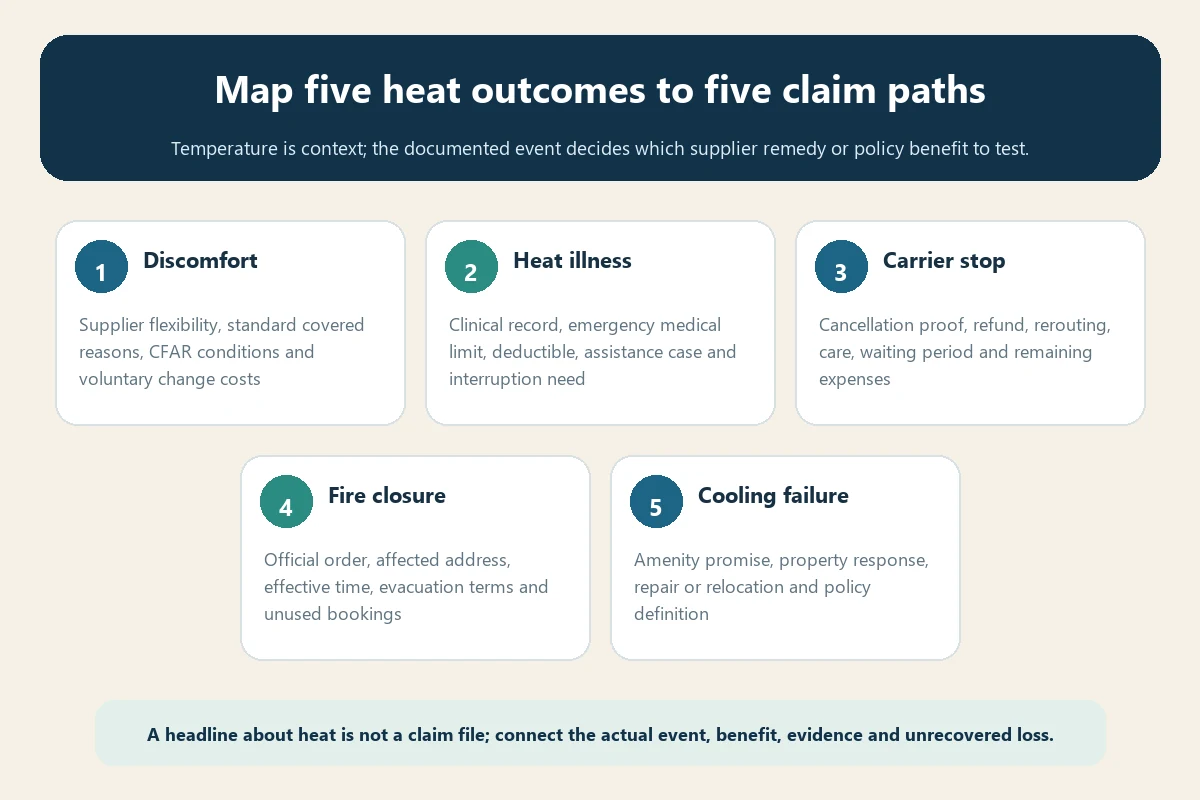
Compare five heat outcomes, not one “heatwave” label
| Outcome | First source of recovery | Policy section to check |
|---|---|---|
| Trip feels too hot | Supplier change or refund rules | Covered cancellation reasons or CFAR |
| Documented heat illness | Health plan if applicable | Emergency medical and interruption |
| Carrier cancels service | Refund, rerouting and passenger rights | Delay, missed connection or interruption |
| Official wildfire evacuation | Supplier and government instructions | Natural disaster or evacuation wording |
| Cooling system fails | Accommodation remedy | Uninhabitable lodging definition |
This table prevents a common claim mistake: citing “extreme heat” without proving the event named in the certificate.
Keep a summer heat claim file
- policy schedule and issued certificate;
- official heat, evacuation or closure notice;
- carrier or supplier cancellation message;
- medical records and itemized bills;
- assistance-service case notes and approvals;
- original booking and refund terms;
- refund, credit and passenger-rights outcome; and
- receipts tied to a dated incident timeline.
Use the Europe insurance checklist to assemble these records before departure.
Frequently asked questions
Can I cancel a Europe trip because of a heatwave?
Not automatically under standard cancellation coverage. The reason must match the issued certificate. A qualifying CFAR benefit may offer broader, partial reimbursement when its conditions are met.
Does travel insurance cover heat stroke?
Emergency treatment may be eligible under medical coverage if the event, expense and traveler satisfy the policy. Limits, deductibles, exclusions and documentation still apply.
Will insurance pay for a hotel with no air conditioning?
Do not assume it will. Start with the property’s written amenity promise and remedy, then compare the facts with the policy’s accommodation and uninhabitable-property definitions.
What if heat cancels my train or flight?
Request carrier refund, rerouting and other applicable assistance first. Travel insurance evaluates eligible delay or interruption costs remaining after those recoveries.
