

An annual travel insurance pre existing condition waiver is not a standard feature of every multi-trip plan. Some annual policies allow travelers with existing diagnoses to enroll but retain a pre-existing-condition exclusion. Some use a look-back tied to the annual plan purchase date. A single-trip policy from the same brand may offer a time-sensitive waiver even when its annual product does not.
This U.S.-focused guide shows how to compare the actual annual contract with a single-trip alternative. It is general education, not medical, insurance, or legal advice. Plan availability, terms, state forms, and renewals vary.
Key takeaways
- “You can buy the plan” does not mean claims related to an existing condition are covered.
- Search the annual certificate for the exclusion and waiver; do not import terms from a single-trip brochure.
- Annual plans can use one purchase-date look-back while covering many later trips.
- Per-trip duration and annual benefit maximums can matter as much as the medical exclusion.
- Renewal may create a new policy term and new dates; verify continuity in writing.
Reviewed August 16, 2026. Annual and multi-trip products differ by insurer, state, policy year, tier, and trip. The issued certificate, schedule, declarations, and endorsements control.
Do not confuse eligibility to buy with coverage
A traveler with diabetes, heart disease, cancer history, asthma, or another chronic diagnosis may be eligible to purchase an annual plan. The policy can still exclude a loss caused by a condition that meets its pre-existing definition.
The first document search should be for “pre-existing,” “existing medical,” “look-back,” “waiver,” “exclusion,” and “change in medication.” If the certificate contains an exclusion but no waiver endorsement, a sales agent’s general statement about covering frequent travelers does not add one.
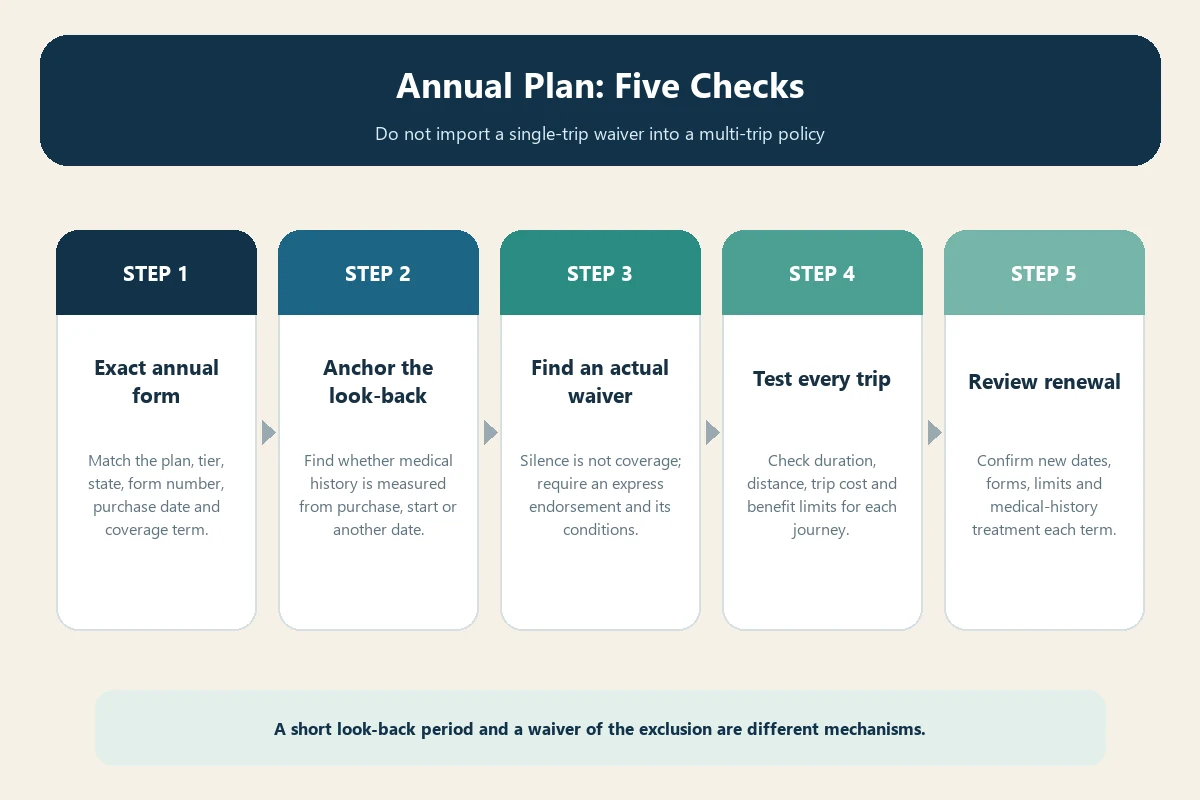
Check one: identify the exact annual policy
Record the insurer, plan name and tier, state of residence, policy form number, purchase date, coverage start and end, and every endorsement. Confirm that the document says annual or multi-trip rather than single trip.
The annual versus single-trip guide compares convenience and trip patterns. For a medical-history decision, the form number is more important than the marketing family name.
One brand can use different rules for different products
Travel Guard’s current annual-plan guidance says its Annual Plan does not offer a pre-existing-medical-condition exclusion waiver and points concerned travelers toward eligible single-trip plans. Its single-trip waiver guidance describes a time-sensitive waiver on eligible plans. That contrast is precisely why brand-level assumptions are unsafe.
Check two: find the annual plan’s anchor date
A single-trip waiver often counts from the first trip payment. An annual policy may define pre-existing conditions by looking back from the annual plan purchase date or another effective date. Later bookings during the coverage year may not reset that medical-history window.
A current state-specific Travel Guard Annual Plan policy example defines a 90-day period immediately preceding and including the plan purchase date. It is an example for one form and state, not a national rule.
Map symptoms and treatment to the defined period
Create a dated timeline for symptoms, diagnoses, physician recommendations, tests, treatment, and prescription changes. Apply only the triggers in the annual form. The existence of a lifelong diagnosis and the occurrence of recent treatment are related but not identical facts.
Use the look-back period examples to structure the timeline. The policy, not a generic meaning of “stable,” controls the result.
Check three: determine whether a waiver is present
Look for an endorsement that expressly waives the pre-existing-condition exclusion and states its conditions. If there is no waiver language, do not interpret silence as coverage. If a waiver exists, list its purchase deadline, medical-ability test, insured trip-cost rule, age or amount limits, and applicable benefits.
The waiver overview explains what a waiver does. The waiver eligibility checklist should be applied only after confirming that the annual product actually includes one.
A short look-back is not the same as a waiver
A 60- or 90-day look-back can be narrower than a 120- or 180-day period, but it still leaves an exclusion. A waiver removes the exclusion from defined benefits when all conditions are met. These are different mechanisms.
If a condition had no triggering symptom, treatment, recommendation, or medication change during the annual form’s look-back, it may fall outside the definition. That conclusion requires accurate records and the exact wording; it is not a promise that a later claim will be paid.
Check four: test every planned trip against the annual rules
An annual coverage term is not necessarily permission for one year-long journey. Many plans impose a maximum length for each trip, a minimum distance from home, an overnight requirement, or a destination rule. A trip outside those boundaries can fail before the medical exclusion is analyzed.
Travel Guard’s current Annual Plan page describes one plan covering multiple trips across a term. Read the certificate for the actual trip definition and maximum duration; product pages can change and may not show state variations.
Review the medical and evacuation benefits separately
Annual trip cancellation, interruption, emergency medical expense, and evacuation benefits can use different covered reasons, limits, and exclusions. Do not treat “medical coverage” as one pool.
A medical expense limit may be per insured, per trip, per occurrence, or across the policy term. Evacuation may require assistance-team approval and transport to an appropriate facility. The evacuation limits guide explains why the headline maximum is not the whole benefit.
Understand annual maximums and benefit exhaustion
Some annual benefits can be reduced by earlier claims during the same coverage term. A traveler who uses a maximum on trip one may have less or no remaining amount for that benefit on trip three, while other benefits remain available.
Ask for a written explanation of whether limits reset per trip, per occurrence, per insured, or only at renewal. Keep each explanation with the current certificate because a later product page may describe a newer version.
Trip cost can expose another gap
Annual plans may cap trip cancellation or interruption at an amount below a traveler’s most expensive journey. A single-trip plan may allow coverage based on that trip’s insured cost and may offer a waiver if bought within the required window.
Compare the nonrefundable cost of the costliest planned trip, not the average trip. Include flights, cruises, tours, prepaid lodging, and other arrangements according to the policy’s definition. The convenience of one annual purchase does not cure an inadequate limit.
Check five: ask what renewal changes
Renewal can mean a new policy term, premium, form, purchase date, coverage dates, and medical-history analysis. Do not assume continuous payment freezes the original terms forever. Save the renewal offer, new declarations, and the full renewed certificate.
Ask whether the insurer treats renewal as a new purchase for the pre-existing definition, whether coverage is continuous, and whether a gap changes any answer. Get the response in writing if the decision affects a major trip.
A medication change near renewal needs careful timing
A new drug, dosage increase, stopped prescription, or physician-recommended change can fall within a form’s definition. Some policies make exceptions for controlled conditions or specific routine adjustments; others do not.
The medication-change guide shows how to document what changed, why, and when. Never alter appropriate treatment to influence insurance timing; health decisions belong with the treating clinician.
Compare annual and single-trip forms side by side
| Question | Annual plan | Single-trip plan |
|---|---|---|
| Coverage period | Multiple eligible trips in one term | One defined trip |
| Medical anchor | May use annual purchase/effective date | Often tied to plan purchase and first trip payment |
| Waiver | May be unavailable | May be time-sensitive on eligible plans |
| Trip duration | Usually capped per trip | Defined by the insured itinerary |
| Cancellation amount | May have a fixed annual/per-trip cap | Often selected from the trip’s insured cost |
| Renewal | New term must be reviewed | New policy for a later trip |
This table is a comparison checklist, not a coverage statement. The exact contracts may reverse or modify any general pattern.
When an annual plan may still fit
An annual plan can suit frequent travelers whose trips fit its duration and cost limits and whose priorities include delay, baggage, rental vehicle, new medical events, or assistance services. A pre-existing diagnosis does not make the product impossible to buy.
The decision becomes risk-specific: which conditions and people could cause a cancellation, interruption, medical claim, or evacuation, and does the annual form address those risks acceptably? The answer can differ for two travelers on the same itinerary.
When to compare a single-trip policy
Compare a single-trip form when an expensive trip depends on coverage for an existing condition, the annual policy has no waiver, the journey exceeds the annual duration cap, or the annual cancellation maximum is too low. Buy-time conditions can expire quickly, so compare before making or immediately after the first trip payment.
The purchase-deadline guide explains how to preserve the booking and purchase record. Do not cancel an annual policy until replacement coverage is issued and its effective dates are confirmed.
Annual-plan review worksheet
- Download the current certificate for the plan, tier, and state.
- Mark the purchase date, term dates, and per-trip maximum duration.
- Copy the pre-existing definition and every exclusion trigger.
- Find an express waiver endorsement or record that none appears.
- Map medical events to the defined look-back.
- List limits for cancellation, interruption, medical expense, and evacuation.
- Ask whether limits reset and what renewal changes.
- Compare a single-trip form for the highest-risk journey.
Bottom line
Never assume an annual travel insurance pre existing condition waiver exists because a carrier offers one on a single-trip plan. Verify the annual form, its anchor date, the exclusion and any endorsement, per-trip eligibility, benefit limits, and renewal treatment. For a medically sensitive or high-cost journey, compare the actual annual certificate with an eligible single-trip certificate while the purchase window is still open.
