

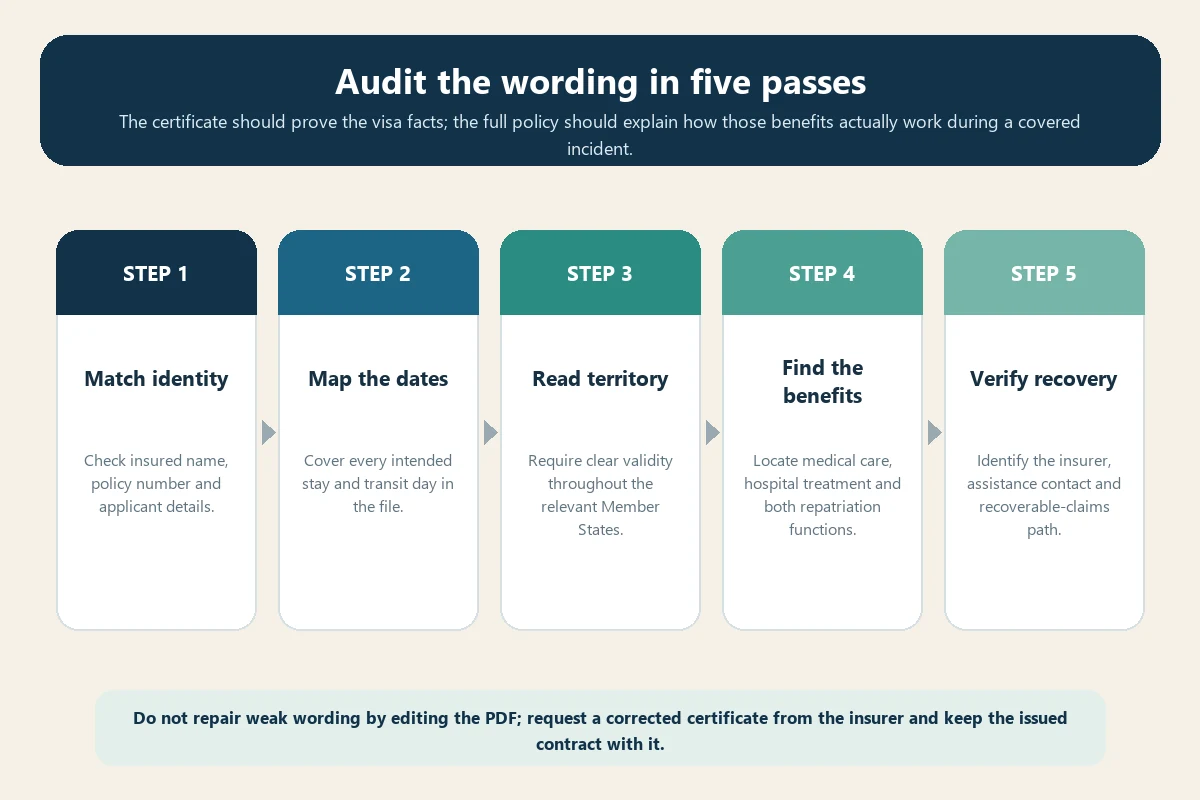
This Schengen insurance policy wording checklist reviews the issued certificate line by line: insured identity, coverage dates, territory, medical amount, required benefits, insurer details and claims recoverability. The certificate proves selected visa facts. The full policy explains exclusions, deductibles, authorization rules and the service process that can determine a real claim.
Key takeaways
- Match the insured name to the passport and visa application exactly enough to identify the applicant.
- Cover the complete intended stay or transit and use clear all-Schengen territorial wording.
- Verify at least €30,000 and the required medical and repatriation functions.
- Identify the legal insurer, policy number and assistance or claims contact.
- Read the full contract because a compliant certificate does not remove exclusions or authorization conditions.
Requirements reviewed August 16, 2026. Always use the current checklist of the consulate or visa center handling the application.
Start with the official rule
Article 15 of the EU Visa Code requires adequate and valid travel medical insurance for ordinary uniform-visa applicants. It identifies expenses connected with medical repatriation, urgent medical attention, emergency hospital treatment or death. Coverage must generally be valid throughout the Member States for the entire intended stay or transit, with a minimum of €30,000.
The law establishes the baseline, but the reviewing authority controls its documentary procedure. The official Netherlands insurance page, for example, asks for proof naming the insured, covering all Schengen countries and the complete stay, with the stated medical services and repatriation. The Spanish Consulate in Washington publishes its own certificate instructions and says an insurance card alone is not accepted as proof.
Use the Schengen insurance requirements guide for the rule overview. This page focuses on the actual words visible in the document.
Pass 1: insured identity and policy reference
Find the applicant’s full name near the top of the certificate or insured schedule. Compare spelling, order, middle names and transliteration with the passport and application. Minor formatting differences may be harmless, but a missing family name, another person’s name or an unexplained nickname creates avoidable ambiguity.
Record the policy or certificate number and the issuing date. If a group policy covers a family, each applicant should be identifiable in the schedule. A booking confirmation that names only the buyer does not prove that every visa applicant is insured.
Do not add a passport number by editing the PDF. Ask the insurer whether it can issue a corrected certificate or endorsement. The certificate audit guide explains safe correction and delivery steps.
Pass 2: start date, end date and complete duration
Locate the exact effective and expiry dates. Compare them with the first intended entry, final exit and any transit day. Overnight flights can shift a date, and a hotel checkout date can precede the actual Schengen departure. Multiple-entry applicants should follow the current instruction for the first intended visit and later stays.
Look for a time zone or hour if the policy uses one. A plan that expires at 12:01 a.m. can end before a late departure. Ask for clarification when a certificate uses only a duration such as “15 days” without fixed dates, especially if the visa checklist expects a concrete period.
The Schengen insurance dates guide provides a day-by-day method. Leave a deliberate buffer only when the authority permits it and the policy actually covers those extra days.
Pass 3: territory wording
Strong wording says the policy is valid in all Schengen Member States or supplies a current complete list. “Europe,” “worldwide” and “international” are private geographic labels unless the contract defines them. A broad marketing region can still produce weak visa evidence if the certificate never states Schengen validity.
Check limited-territorial visas literally. If the certificate lists countries, ensure Bulgaria and Romania are not omitted from an outdated 26-country template. A side trip to Ireland, the United Kingdom, Cyprus or a European microstate may require broader private coverage even though it is not part of the same Schengen certificate question.
Use the territorial coverage guide to match the current 29-country area with a real route.
Pass 4: minimum amount and currency
The certificate should display at least €30,000 or a clearly equivalent amount. Do not assume a dollar figure is sufficient without checking the conversion and the authority’s preference. If benefits have separate caps, identify which amount applies to emergency medical expenses and which applies to evacuation or repatriation.
A high headline limit does not fix a missing benefit. “Medical maximum $100,000” says little about return in the event of death, medical repatriation or excluded activities. The minimum-coverage guide distinguishes the regulatory floor from sublimits and real financial protection.
Pass 5: required medical functions
Find wording for urgent medical attention and emergency hospital treatment. Some certificates use broader phrases such as emergency medical expenses, but the document should let the reviewing authority connect the promise with the required functions. Prescription medicine may appear where a consulate specifically requests it.
Then find repatriation for medical reasons and return in the event of death, or equivalent clear language. “Evacuation” alone can mean transport only to the nearest suitable facility. It does not necessarily mean return to the country of residence or transport of remains.
The repatriation wording guide separates ambulance, evacuation, medical return and return after death. Locate both the certificate statement and the underlying definitions.
Pass 6: insurer and claims recoverability
Identify the underwriting insurer, not only the comparison site, assistance brand or administrator. The certificate should provide a policy reference and usable contact. Article 15 says consulates assess whether claims against the insurance company would be recoverable in a Member State.
Ask where claims are submitted, which legal entity owes payment and whether the certificate can be verified. A generic receipt from a reseller does not answer those questions. Save the full wording, schedule, invoice and assistance contact together.
Certificate wording versus contract wording
| Visible certificate line | Contract section to inspect | Why it matters |
|---|---|---|
| Emergency medical up to €30,000+ | Covered expenses, deductible and exclusions | Defines which treatment is payable |
| Repatriation included | Medical necessity, destination and authorization | Determines who arranges transport and where |
| All Schengen states | Territorial definition and sanctions clauses | Tests the actual itinerary |
| Coverage dates | Effective-time, extension and termination clauses | Shows when protection begins and ends |
| No deductible | Benefit schedule and provider rules | Checks whether zero applies to every benefit |
Words that deserve clarification
- Worldwide: Does it include the entire Schengen itinerary and the country of residence?
- Reasonable and customary: Which benchmark limits reimbursement?
- Medically necessary: Who decides and what evidence is required?
- Preauthorization: Which services require advance approval, and what happens in an emergency?
- Pre-existing condition: What lookback period and stability test apply?
- Secondary coverage: Which other plan must be billed first?
- Usual residence: Does the applicant meet purchase and coverage eligibility?
How to request a correction
- Mark the exact weak or incorrect field on a copy.
- Quote the consulate’s current instruction without rewriting it.
- Ask the insurer for a revised certificate or formal endorsement.
- Verify the new issue date, name, period, territory and benefit lines.
- Keep both the request and the insurer’s response.
- Submit only the version that accurately reflects the issued policy.
Do not design a replacement certificate, add a logo or paste text into the insurer’s document. An altered file can undermine trust and may no longer be verifiable. If the insurer cannot provide acceptable wording, review cancellation and refund terms before buying another plan.
Common wording failures
- The purchaser is named, but the applicant is not listed as insured.
- The policy covers “Europe” without an all-Schengen statement or definition.
- Dates omit an arrival, transit or final departure day.
- The amount appears without a currency.
- Evacuation is shown, but medical repatriation or death wording is absent.
- The document is only a payment receipt or wallet card.
- The insurer is not identifiable or the verification contact is unusable.
The insurance-proof rejection guide groups these failures by identity, dates, territory, limits and issuer evidence.
Perform the audit again after any itinerary or appointment change. A certificate that was accurate at purchase can become incomplete when a departure moves, a transit country changes or another applicant joins the trip.
Keep a simple review record beside the application: document version, issue date, reviewer, unresolved field and insurer response. That record reduces the chance of submitting an older certificate after a correction and makes a final appointment-day check much faster.
Frequently asked questions
Must the certificate use the exact words from Article 15?
Not necessarily, but the wording should clearly demonstrate the required functions to the reviewing authority. Follow its current checklist.
Is a policy card enough?
Many authorities expect a certificate or schedule showing the applicant and required facts. A card usually lacks dates, territory and detailed benefits.
Can I correct the PDF myself?
No. Ask the insurer to reissue or endorse it. Submit authentic documents that match the actual contract.
Does a €30,000 line prove every benefit has that amount?
No. The schedule may share an overall limit or apply sublimits. Read the full contract and the authority’s instruction.
Does certificate acceptance guarantee a claim?
No. Visa-document acceptance and claim adjudication are separate. Exclusions, authorization, medical facts and evidence still apply.
This educational checklist is not legal or insurance advice. Official authorities and the issued policy control.
