

Travel insurance over 85 may be available, but availability is only the first gate. A product can accept an 85-year-old while reducing the medical maximum, limiting pre-existing-condition benefits, shortening eligible trips, or providing no cancellation coverage. A different search result may insure an inbound visitor to the United States rather than a U.S. resident traveling abroad.
This guide sets an adequacy floor before price is compared. It does not assume that an older traveler lacks capacity, independence, or fitness to travel. It is educational, not insurance, medical, legal, financial, accessibility, or Medicare advice. Use exact quotes and issued forms.
Key takeaways
- Filter the correct market and product class before reading benefit amounts.
- Verify the actual age-85 tier, not a plan’s highest advertised maximum.
- Set medical, evacuation, duration, and pre-existing-condition floors for the itinerary.
- Test assistance, direct payment, accessibility, companion, and communication logistics.
- Reject an inadequate eligible plan before comparing its premium.
Reviewed August 16, 2026. “Eligible,” “maximum limit,” “pre-existing condition,” “sudden recurrence,” “acute onset,” “medically necessary,” and “coverage duration” are contract-specific terms.
Eligibility and adequacy are different questions
The existing travel insurance over 80 guide explains which product shapes can remain available. At age 85, build a second test. First ask whether the traveler can buy the exact plan. Then ask whether its exact-age benefits fit the destination, trip length, medical exposure, and ability to use the claims process.
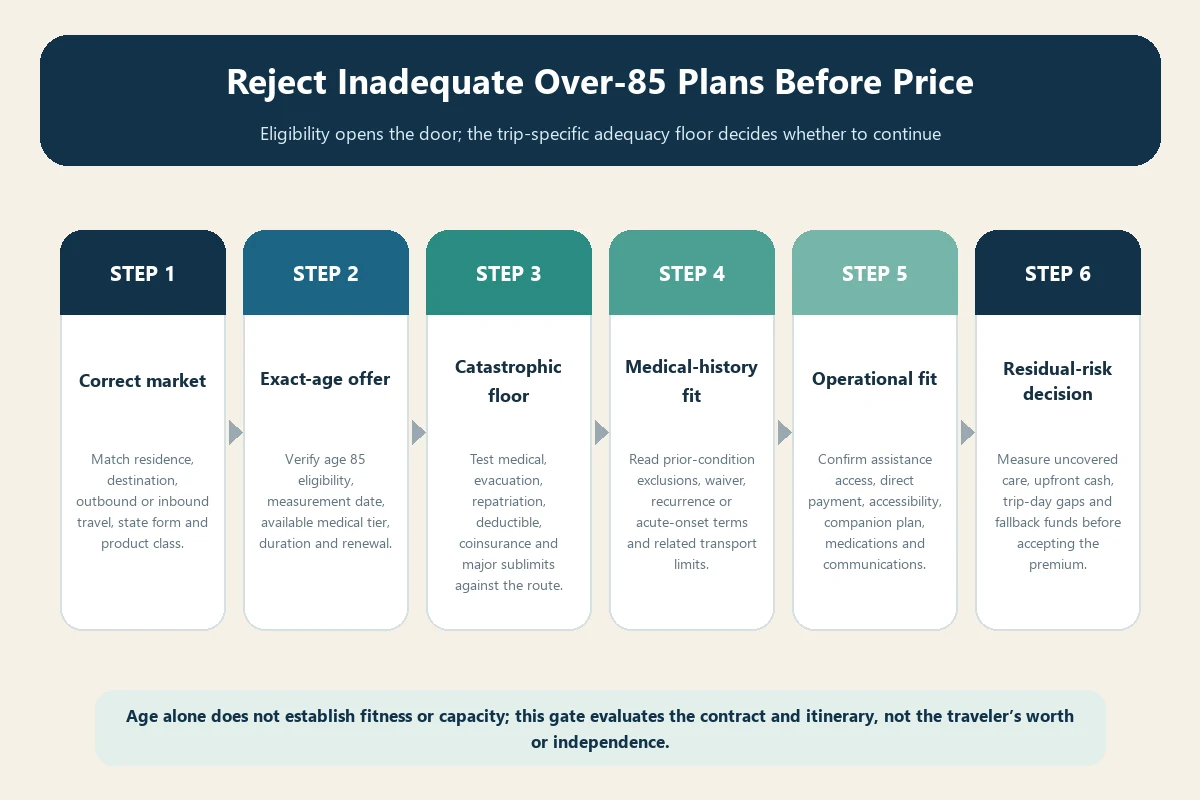
Gate 1: match the correct market
| Traveler situation | Likely product search | Do not substitute |
|---|---|---|
| U.S. resident traveling abroad | Outbound trip protection or travel medical | Visitor medical for entry to the U.S. |
| Non-U.S. resident visiting America | Inbound visitor medical | U.S.-resident outbound senior plan |
| Several short trips | Annual multi-trip | One continuous long-stay plan |
| One expensive prepaid trip | Single-trip protection | Medical-only policy |
| Transport service priority | Insurance plus possible assistance membership | Membership as hospital-bill coverage |
Record state and country of residence, citizenship when relevant, destination, trip dates, trip purpose, and full date of birth. A page labeled “senior insurance” can be accurate for another country and useless for the traveler in front of you.
Gate 2: obtain an exact age-85 quote
Enter the actual date of birth and save the result. Ask whether age is measured at purchase, coverage start, departure, or renewal. Confirm the plan name, form, state availability, medical option, deductible, and period. The age-limit certificate audit shows where an enrollment rule can differ from a benefit rule.
Do not infer age-85 availability from a page that says “65+” or “seniors.” A current quote or an explicit eligibility clause is stronger evidence. If a birthday occurs before departure, obtain a written answer about the applicable tier.
Plan examples show why the exact age tier matters
IMG’s current GlobeHopper Senior page describes a U.S.-citizen or permanent-resident outbound medical product for age 65+ and states no maximum age in its supporting materials. It presents a smaller set of medical maximum choices at age 80+ than for ages 65–79. The sample contract supplies the product-specific eligibility, duration, precertification, prior-condition, and claim details.
WorldTrips’ current senior medical page supplies a second plan-family example: it says some plans can cover age 80+ while listing lower age-80+ overall maximums. These examples do not prove availability or adequacy for a particular state, destination, or traveler. They prove why “accepts age 85” and “offers the amount I need” are separate fields.
Gate 3: set a medical adequacy floor
Estimate exposure from the destination’s private-hospital practice, length of stay, planned activities, cruise or remote legs, existing coverage, and ability to return home. Then compare the exact medical maximum, deductible, coinsurance, hospital and ambulance sublimits, emergency dental, prescription, imaging, therapy, and continuation provisions.
The medical policy-limits guide explains why a headline maximum is only the first layer. Reject a plan if a material sublimit or payment structure leaves an unacceptable gap, even if its premium is attractive.
Set the floor before requesting quotes
A floor is not a universal recommendation. It is a trip-specific minimum the traveler and appropriate advisers decide they can accept. Write the maximum tolerable deductible, minimum medical amount, minimum evacuation amount, longest trip, required pre-existing-condition treatment, and maximum cash the traveler can advance.
Changing the floor after seeing a high premium turns the comparison into wishful thinking. If no plan meets it, change the trip, destination, duration, refundable arrangements, or funding plan rather than calling an inadequate contract adequate.
Gate 4: evaluate evacuation as a route
Emergency transport is not one flight price. It can include local ambulance, stabilization, hospital transfer, ground access, scheduled-airline escort, stretcher, oxygen, fixed-wing aircraft, border permissions, and a receiving facility. Approval, medical necessity, mode, and destination rules can be as important as the maximum.
Use the evacuation risk worksheet to identify the likely route and a fallback. An age-85 plan’s actual transportation limit must be copied from its exact tier and benefit clause.
Gate 5: classify pre-existing-condition treatment
Place each plan in one of four evidence-based columns: waiver of an exclusion under stated conditions; limited sudden-recurrence benefit; limited acute-onset benefit; or exclusion without a relevant exception. Then copy the definition, look-back or stability rule, purchase deadline, age threshold, maximum, deductible, excluded symptoms, and evacuation relationship.
The senior medical-history questions help organize the review. A condition controlled with medication can still fall within a certificate’s definition, and a limited recurrence benefit is not the same as a waiver.
Check medical advice without turning insurance into clearance
The State Department’s age 65+ guidance recommends consulting a physician before travel, carrying a provider letter, medications, medical alert information, and emergency contacts. Those steps support preparation; they do not make an excluded condition covered or guarantee airline acceptance.
Ask the treating clinician about the actual itinerary, altitude, heat, infectious risks, mobility, oxygen, recent hospitalization, procedure timing, medication storage, and access to follow-up care. Keep clinical advice separate from the insurer’s coverage decision.
Gate 6: test trip duration precisely
Count the trip using the certificate’s rule and include travel days, time-zone changes, cruise boarding, side trips, and planned extensions. An annual policy can have a short per-trip limit. A single-trip plan can offer months of coverage but end when the traveler returns to the country of residence.
Ask what happens if treatment continues past the end date, if the traveler cannot travel home, or if a birthday occurs during the period. A continuation-of-treatment clause may extend eligible care without extending cancellation, baggage, or unrelated medical coverage.
Operational fit matters at age 85—and at every age
Evaluate how the traveler will contact assistance, share the policy number, authorize records, pay a deposit, obtain translation, transport medications, and communicate with family. Identify a trusted contact only with the traveler’s permission. Do not assume a companion controls decisions.
Check accessible transport and lodging, mobility-device handling, hearing or vision communication needs, charging and refrigeration, and backup documentation. The direct-billing guide explains why a 24-hour assistance line is not the same as a guaranteed hospital payment.
Medicare and U.S. plans belong in the coordination column
Medicare’s official foreign coverage page states that Medicare usually does not cover care abroad, subject to limited exceptions, and notes that some Medigap policies may provide foreign emergency coverage. Verify Medicare Advantage, Medigap, employer, retiree, military, and private coverage individually.
Record whether the travel plan is primary or secondary and which EOB or denial it may require. Confirm whether medical evacuation is covered by any domestic plan; do not infer it from hospital coverage.
Price only the plans that survive
For each surviving plan, record premium, deductible, coinsurance, medical and evacuation shortfalls, excluded conditions, upfront cash exposure, trip-day gap, claim deadlines, and other-insurance coordination. Compare the likely residual loss, not just the purchase price.
If no plan survives, document why. Possible responses include shortening the trip, choosing a destination with stronger medical access, using refundable bookings, arranging a clinician review, building a larger emergency fund, or postponing. None creates coverage, but each can reduce exposure honestly.
Use this age-85 adequacy sheet
- Residence, state, destination, dates, age measurement, and product class
- Eligibility evidence, form number, plan option, and issue date
- Medical maximum, deductible, coinsurance, direct payment, and key sublimits
- Evacuation maximum, authorization, route, mode, endpoint, and receiving-care assumptions
- Pre-existing-condition category, timing, age threshold, limit, and transport treatment
- Per-trip days, extension, return-home rule, continuation, and renewal
- Medication, accessibility, communication, companion, and document plan
- Premium, upfront cash, uncovered amounts, fallback funds, and stop decision
The State Department’s medicine and health page recommends checking overseas health coverage, carrying claim forms, and considering evacuation insurance. Use those preparation actions after the plan passes the adequacy gate.
The practical conclusion
Travel insurance over 85 should be filtered in this order: correct market, exact-age eligibility, catastrophic medical and evacuation floor, medical-history fit, trip duration, operational usability, and residual risk. Price comes last.
This method respects the traveler by testing the contract rather than making assumptions about age. A plan is adequate only when its exact age-85 terms fit the route and the traveler can realistically use its assistance, payment, and claim process.
